
The Line
Bespoke telecommunication service for artistic bewilderments
by The Department of Destruction
______________________________________________________________________________
Bespoke telecommunication service for artistic bewilderments
by The Department of Destruction
______________________________________________________________________________
Table of Contents
______________________________________________________________________________
Introduction………………………………………………………………………………………1
Organisation & Hierarchy……………………………………………………………………….3
The Directors…………………………………………………………………………………….8
The Floor Managers…………………………………………………………………………...15
The Onboarding Agent………………………………………………………………………..28
The Agents…………………………………………………………………………………..…33
What the Line can do………………………………………………………………….44
Agent 1………………………………………………………………………………….48
Agent 2………………………………………………………………………………….52
Agent 3………………………………………………………………………………….59
The Blind Box…………………………………………………………………………………..63
Staff Schedule………………………………………………………………………………….72
Quick References & FAQ…….………………………………………………………………..74
FAQ…………………………………………………………………………………...…74
Who Handles What……………………………………………………………………77
2
______________________________________________________________________________
Introduction………………………………………………………………………………………1
Organisation & Hierarchy……………………………………………………………………….3
The Directors…………………………………………………………………………………….8
The Floor Managers…………………………………………………………………………...15
The Onboarding Agent………………………………………………………………………..28
The Agents…………………………………………………………………………………..…33
What the Line can do………………………………………………………………….44
Agent 1………………………………………………………………………………….48
Agent 2………………………………………………………………………………….52
Agent 3………………………………………………………………………………….59
The Blind Box…………………………………………………………………………………..63
Staff Schedule………………………………………………………………………………….72
Quick References & FAQ…….………………………………………………………………..74
FAQ…………………………………………………………………………………...…74
Who Handles What……………………………………………………………………77
2
1.1 On the The Department of Destruction
The Department of Destruction is a fictional bureau and an ongoing series of live
performances. Often taking the form of theatre, the work looks at labour through the
lifespan of cultural institutions and the artists who work within them. At its core, the
Department is a kind of self-portrait of both ends of that relationship that looks at those
who are subjected to institutional structures and those who help shape them.
1.2 On The Line
The Line is a subsection of the Department of Destruction. It takes the form of a
bespoke call centre where visitors can bring questions about art, artworks, working as
an artist, institutions, decisions, or simply something they have been thinking about and
would like to talk through. Our aim is not necessarily to answer the first question asked.
It is to listen closely enough to understand what the person is really trying to get at, (and
where possible) to find the need underneath the want.
1.3 Intention of the work
The Line really is just a simple question. Why are you here?
The concept of the fair has a much older history than art fairs themselves. Medieval
trade fairs were already taking place across Europe in places such as Champagne in
northern France, Frankfurt and Leipzig in Germany, where merchants would temporarily
gather to sell goods and meet people coming in from different trading routes. Frankfurt
and Leipzig’s fairs are documented from around the 12th century. By the time the
modern art fair appeared, the temporary fair was already a very established way of
organising commerce. Kunstmarkt Köln began in Cologne in 1967. The Rhineland
already had a strong base of collectors but galleries were scattered across Germany
and had relatively little visibility internationally. The fair brought them together in one
place as a way of strengthening the German art trade, giving German artists more
visibility and establishing Cologne as a centre for contemporary art after the war. Art
Basel followed soon after taking a similar structure but opening it up internationally, in
part because the Cologne fair was initially restricted to German galleries. The point
1
The Department of Destruction is a fictional bureau and an ongoing series of live
performances. Often taking the form of theatre, the work looks at labour through the
lifespan of cultural institutions and the artists who work within them. At its core, the
Department is a kind of self-portrait of both ends of that relationship that looks at those
who are subjected to institutional structures and those who help shape them.
1.2 On The Line
The Line is a subsection of the Department of Destruction. It takes the form of a
bespoke call centre where visitors can bring questions about art, artworks, working as
an artist, institutions, decisions, or simply something they have been thinking about and
would like to talk through. Our aim is not necessarily to answer the first question asked.
It is to listen closely enough to understand what the person is really trying to get at, (and
where possible) to find the need underneath the want.
1.3 Intention of the work
The Line really is just a simple question. Why are you here?
The concept of the fair has a much older history than art fairs themselves. Medieval
trade fairs were already taking place across Europe in places such as Champagne in
northern France, Frankfurt and Leipzig in Germany, where merchants would temporarily
gather to sell goods and meet people coming in from different trading routes. Frankfurt
and Leipzig’s fairs are documented from around the 12th century. By the time the
modern art fair appeared, the temporary fair was already a very established way of
organising commerce. Kunstmarkt Köln began in Cologne in 1967. The Rhineland
already had a strong base of collectors but galleries were scattered across Germany
and had relatively little visibility internationally. The fair brought them together in one
place as a way of strengthening the German art trade, giving German artists more
visibility and establishing Cologne as a centre for contemporary art after the war. Art
Basel followed soon after taking a similar structure but opening it up internationally, in
part because the Cologne fair was initially restricted to German galleries. The point
1
wasn't just to sell art but to concentrate a network that had previously been much more
dispersed. Thus bringing galleries and collectors into the same temporary space.
The art fair is really only one very visible version of something much larger. Art is
constantly moving through such structures that organise how it is shown and valued,
and those structures inevitably shape the conditions artists end up working within. The
fair just makes a lot of this unusually visible because so many different parts of the art
world are compressed into the same temporary space.
As new artists, we talk about this among ourselves all the time. We talk about the
systems we have to participate in, the strange expectations that come with them and
how far removed they can sometimes feel from the actual process of making art. What
happens much less often is that those conversations are had directly with the other
people occupying and shaping the same spaces.
The Line creates a small intermediary space for that conversation to happen more
directly. There is something useful in the slight farce of it all. Two people physically hold
a phone between them, separated just enough to perhaps say something they would
not otherwise say face to face. It gives people a reason to talk about why they are here
and what they want from the structures they are participating in. Maybe, by actually
talking to one another, we can understand a little better the systems we have all
somehow found ourselves inside?
1.5 How to use this manual
This manual explains how The Line operates. It gives you the organisational structure,
the chain of responsibility, the procedures that need to be followed and the practical
information you may need during a shift. Some parts of it are fixed and should be
treated as such. Others are there as guidance and should function more as
suggestions. Use the manual when you need structure and use your own judgment
when the conversation begins.
1.6 What this manual cannot tell you
This manual cannot tell you exactly how to respond to another person. It cannot give
you instinct or tell you when something in a conversation is worth following. That part
belongs to you and it is a large part of why you were asked to work on The Line.
Sometimes you will stay within the line. Other times you may need to cross it. Part of
the work is figuring out where you are while the conversation is happening.
2
dispersed. Thus bringing galleries and collectors into the same temporary space.
The art fair is really only one very visible version of something much larger. Art is
constantly moving through such structures that organise how it is shown and valued,
and those structures inevitably shape the conditions artists end up working within. The
fair just makes a lot of this unusually visible because so many different parts of the art
world are compressed into the same temporary space.
As new artists, we talk about this among ourselves all the time. We talk about the
systems we have to participate in, the strange expectations that come with them and
how far removed they can sometimes feel from the actual process of making art. What
happens much less often is that those conversations are had directly with the other
people occupying and shaping the same spaces.
The Line creates a small intermediary space for that conversation to happen more
directly. There is something useful in the slight farce of it all. Two people physically hold
a phone between them, separated just enough to perhaps say something they would
not otherwise say face to face. It gives people a reason to talk about why they are here
and what they want from the structures they are participating in. Maybe, by actually
talking to one another, we can understand a little better the systems we have all
somehow found ourselves inside?
1.5 How to use this manual
This manual explains how The Line operates. It gives you the organisational structure,
the chain of responsibility, the procedures that need to be followed and the practical
information you may need during a shift. Some parts of it are fixed and should be
treated as such. Others are there as guidance and should function more as
suggestions. Use the manual when you need structure and use your own judgment
when the conversation begins.
1.6 What this manual cannot tell you
This manual cannot tell you exactly how to respond to another person. It cannot give
you instinct or tell you when something in a conversation is worth following. That part
belongs to you and it is a large part of why you were asked to work on The Line.
Sometimes you will stay within the line. Other times you may need to cross it. Part of
the work is figuring out where you are while the conversation is happening.
2
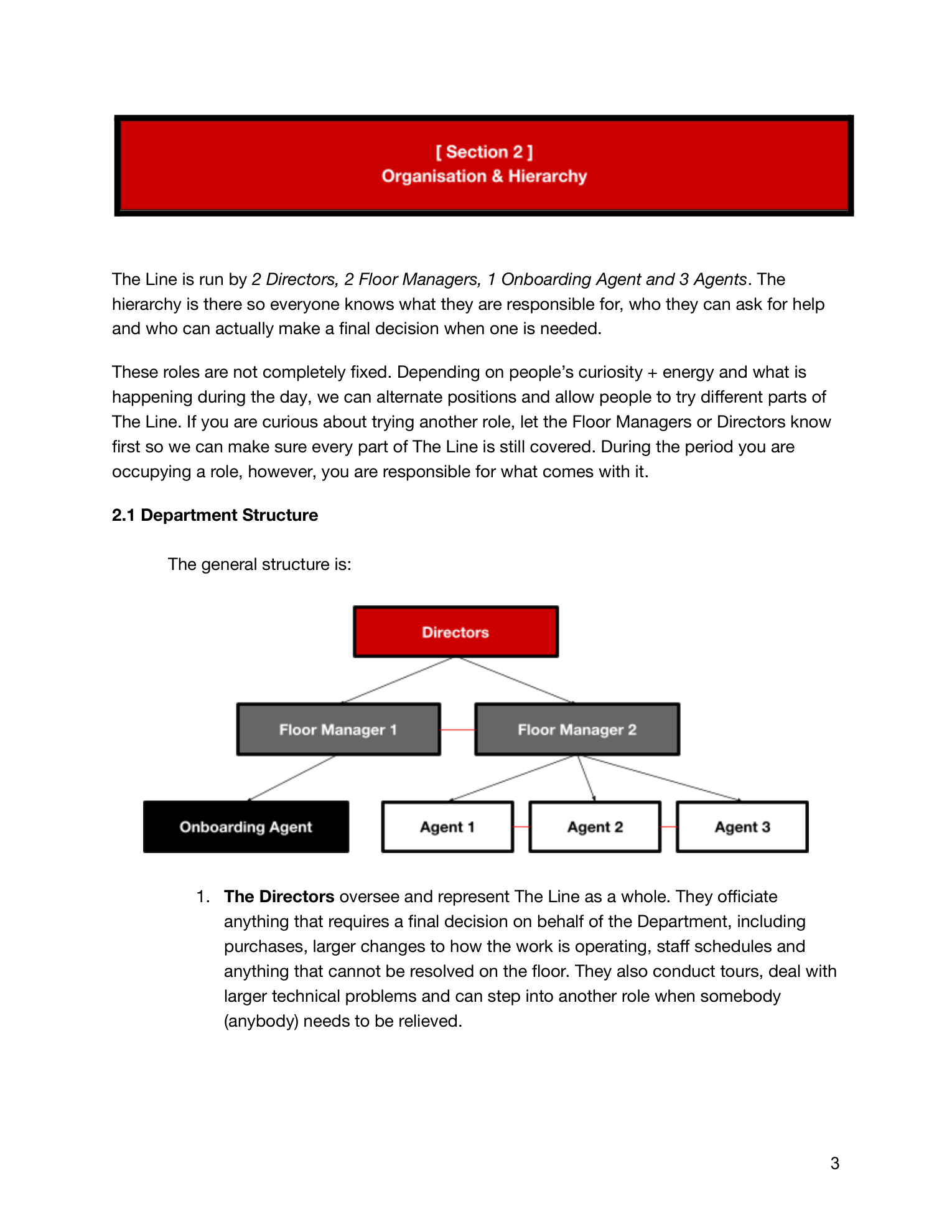
The Line is run by 2 Directors, 2 Floor Managers, 1 Onboarding Agent and 3 Agents. The
hierarchy is there so everyone knows what they are responsible for, who they can ask for help
and who can actually make a final decision when one is needed.
These roles are not completely fixed. Depending on people’s curiosity + energy and what is
happening during the day, we can alternate positions and allow people to try different parts of
The Line. If you are curious about trying another role, let the Floor Managers or Directors know
first so we can make sure every part of The Line is still covered. During the period you are
occupying a role, however, you are responsible for what comes with it.
2.1 Department Structure
The general structure is:
1. The Directors oversee and represent The Line as a whole. They officiate
anything that requires a final decision on behalf of the Department, including
purchases, larger changes to how the work is operating, staff schedules and
anything that cannot be resolved on the floor. They also conduct tours, deal with
larger technical problems and can step into another role when somebody
(anybody) needs to be relieved.
3
hierarchy is there so everyone knows what they are responsible for, who they can ask for help
and who can actually make a final decision when one is needed.
These roles are not completely fixed. Depending on people’s curiosity + energy and what is
happening during the day, we can alternate positions and allow people to try different parts of
The Line. If you are curious about trying another role, let the Floor Managers or Directors know
first so we can make sure every part of The Line is still covered. During the period you are
occupying a role, however, you are responsible for what comes with it.
2.1 Department Structure
The general structure is:
1. The Directors oversee and represent The Line as a whole. They officiate
anything that requires a final decision on behalf of the Department, including
purchases, larger changes to how the work is operating, staff schedules and
anything that cannot be resolved on the floor. They also conduct tours, deal with
larger technical problems and can step into another role when somebody
(anybody) needs to be relieved.
3
2. The Floor Managers facilitate everything happening around the work while it is
functioning. They keep an eye on the staff, the visitors, their respective working
stations and the general rhythm of the space.
-
Floor Manager 1, positioned closer to the Calling Booth, works more
closely with the visitor journey. They support the Onboarding Agent,
speak to people who are curious about the work, invite people to make a
call, help organise the flow into and out of the booth, and help with
offboarding when things become busy. They can also step into another
staff member if somebody needs a break.
-
Floor Manager 2, positioned closer to the Agent Booth, keeps an eye on
the Agents and the space around them. They deal with stray questions,
organise tour requests, facilitate sales until a Director is needed to
officiate them, and step in when an Agent needs help.
-
If somebody approaches an Agent directly while they are working, they
should be redirected to the Floor Managers.
-
The Floor Managers can move between these responsibilities (1 and 2)
whenever necessary. The distinction is mainly there so that both sides of
the work are being watched.
3. The Onboarding Agent manages the visitor before and after the call. They
prepare the visitor to enter the Calling Booth and, when it is not too busy, handle
the offboarding when they leave.
4. Agent 1 is the general agent and receives every call first. They work out what
the caller is actually asking, help narrow the question when necessary and
decide how the call should move.
5. Agent 2 deals more closely with practical or technical questions and is the only
Agent with access to the internet for research during a call.
6. Agent 3 deals with questions that need a more irrational, abstract, personal or
instinctive approach.
The individual responsibilities of each position are explained properly in the following sections:
2.2 Chain of Responsibility
-
If an Agent needs help with something inside the conversation, they can first speak to
the other Agents. If the issue is no longer about the conversation itself, it goes to a Floor
Manager.
-
The Onboarding Agent goes to a Floor Manager when they cannot resolve something
themselves.
4
functioning. They keep an eye on the staff, the visitors, their respective working
stations and the general rhythm of the space.
-
Floor Manager 1, positioned closer to the Calling Booth, works more
closely with the visitor journey. They support the Onboarding Agent,
speak to people who are curious about the work, invite people to make a
call, help organise the flow into and out of the booth, and help with
offboarding when things become busy. They can also step into another
staff member if somebody needs a break.
-
Floor Manager 2, positioned closer to the Agent Booth, keeps an eye on
the Agents and the space around them. They deal with stray questions,
organise tour requests, facilitate sales until a Director is needed to
officiate them, and step in when an Agent needs help.
-
If somebody approaches an Agent directly while they are working, they
should be redirected to the Floor Managers.
-
The Floor Managers can move between these responsibilities (1 and 2)
whenever necessary. The distinction is mainly there so that both sides of
the work are being watched.
3. The Onboarding Agent manages the visitor before and after the call. They
prepare the visitor to enter the Calling Booth and, when it is not too busy, handle
the offboarding when they leave.
4. Agent 1 is the general agent and receives every call first. They work out what
the caller is actually asking, help narrow the question when necessary and
decide how the call should move.
5. Agent 2 deals more closely with practical or technical questions and is the only
Agent with access to the internet for research during a call.
6. Agent 3 deals with questions that need a more irrational, abstract, personal or
instinctive approach.
The individual responsibilities of each position are explained properly in the following sections:
2.2 Chain of Responsibility
-
If an Agent needs help with something inside the conversation, they can first speak to
the other Agents. If the issue is no longer about the conversation itself, it goes to a Floor
Manager.
-
The Onboarding Agent goes to a Floor Manager when they cannot resolve something
themselves.
4
-
If a Floor Manager cannot make the decision, it goes to a Director. They can be
contacted via phone call or Whatsapp.
2.3 Who Can Make Which Decisions
-
Agents have a lot of freedom inside their conversations. They can change direction,
transfer the call, place someone on hold or ask another agent to join them.
-
Calls can also be shared. A conversation does not have to belong to one Agent from
beginning to end. If another Agent has something useful to bring in, you can involve
them without necessarily making a formal transfer. Just ask for consent from the caller
and then add the other agent into the call.
-
Agent 1 has the additional responsibility of directing the general choreography of the
call and officialising complaints.
-
Floor Managers can make decisions about what is happening on the floor. They can
reorganise staff, cover somebody who needs a break, deal with visitor flow and resolve
smaller problems as they appear.
-
Anything that needs to become official on behalf of The Line goes to the Directors. This
includes finalising a sale, conducting a tour, changing an established procedure or
making a larger decision about how the work is being run or how the Line is operating.
The Directors do not need to be involved in the normal movement of every call.
-
When in an emergency, the Floor Managers should locate one of the Directors
immediately.
2.4 Internal Communication
-
The Line works through choreography between everyone in the space. You should be
talking to each other throughout the day and not when something has gone wrong.
-
If you are unsure where a conversation should go, Agent 1 can put the caller on hold so
the Agents can quickly discuss it together. The same applies if two Agents want to join
the same call, or if all three of you feel that the conversation would be better handled
together. Take a moment, work out what you want to do and then return to the caller.
-
You should also feel comfortable disagreeing with one another. If you hear something in
a call that you do not agree with or you feel the conversation is moving in a direction
that does not feel right, tell each other. Ask Agent 1 to place the caller on hold and talk
about it. You are not policing each other. It is about holding each other accountable and
allowing the conversation to be shaped by more than one perspective when necessary.
5
If a Floor Manager cannot make the decision, it goes to a Director. They can be
contacted via phone call or Whatsapp.
2.3 Who Can Make Which Decisions
-
Agents have a lot of freedom inside their conversations. They can change direction,
transfer the call, place someone on hold or ask another agent to join them.
-
Calls can also be shared. A conversation does not have to belong to one Agent from
beginning to end. If another Agent has something useful to bring in, you can involve
them without necessarily making a formal transfer. Just ask for consent from the caller
and then add the other agent into the call.
-
Agent 1 has the additional responsibility of directing the general choreography of the
call and officialising complaints.
-
Floor Managers can make decisions about what is happening on the floor. They can
reorganise staff, cover somebody who needs a break, deal with visitor flow and resolve
smaller problems as they appear.
-
Anything that needs to become official on behalf of The Line goes to the Directors. This
includes finalising a sale, conducting a tour, changing an established procedure or
making a larger decision about how the work is being run or how the Line is operating.
The Directors do not need to be involved in the normal movement of every call.
-
When in an emergency, the Floor Managers should locate one of the Directors
immediately.
2.4 Internal Communication
-
The Line works through choreography between everyone in the space. You should be
talking to each other throughout the day and not when something has gone wrong.
-
If you are unsure where a conversation should go, Agent 1 can put the caller on hold so
the Agents can quickly discuss it together. The same applies if two Agents want to join
the same call, or if all three of you feel that the conversation would be better handled
together. Take a moment, work out what you want to do and then return to the caller.
-
You should also feel comfortable disagreeing with one another. If you hear something in
a call that you do not agree with or you feel the conversation is moving in a direction
that does not feel right, tell each other. Ask Agent 1 to place the caller on hold and talk
about it. You are not policing each other. It is about holding each other accountable and
allowing the conversation to be shaped by more than one perspective when necessary.
5
-
The question on the interface should also keep being updated during the call. Part of
what we are interested in is seeing how the question changes as it moves through
different people and how each Agent affects the direction of the conversation.
-
Agents are able to listen in from their respective stations so there is no need to
constantly explain every detail of a call to each other. Pass on what the other person
actually needs to know.
-
Each staff member will also be given two notebooks. These notebooks stays with you,
not with the position you are working in. One book is recommended to keep track of
things you notice while moving through different roles, questions that keep returning,
something that worked particularly well, or anything you want to bring back to the group
later. This book will stay with the Line and can be read by other staff members. The
other one can function as a private journal. It is the private property of the Agent and
will not be read by anyone else.
2.5 Breaks and Cover
-
While The Line is running, everyone should generally remain within their respective area.
Agents should remain inside the Agent Booth, Floor Manager 1 should stay close to the
Agent Booth, and Floor Manager 2 and the Onboarding Agent should stay close to the
Calling Booth.
-
Floor Managers can move away from their area when they need to find a Director or
deal with something elsewhere. Directors can move freely throughout the fair unless
they are temporarily filling in a position.
-
Breaks, rotations and handovers are generally the moments when you are free to
properly step away.
-
If a Floor Manager notices that somebody (or they, themselves) needs a break, they can
check in and arrange cover. You also do not need to wait for somebody else to notice. If
you need to step away, tell the Floor Manager.
-
Not every call requires all three Agents to be actively involved. If a conversation is sitting
comfortably with one or two Agents, the others do not need to force themselves into it. If
you need a short moment and the call can continue without you, communicate that with
the other Agents and Floor Manager and step away. Make sure to come back on time for
the next call.
6
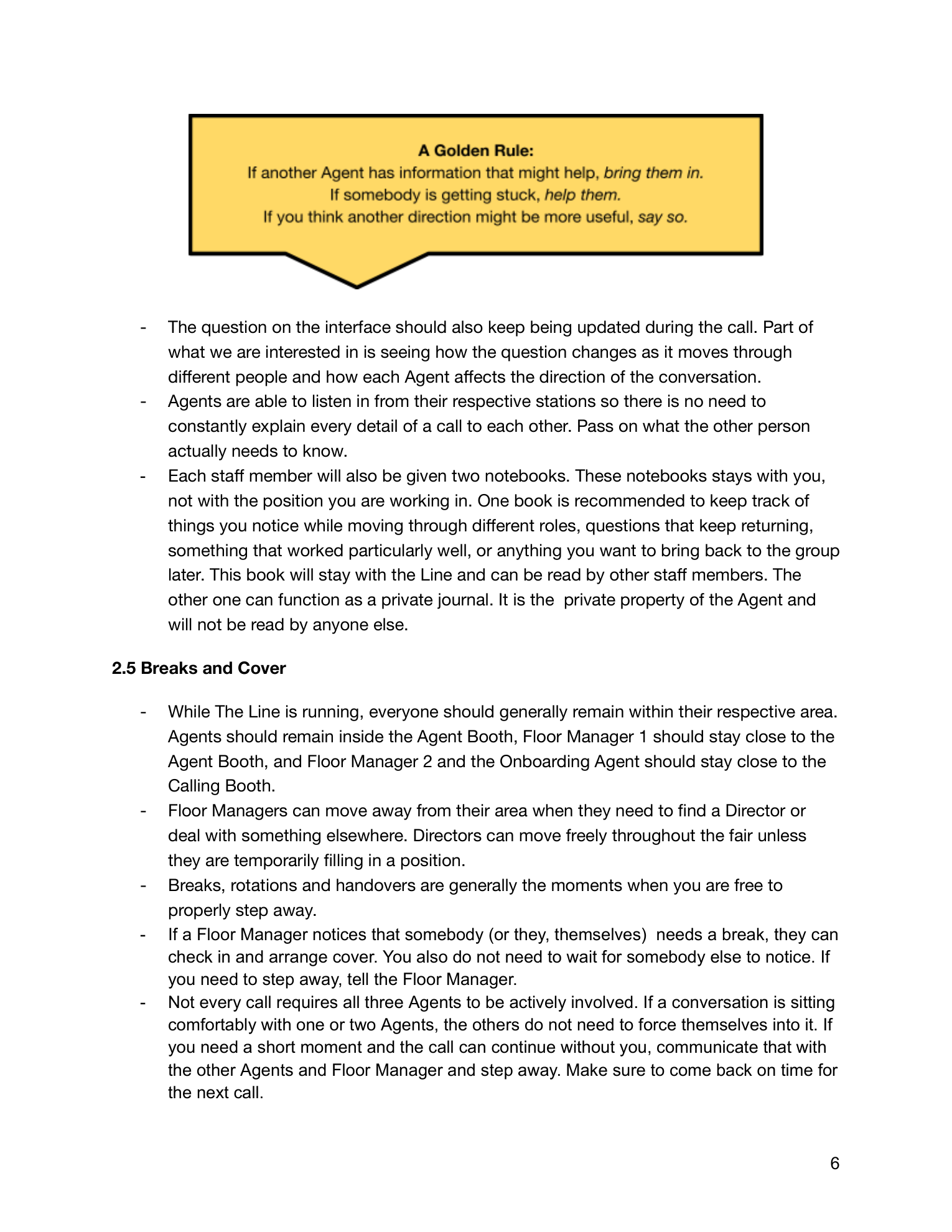
The question on the interface should also keep being updated during the call. Part of
what we are interested in is seeing how the question changes as it moves through
different people and how each Agent affects the direction of the conversation.
-
Agents are able to listen in from their respective stations so there is no need to
constantly explain every detail of a call to each other. Pass on what the other person
actually needs to know.
-
Each staff member will also be given two notebooks. These notebooks stays with you,
not with the position you are working in. One book is recommended to keep track of
things you notice while moving through different roles, questions that keep returning,
something that worked particularly well, or anything you want to bring back to the group
later. This book will stay with the Line and can be read by other staff members. The
other one can function as a private journal. It is the private property of the Agent and
will not be read by anyone else.
2.5 Breaks and Cover
-
While The Line is running, everyone should generally remain within their respective area.
Agents should remain inside the Agent Booth, Floor Manager 1 should stay close to the
Agent Booth, and Floor Manager 2 and the Onboarding Agent should stay close to the
Calling Booth.
-
Floor Managers can move away from their area when they need to find a Director or
deal with something elsewhere. Directors can move freely throughout the fair unless
they are temporarily filling in a position.
-
Breaks, rotations and handovers are generally the moments when you are free to
properly step away.
-
If a Floor Manager notices that somebody (or they, themselves) needs a break, they can
check in and arrange cover. You also do not need to wait for somebody else to notice. If
you need to step away, tell the Floor Manager.
-
Not every call requires all three Agents to be actively involved. If a conversation is sitting
comfortably with one or two Agents, the others do not need to force themselves into it. If
you need a short moment and the call can continue without you, communicate that with
the other Agents and Floor Manager and step away. Make sure to come back on time for
the next call.
6
-
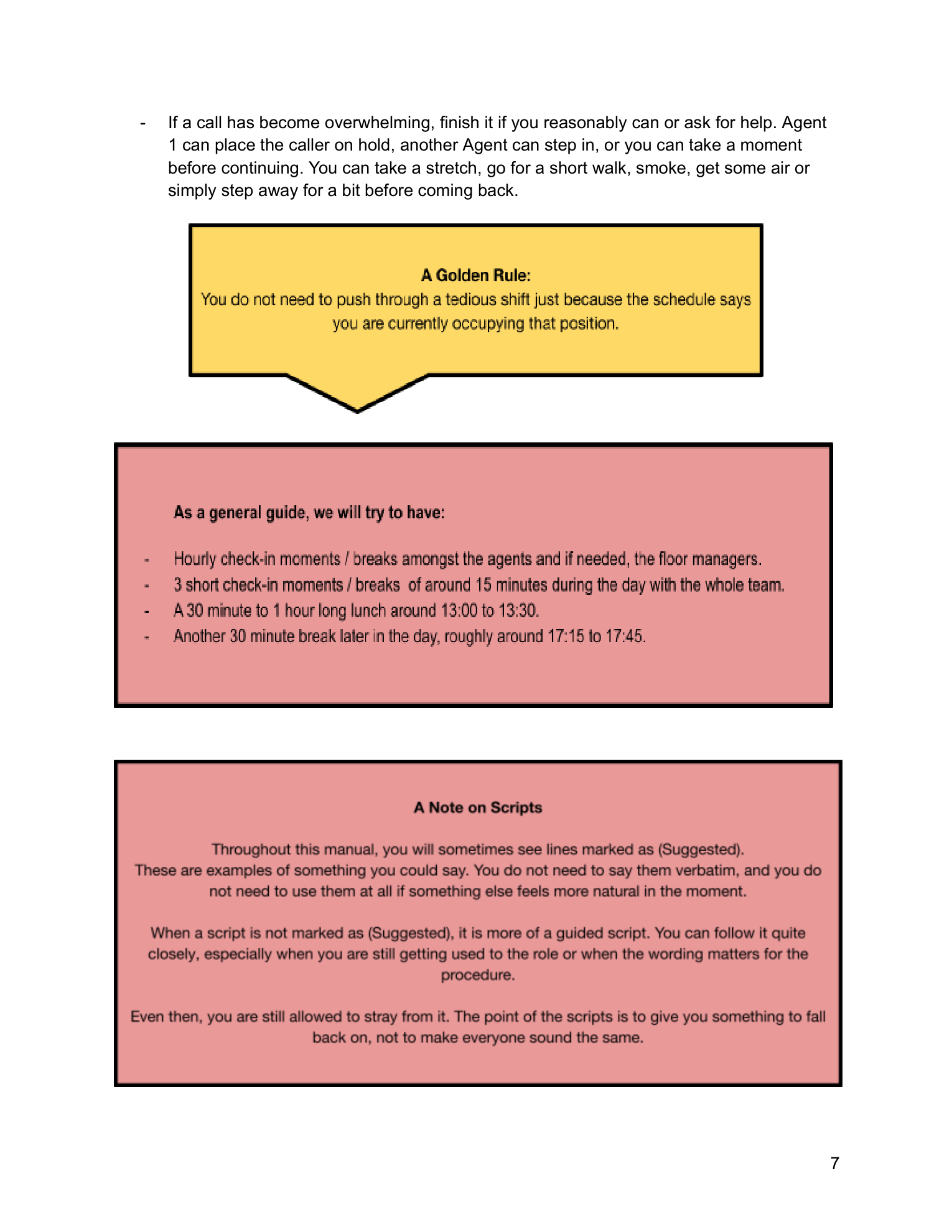
If a call has become overwhelming, finish it if you reasonably can or ask for help. Agent
1 can place the caller on hold, another Agent can step in, or you can take a moment
before continuing. You can take a stretch, go for a short walk, smoke, get some air or
simply step away for a bit before coming back.
7
If a call has become overwhelming, finish it if you reasonably can or ask for help. Agent
1 can place the caller on hold, another Agent can step in, or you can take a moment
before continuing. You can take a stretch, go for a short walk, smoke, get some air or
simply step away for a bit before coming back.
7
3.1 Oversight and Consistency
-
The Directors should have a general sense of what is happening across The Line
without needing to interfere with every call or decision.
-
One of the main responsibilities of the Directors is consistency. If a rate changes,
everyone needs to know. If a procedure changes, everyone needs to know. If something
happened the previous day and we decided to deal with it differently today, everyone
needs to know.
-
The work can change as the experiment develops. The important thing is that those
changes are shared and understood by the people actually running it.
-
Check in with the floor managers periodically.
3.2 Staff Support and Cover
-
Directors can temporarily fill any position.
-
If somebody needs a break, becomes overwhelmed, has to leave unexpectedly, or
simply needs to step away for a while, a Director can take over their position. When
doing this, wear both the Director pin and the pin belonging to the role you are covering.
-
If a Director is called into the Agent Booth, they can sit in the place of Agent 1, Agent 2
or Agent 3 depending on what is needed. The Agent being covered can leave the
booth, go for a smoke, take a walk, get some air or simply sit somewhere else for a
while. They are also completely welcome to stay in the booth and listen if they would
rather do that. Cover does not mean you are being kicked out of your own call. It simply
gives you the option to step away.
-
If a Floor Manager tells you somebody needs a break, help make that happen rather
than expecting the person to continue.
-
Directors are also there when something between staff members is not working.
-
We have a transparency rule. If there is tension, disagreement, frustration or an
interpersonal tussle between Agents or any other members of staff, please come to us.
It does not need to have become a huge problem before you say something.
-
We can talk about it privately, together, or however feels most useful. The aim is not to
decide who is right immediately. It is to make sure small tensions do not quietly become
large ones while everybody is trying to run the work.
3.3 Decisions Reserved for Directors
8
-
The Directors should have a general sense of what is happening across The Line
without needing to interfere with every call or decision.
-
One of the main responsibilities of the Directors is consistency. If a rate changes,
everyone needs to know. If a procedure changes, everyone needs to know. If something
happened the previous day and we decided to deal with it differently today, everyone
needs to know.
-
The work can change as the experiment develops. The important thing is that those
changes are shared and understood by the people actually running it.
-
Check in with the floor managers periodically.
3.2 Staff Support and Cover
-
Directors can temporarily fill any position.
-
If somebody needs a break, becomes overwhelmed, has to leave unexpectedly, or
simply needs to step away for a while, a Director can take over their position. When
doing this, wear both the Director pin and the pin belonging to the role you are covering.
-
If a Director is called into the Agent Booth, they can sit in the place of Agent 1, Agent 2
or Agent 3 depending on what is needed. The Agent being covered can leave the
booth, go for a smoke, take a walk, get some air or simply sit somewhere else for a
while. They are also completely welcome to stay in the booth and listen if they would
rather do that. Cover does not mean you are being kicked out of your own call. It simply
gives you the option to step away.
-
If a Floor Manager tells you somebody needs a break, help make that happen rather
than expecting the person to continue.
-
Directors are also there when something between staff members is not working.
-
We have a transparency rule. If there is tension, disagreement, frustration or an
interpersonal tussle between Agents or any other members of staff, please come to us.
It does not need to have become a huge problem before you say something.
-
We can talk about it privately, together, or however feels most useful. The aim is not to
decide who is right immediately. It is to make sure small tensions do not quietly become
large ones while everybody is trying to run the work.
3.3 Decisions Reserved for Directors
8
-
Most things should be resolved within the normal chain of command before reaching a
Director.
-
A Director should be involved when:
A Blind Box purchase requires final approval
A payment or rate falls outside the normal procedure
Somebody wants to pay more or less than expected and the situation cannot be
resolved normally
An exception to an established rule is being requested
An established procedure needs to change
Something new happens that the manual does not account for and will affect
future cases
A serious complaint has been made from the staff
There has been an incident involving a visitor or staff member
A complaint concerns The Line itself
A complaint concerns a member of staff
A visitor wants an official response from the Directors
There is a technical problem that might stop The Line from operating
The payment system is not working
The Calling Booth or Agent Booth needs to be closed
Somebody needs to be removed from the space
There is a safety issue
There is a request from NAP+, a gallery, an institution or the press that requires
an official answer
Somebody wants access to something normally unavailable to visitors
Anything related to tours
A Floor Manager cannot reasonably make the decision themselves
The Agents and Floor Managers have reached the end of what they know how
to do (the panic procedure may be required)
9
Most things should be resolved within the normal chain of command before reaching a
Director.
-
A Director should be involved when:
A Blind Box purchase requires final approval
A payment or rate falls outside the normal procedure
Somebody wants to pay more or less than expected and the situation cannot be
resolved normally
An exception to an established rule is being requested
An established procedure needs to change
Something new happens that the manual does not account for and will affect
future cases
A serious complaint has been made from the staff
There has been an incident involving a visitor or staff member
A complaint concerns The Line itself
A complaint concerns a member of staff
A visitor wants an official response from the Directors
There is a technical problem that might stop The Line from operating
The payment system is not working
The Calling Booth or Agent Booth needs to be closed
Somebody needs to be removed from the space
There is a safety issue
There is a request from NAP+, a gallery, an institution or the press that requires
an official answer
Somebody wants access to something normally unavailable to visitors
Anything related to tours
A Floor Manager cannot reasonably make the decision themselves
The Agents and Floor Managers have reached the end of what they know how
to do (the panic procedure may be required)
9
3.4 The Panic Procedure
-
If an issue has moved through the Agents, Floor Managers and Directors and genuinely
nobody has an answer, the panic procedure can be used.
-
This should be rare and to be performed only by the Directors.
-
The panic audio is played through the system. Use it as a moment to stop, regroup and
acknowledge that, for the moment, nobody knows.
-
After the panic audio ends (in approximately 7 minutes), decide whether the question
can be returned to the caller without an answer, whether more information is needed, or
whether the call should end.
-
Not knowing is allowed.
-
The panic procedure is there for the moments when the entire Department needs to
admit it together.
3.5 Tours
-
Tours only happen if there are people who are actually interested. They do not need to
happen automatically just because there is a time listed in the schedule. If nobody has
signed up or nobody seems interested, the tour can be skipped.
-
The tours are also not something we need to formally advertise all the time. They can
spread more through word of mouth, conversation and instinct. If someone seems
genuinely curious about how The Line works, wants to understand the Agent Booth, or
just seems like they would really enjoy seeing behind the scenes, staff can mention that
a tour is possible.
-
Floor Managers organise the tours. Directors conduct them.
-
Tours occur only when agents are on break.
-
Tours are for people who have signed up and should give them access to parts of The
Line that an ordinary visitor would not necessarily see.
-
Tour Checklist
Before beginning, check:
Who is on the tour list
How many people are attending (a maximum of 5 is preferred)
Whether the Calling Booth is occupied
Whether the Agent Booth can currently receive visitors
Whether the technical person is available
Whether there is space for somebody to briefly try being an Agent
That you have the tour coupons with you
-
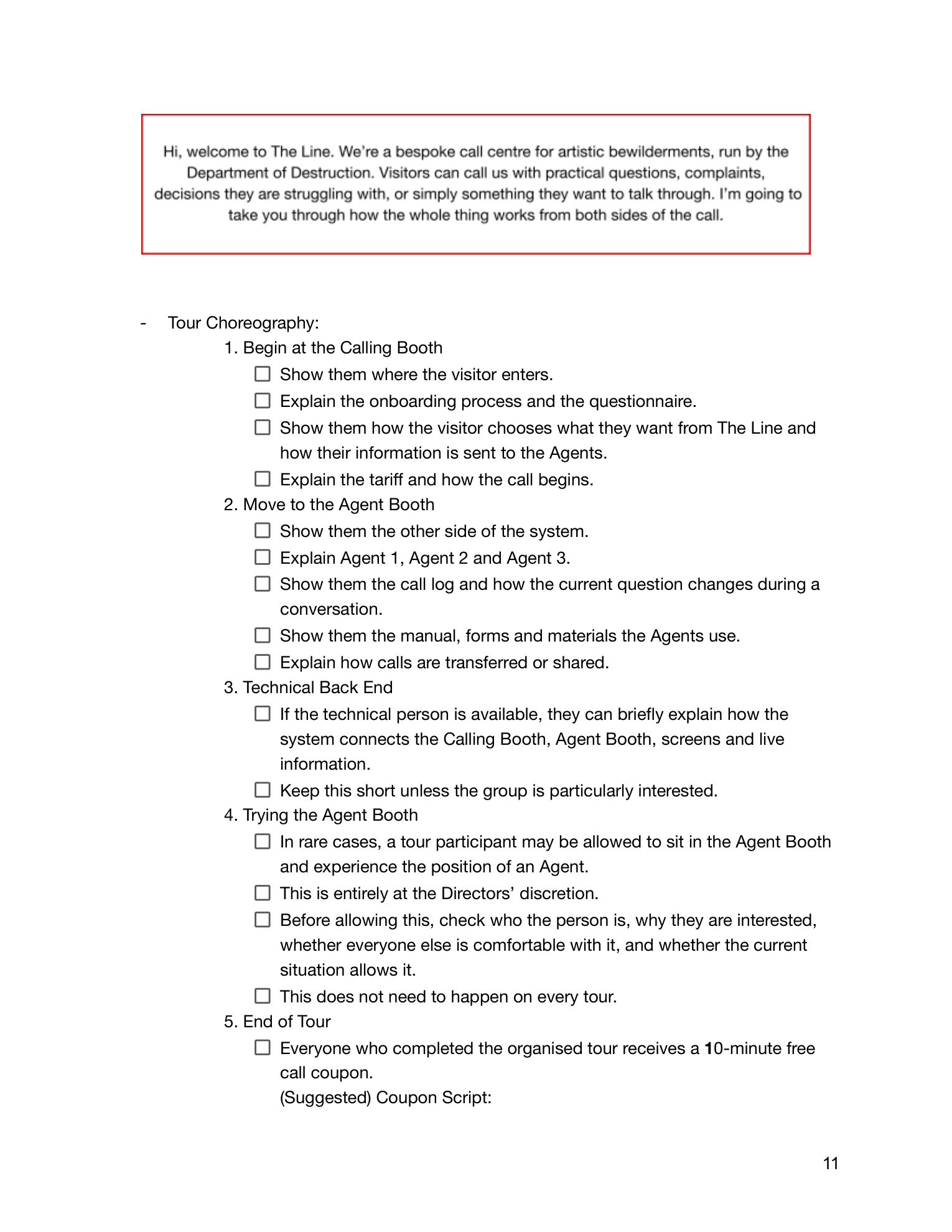
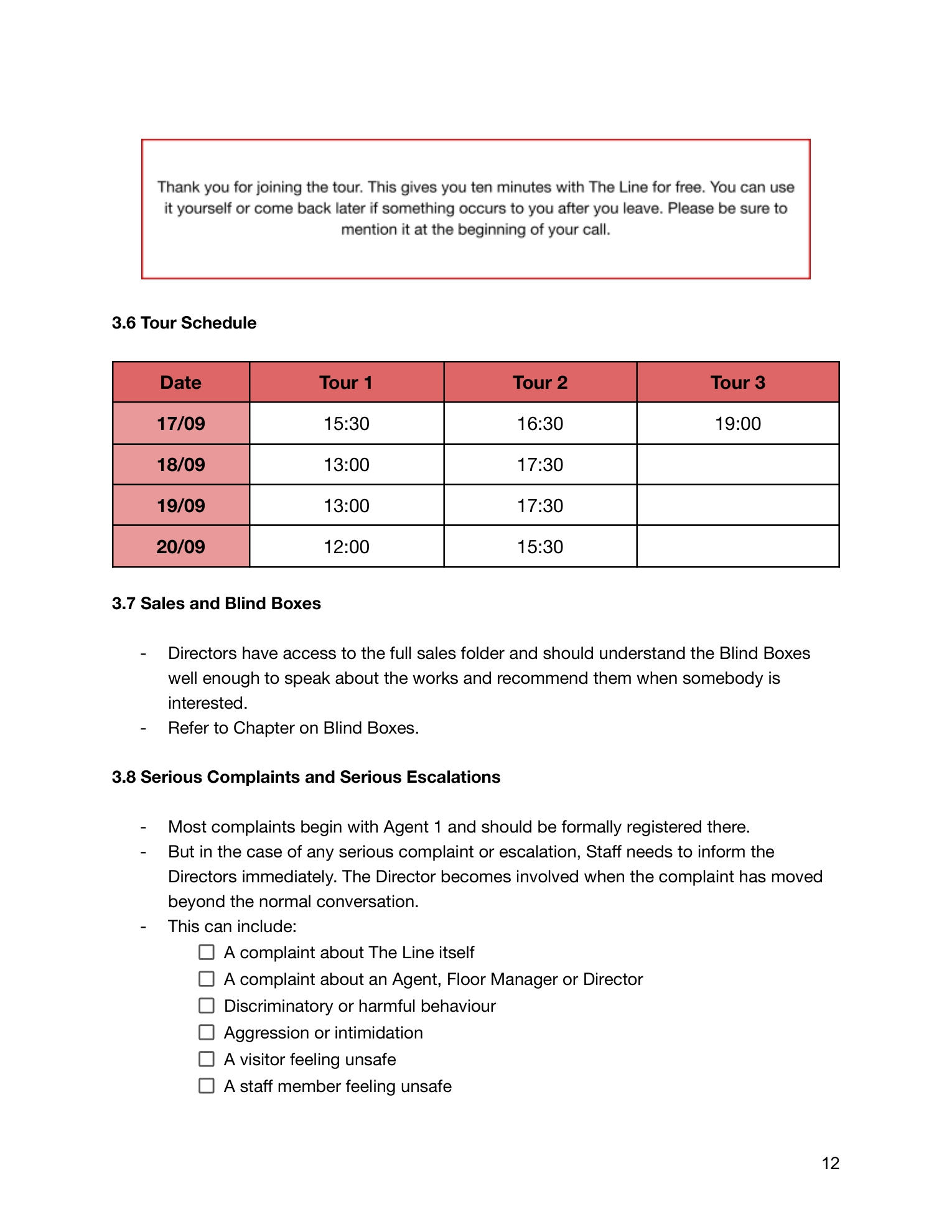
(Suggested) Tour Opening:
10
-
If an issue has moved through the Agents, Floor Managers and Directors and genuinely
nobody has an answer, the panic procedure can be used.
-
This should be rare and to be performed only by the Directors.
-
The panic audio is played through the system. Use it as a moment to stop, regroup and
acknowledge that, for the moment, nobody knows.
-
After the panic audio ends (in approximately 7 minutes), decide whether the question
can be returned to the caller without an answer, whether more information is needed, or
whether the call should end.
-
Not knowing is allowed.
-
The panic procedure is there for the moments when the entire Department needs to
admit it together.
3.5 Tours
-
Tours only happen if there are people who are actually interested. They do not need to
happen automatically just because there is a time listed in the schedule. If nobody has
signed up or nobody seems interested, the tour can be skipped.
-
The tours are also not something we need to formally advertise all the time. They can
spread more through word of mouth, conversation and instinct. If someone seems
genuinely curious about how The Line works, wants to understand the Agent Booth, or
just seems like they would really enjoy seeing behind the scenes, staff can mention that
a tour is possible.
-
Floor Managers organise the tours. Directors conduct them.
-
Tours occur only when agents are on break.
-
Tours are for people who have signed up and should give them access to parts of The
Line that an ordinary visitor would not necessarily see.
-
Tour Checklist
Before beginning, check:
Who is on the tour list
How many people are attending (a maximum of 5 is preferred)
Whether the Calling Booth is occupied
Whether the Agent Booth can currently receive visitors
Whether the technical person is available
Whether there is space for somebody to briefly try being an Agent
That you have the tour coupons with you
-
(Suggested) Tour Opening:
10
-
Tour Choreography:
1. Begin at the Calling Booth
Show them where the visitor enters.
Explain the onboarding process and the questionnaire.
Show them how the visitor chooses what they want from The Line and
how their information is sent to the Agents.
Explain the tariff and how the call begins.
2. Move to the Agent Booth
Show them the other side of the system.
Explain Agent 1, Agent 2 and Agent 3.
Show them the call log and how the current question changes during a
conversation.
Show them the manual, forms and materials the Agents use.
Explain how calls are transferred or shared.
3. Technical Back End
If the technical person is available, they can briefly explain how the
system connects the Calling Booth, Agent Booth, screens and live
information.
Keep this short unless the group is particularly interested.
4. Trying the Agent Booth
In rare cases, a tour participant may be allowed to sit in the Agent Booth
and experience the position of an Agent.
This is entirely at the Directors’ discretion.
Before allowing this, check who the person is, why they are interested,
whether everyone else is comfortable with it, and whether the current
situation allows it.
This does not need to happen on every tour.
5. End of Tour
Everyone who completed the organised tour receives a 10-minute free
call coupon.
(Suggested) Coupon Script:
11
Tour Choreography:
1. Begin at the Calling Booth
Show them where the visitor enters.
Explain the onboarding process and the questionnaire.
Show them how the visitor chooses what they want from The Line and
how their information is sent to the Agents.
Explain the tariff and how the call begins.
2. Move to the Agent Booth
Show them the other side of the system.
Explain Agent 1, Agent 2 and Agent 3.
Show them the call log and how the current question changes during a
conversation.
Show them the manual, forms and materials the Agents use.
Explain how calls are transferred or shared.
3. Technical Back End
If the technical person is available, they can briefly explain how the
system connects the Calling Booth, Agent Booth, screens and live
information.
Keep this short unless the group is particularly interested.
4. Trying the Agent Booth
In rare cases, a tour participant may be allowed to sit in the Agent Booth
and experience the position of an Agent.
This is entirely at the Directors’ discretion.
Before allowing this, check who the person is, why they are interested,
whether everyone else is comfortable with it, and whether the current
situation allows it.
This does not need to happen on every tour.
5. End of Tour
Everyone who completed the organised tour receives a 10-minute free
call coupon.
(Suggested) Coupon Script:
11
3.6 Tour Schedule
Date
Tour 1
Tour 2
Tour 3
17/09
15:30
16:30
19:00
18/09
13:00
17:30
19/09
13:00
17:30
20/09
12:00
15:30
3.7 Sales and Blind Boxes
-
Directors have access to the full sales folder and should understand the Blind Boxes
well enough to speak about the works and recommend them when somebody is
interested.
-
Refer to Chapter on Blind Boxes.
3.8 Serious Complaints and Serious Escalations
-
Most complaints begin with Agent 1 and should be formally registered there.
-
But in the case of any serious complaint or escalation, Staff needs to inform the
Directors immediately. The Director becomes involved when the complaint has moved
beyond the normal conversation.
-
This can include:
A complaint about The Line itself
A complaint about an Agent, Floor Manager or Director
Discriminatory or harmful behaviour
Aggression or intimidation
A visitor feeling unsafe
A staff member feeling unsafe
12
Date
Tour 1
Tour 2
Tour 3
17/09
15:30
16:30
19:00
18/09
13:00
17:30
19/09
13:00
17:30
20/09
12:00
15:30
3.7 Sales and Blind Boxes
-
Directors have access to the full sales folder and should understand the Blind Boxes
well enough to speak about the works and recommend them when somebody is
interested.
-
Refer to Chapter on Blind Boxes.
3.8 Serious Complaints and Serious Escalations
-
Most complaints begin with Agent 1 and should be formally registered there.
-
But in the case of any serious complaint or escalation, Staff needs to inform the
Directors immediately. The Director becomes involved when the complaint has moved
beyond the normal conversation.
-
This can include:
A complaint about The Line itself
A complaint about an Agent, Floor Manager or Director
Discriminatory or harmful behaviour
Aggression or intimidation
A visitor feeling unsafe
A staff member feeling unsafe
12
Harassment
A serious disagreement about payment
A complaint that could affect another visitor
A complaint involving NAP+, a gallery or another institution
Something that may need follow-up after the fair
Anything the Floor Manager believes should not be handled alone
-
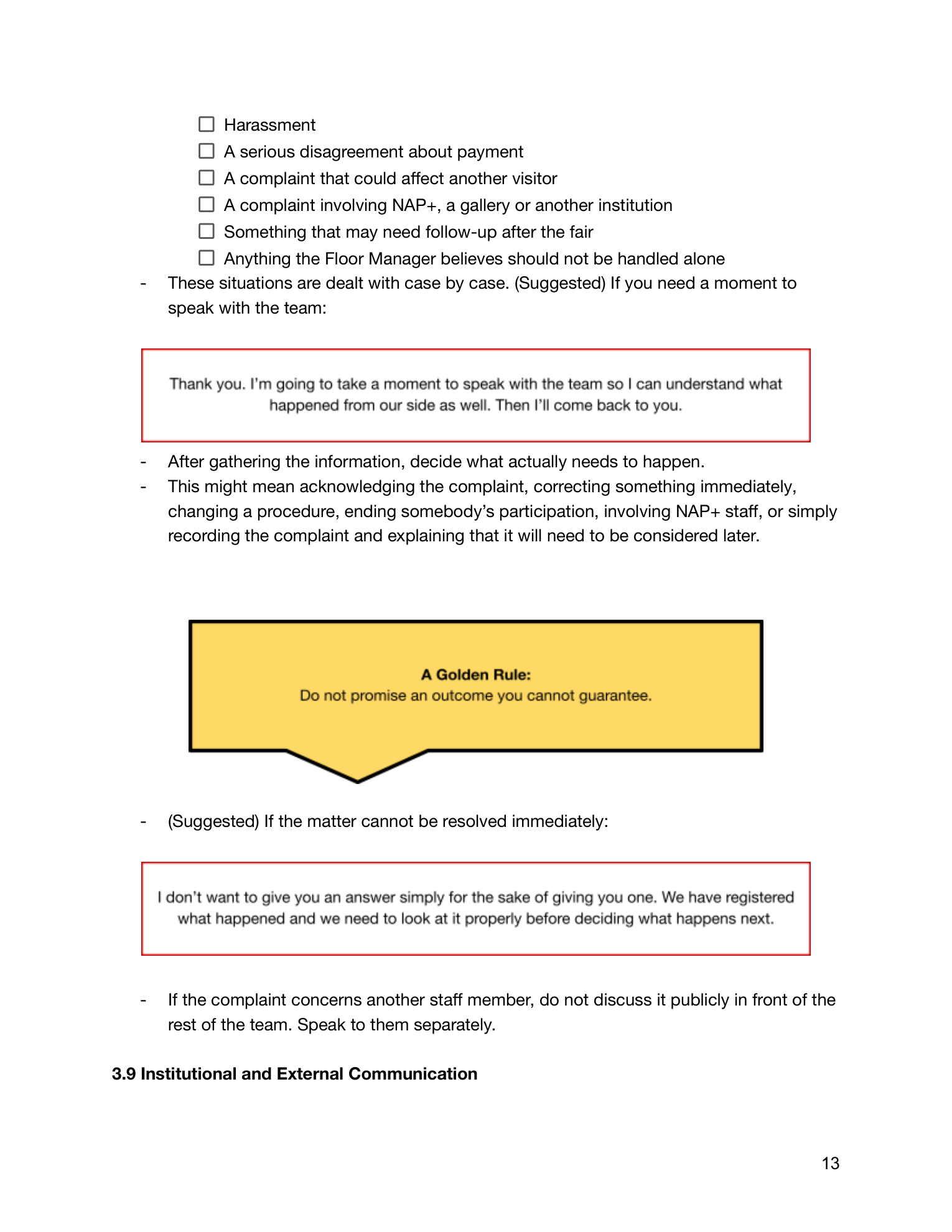
These situations are dealt with case by case. (Suggested) If you need a moment to
speak with the team:
-
After gathering the information, decide what actually needs to happen.
-
This might mean acknowledging the complaint, correcting something immediately,
changing a procedure, ending somebody’s participation, involving NAP+ staff, or simply
recording the complaint and explaining that it will need to be considered later.
-
(Suggested) If the matter cannot be resolved immediately:
-
If the complaint concerns another staff member, do not discuss it publicly in front of the
rest of the team. Speak to them separately.
3.9 Institutional and External Communication
13
A serious disagreement about payment
A complaint that could affect another visitor
A complaint involving NAP+, a gallery or another institution
Something that may need follow-up after the fair
Anything the Floor Manager believes should not be handled alone
-
These situations are dealt with case by case. (Suggested) If you need a moment to
speak with the team:
-
After gathering the information, decide what actually needs to happen.
-
This might mean acknowledging the complaint, correcting something immediately,
changing a procedure, ending somebody’s participation, involving NAP+ staff, or simply
recording the complaint and explaining that it will need to be considered later.
-
(Suggested) If the matter cannot be resolved immediately:
-
If the complaint concerns another staff member, do not discuss it publicly in front of the
rest of the team. Speak to them separately.
3.9 Institutional and External Communication
13
-
Anything requiring an official statement or decision on behalf of The Line goes through
the Directors.
-
This includes communication with NAP+, participating galleries, artists, press,
institutional representatives, technical partners, or anyone making an unusual external
request.
-
You do not need to turn every conversation into an official statement. Use your
judgment about when you are speaking casually and when you are speaking on behalf
of the Department.
3.10 Internal Communication
-
The Directors should remain reachable throughout the day.
-
Staff can contact them through the team WhatsApp or directly by phone.
3.11 End of the Day
-
Clean up stations.
-
Before leaving, check in with the Floor Managers and Agents.
-
Find out what kept happening, what did not work, what confused people, and whether
anything needs to change for the next day.
-
Any change that affects how somebody does their job should be communicated before
the next shift begins.
14
[Personal information redacted on this page.]
Anything requiring an official statement or decision on behalf of The Line goes through
the Directors.
-
This includes communication with NAP+, participating galleries, artists, press,
institutional representatives, technical partners, or anyone making an unusual external
request.
-
You do not need to turn every conversation into an official statement. Use your
judgment about when you are speaking casually and when you are speaking on behalf
of the Department.
3.10 Internal Communication
-
The Directors should remain reachable throughout the day.
-
Staff can contact them through the team WhatsApp or directly by phone.
3.11 End of the Day
-
Clean up stations.
-
Before leaving, check in with the Floor Managers and Agents.
-
Find out what kept happening, what did not work, what confused people, and whether
anything needs to change for the next day.
-
Any change that affects how somebody does their job should be communicated before
the next shift begins.
14
[Personal information redacted on this page.]
The Floor Managers keep The Line moving while it is live. They are the intermediaries between
the public, the Agents, the Onboarding Agent and the Directors. They are the ones facilitating.
They do not need to officialise every decision themselves.
Floor Manager 1 stays closer to the Calling Booth and manages the visitor side of The Line.
Floor Manager 2 stays closer to the Agent Booth and manages the Agent side of The Line.
-
Useful things to communicate include:
a queue beginning to form
a long call
somebody needing a break
an Agent becoming overwhelmed
the Onboarding Agent needing support
somebody waiting to make a purchase
a Director being needed
a technical problem
a tour arriving
the Calling Booth temporarily closing
an unusual visitor or situation
something that may affect the next call
Blind box purchase
-
WhatsApp can be used when appropriate, but if you are standing ten metres away from
each other, please just talk to each other.
-
Try to resolve what you reasonably can.
-
Do not invent an answer because you are embarrassed to ask.
-
And do not sit on a problem because you are worried about bothering the Directors.
The entire point of the hierarchy is that you always have somewhere for the problem to
go.
4.0.1 Sales and Blind Boxes
-
Refer to Chapter on Blind Boxes.
4.0.2 Tours
15
the public, the Agents, the Onboarding Agent and the Directors. They are the ones facilitating.
They do not need to officialise every decision themselves.
Floor Manager 1 stays closer to the Calling Booth and manages the visitor side of The Line.
Floor Manager 2 stays closer to the Agent Booth and manages the Agent side of The Line.
-
Useful things to communicate include:
a queue beginning to form
a long call
somebody needing a break
an Agent becoming overwhelmed
the Onboarding Agent needing support
somebody waiting to make a purchase
a Director being needed
a technical problem
a tour arriving
the Calling Booth temporarily closing
an unusual visitor or situation
something that may affect the next call
Blind box purchase
-
WhatsApp can be used when appropriate, but if you are standing ten metres away from
each other, please just talk to each other.
-
Try to resolve what you reasonably can.
-
Do not invent an answer because you are embarrassed to ask.
-
And do not sit on a problem because you are worried about bothering the Directors.
The entire point of the hierarchy is that you always have somewhere for the problem to
go.
4.0.1 Sales and Blind Boxes
-
Refer to Chapter on Blind Boxes.
4.0.2 Tours
15
-
Both Floor Managers can take tour requests.
-
There is one shared online tour list that both Floor Managers can access and update. If
somebody is interested in joining a tour, just add their name to the list and check the
current availability there.
-
Tours are generally limited to five people and are conducted only by the Directors. Floor
Managers do not conduct tours themselves.
-
The tours usually happen during staff break periods, when the Directors are available to
take people through The Line without disrupting the normal flow of calls.
-
Tours do not need to be formally pushed. If somebody seems especially curious about
The Line or wants to understand how the system works, you can mention that small
tours are sometimes available.
-
If a tour is full but somebody is particularly interested, check with the Directors and see
what is possible.
-
If nobody is interested, there is no need to run the tour.
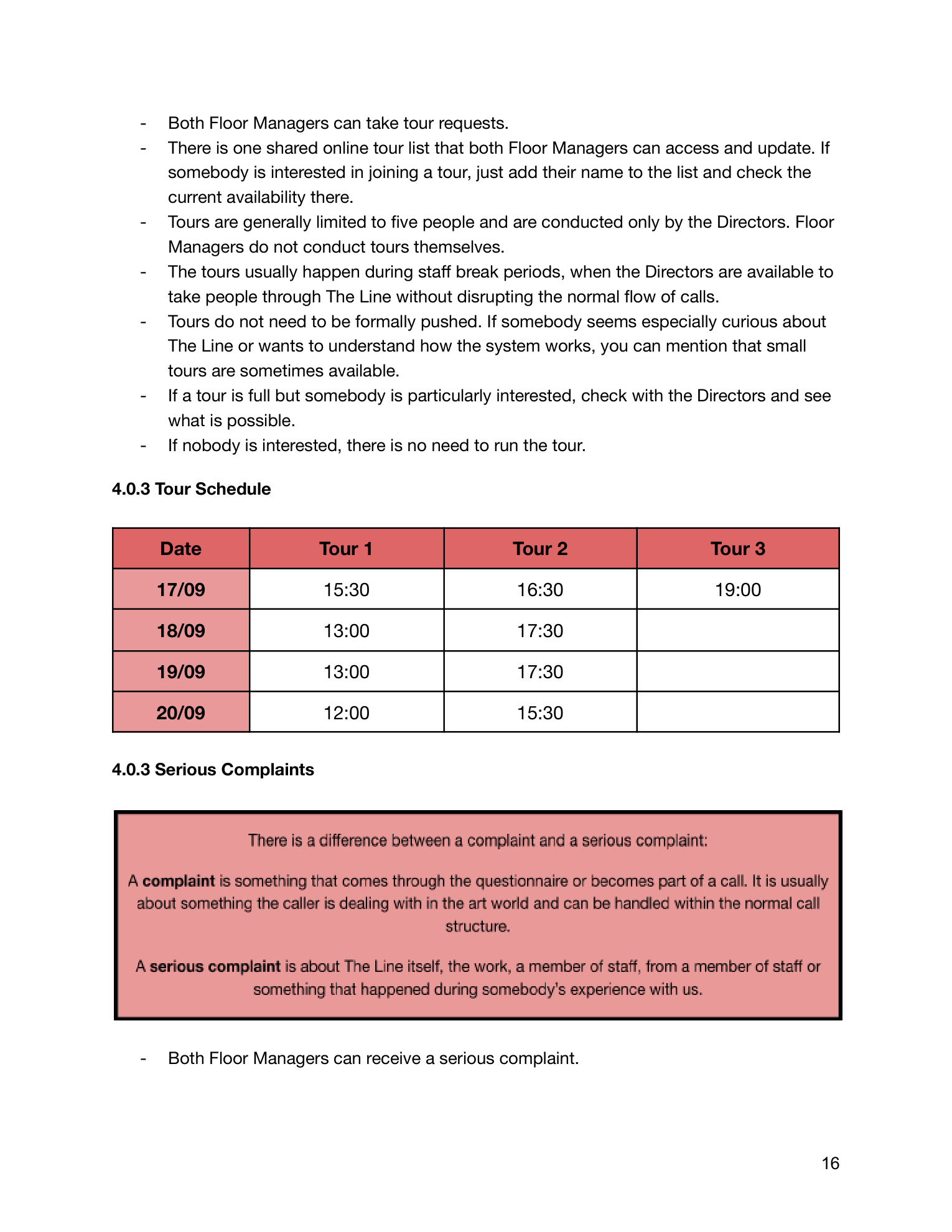
4.0.3 Tour Schedule
Date
Tour 1
Tour 2
Tour 3
17/09
15:30
16:30
19:00
18/09
13:00
17:30
19/09
13:00
17:30
20/09
12:00
15:30
4.0.3 Serious Complaints
-
Both Floor Managers can receive a serious complaint.
16
Both Floor Managers can take tour requests.
-
There is one shared online tour list that both Floor Managers can access and update. If
somebody is interested in joining a tour, just add their name to the list and check the
current availability there.
-
Tours are generally limited to five people and are conducted only by the Directors. Floor
Managers do not conduct tours themselves.
-
The tours usually happen during staff break periods, when the Directors are available to
take people through The Line without disrupting the normal flow of calls.
-
Tours do not need to be formally pushed. If somebody seems especially curious about
The Line or wants to understand how the system works, you can mention that small
tours are sometimes available.
-
If a tour is full but somebody is particularly interested, check with the Directors and see
what is possible.
-
If nobody is interested, there is no need to run the tour.
4.0.3 Tour Schedule
Date
Tour 1
Tour 2
Tour 3
17/09
15:30
16:30
19:00
18/09
13:00
17:30
19/09
13:00
17:30
20/09
12:00
15:30
4.0.3 Serious Complaints
-
Both Floor Managers can receive a serious complaint.
16
-
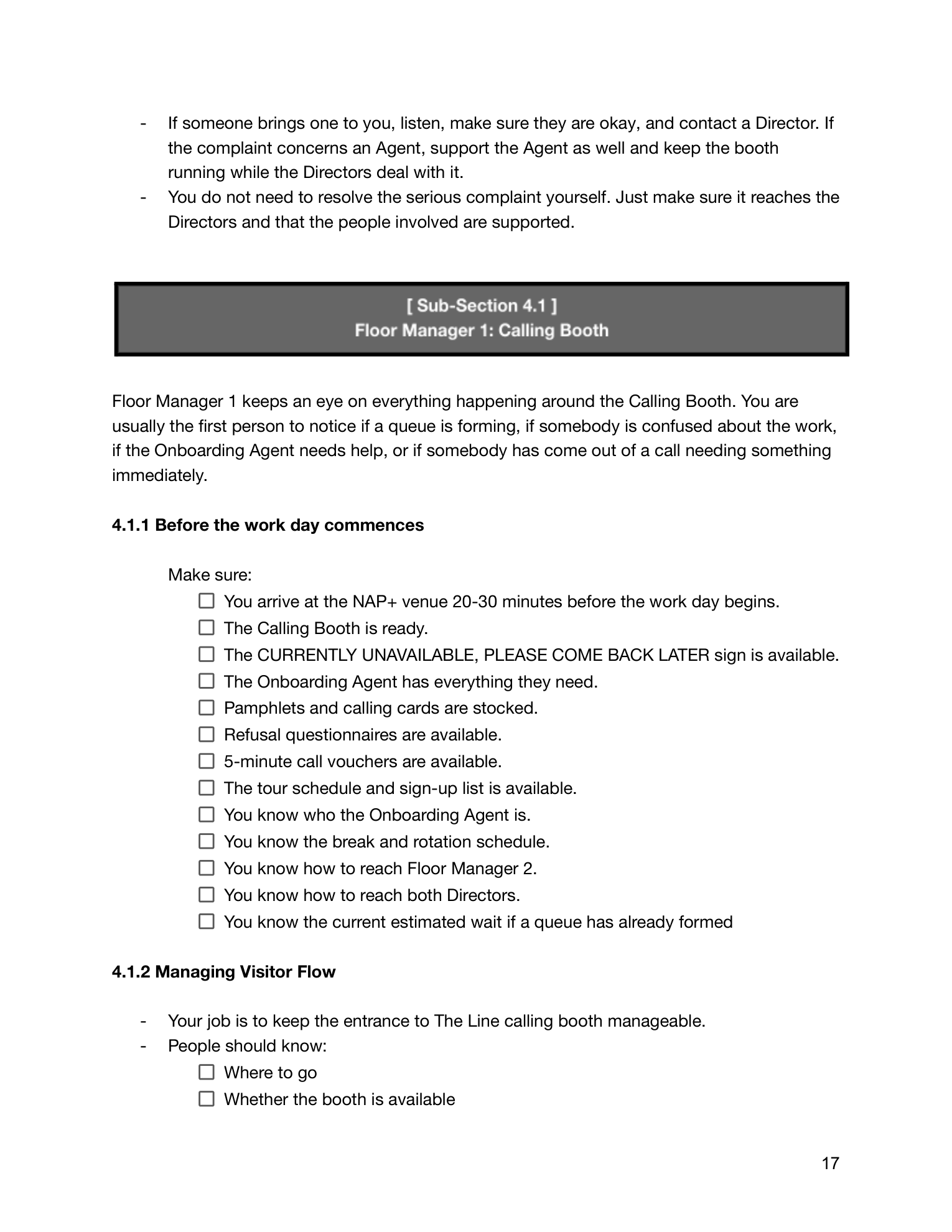
If someone brings one to you, listen, make sure they are okay, and contact a Director. If
the complaint concerns an Agent, support the Agent as well and keep the booth
running while the Directors deal with it.
-
You do not need to resolve the serious complaint yourself. Just make sure it reaches the
Directors and that the people involved are supported.
Floor Manager 1 keeps an eye on everything happening around the Calling Booth. You are
usually the first person to notice if a queue is forming, if somebody is confused about the work,
if the Onboarding Agent needs help, or if somebody has come out of a call needing something
immediately.
4.1.1 Before the work day commences
Make sure:
You arrive at the NAP+ venue 20-30 minutes before the work day begins.
The Calling Booth is ready.
The CURRENTLY UNAVAILABLE, PLEASE COME BACK LATER sign is available.
The Onboarding Agent has everything they need.
Pamphlets and calling cards are stocked.
Refusal questionnaires are available.
5-minute call vouchers are available.
The tour schedule and sign-up list is available.
You know who the Onboarding Agent is.
You know the break and rotation schedule.
You know how to reach Floor Manager 2.
You know how to reach both Directors.
You know the current estimated wait if a queue has already formed
4.1.2 Managing Visitor Flow
-
Your job is to keep the entrance to The Line calling booth manageable.
-
People should know:
Where to go
Whether the booth is available
17
If someone brings one to you, listen, make sure they are okay, and contact a Director. If
the complaint concerns an Agent, support the Agent as well and keep the booth
running while the Directors deal with it.
-
You do not need to resolve the serious complaint yourself. Just make sure it reaches the
Directors and that the people involved are supported.
Floor Manager 1 keeps an eye on everything happening around the Calling Booth. You are
usually the first person to notice if a queue is forming, if somebody is confused about the work,
if the Onboarding Agent needs help, or if somebody has come out of a call needing something
immediately.
4.1.1 Before the work day commences
Make sure:
You arrive at the NAP+ venue 20-30 minutes before the work day begins.
The Calling Booth is ready.
The CURRENTLY UNAVAILABLE, PLEASE COME BACK LATER sign is available.
The Onboarding Agent has everything they need.
Pamphlets and calling cards are stocked.
Refusal questionnaires are available.
5-minute call vouchers are available.
The tour schedule and sign-up list is available.
You know who the Onboarding Agent is.
You know the break and rotation schedule.
You know how to reach Floor Manager 2.
You know how to reach both Directors.
You know the current estimated wait if a queue has already formed
4.1.2 Managing Visitor Flow
-
Your job is to keep the entrance to The Line calling booth manageable.
-
People should know:
Where to go
Whether the booth is available
17
Roughly how long they may need to wait
Who they should speak to
Whether they can come back later
-
Do not allow a large group to quietly form around the Calling Booth without anybody
knowing what is happening.
-
If there are several people waiting, create a simple line.
-
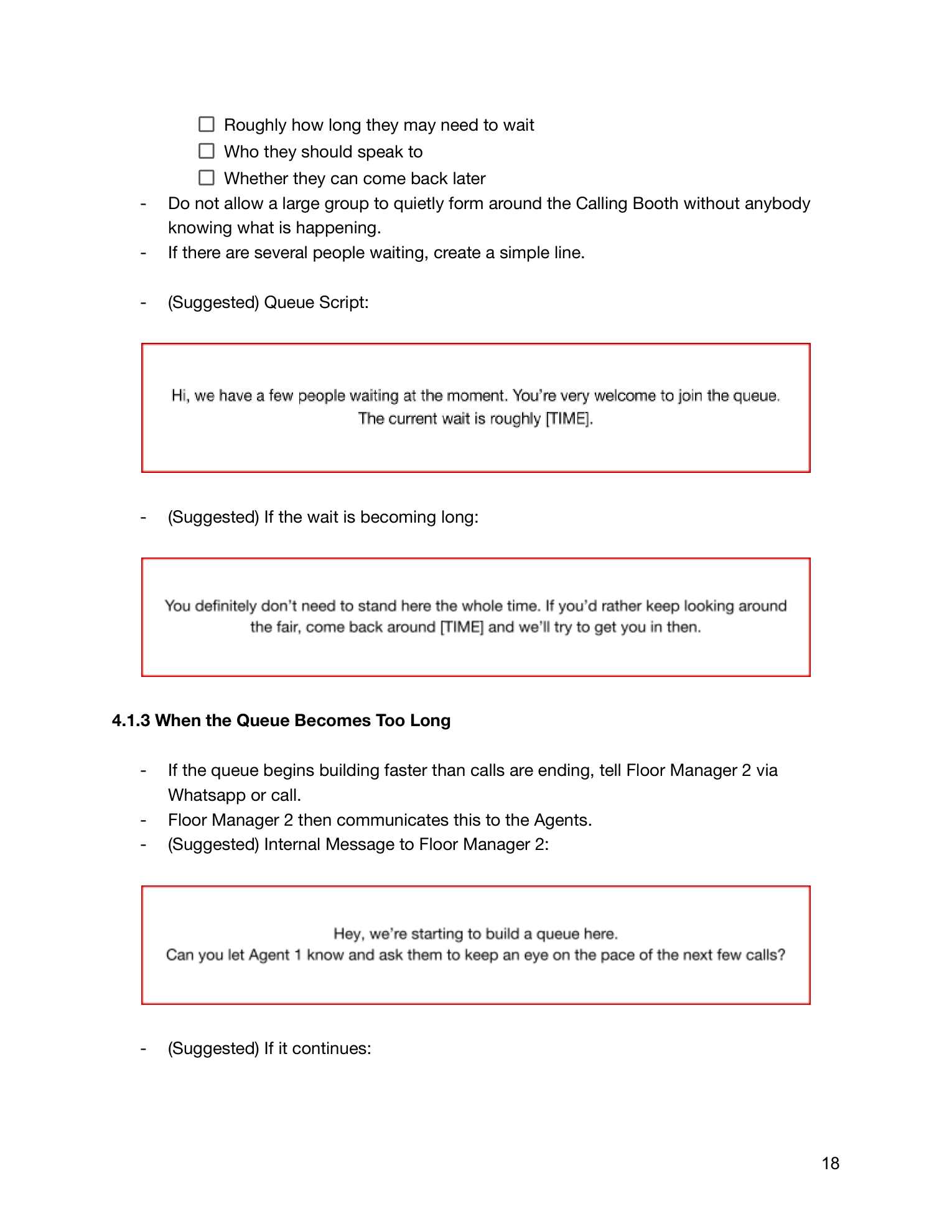
(Suggested) Queue Script:
-
(Suggested) If the wait is becoming long:
4.1.3 When the Queue Becomes Too Long
-
If the queue begins building faster than calls are ending, tell Floor Manager 2 via
Whatsapp or call.
-
Floor Manager 2 then communicates this to the Agents.
-
(Suggested) Internal Message to Floor Manager 2:
-
(Suggested) If it continues:
18
Who they should speak to
Whether they can come back later
-
Do not allow a large group to quietly form around the Calling Booth without anybody
knowing what is happening.
-
If there are several people waiting, create a simple line.
-
(Suggested) Queue Script:
-
(Suggested) If the wait is becoming long:
4.1.3 When the Queue Becomes Too Long
-
If the queue begins building faster than calls are ending, tell Floor Manager 2 via
Whatsapp or call.
-
Floor Manager 2 then communicates this to the Agents.
-
(Suggested) Internal Message to Floor Manager 2:
-
(Suggested) If it continues:
18
4.1.4 Scouting Visitors
-
When the booth is available or the area is quiet you can invite visitors to participate.
-
Stay within the immediate area. You do not need to patrol the entire fair hunting for
callers.
-
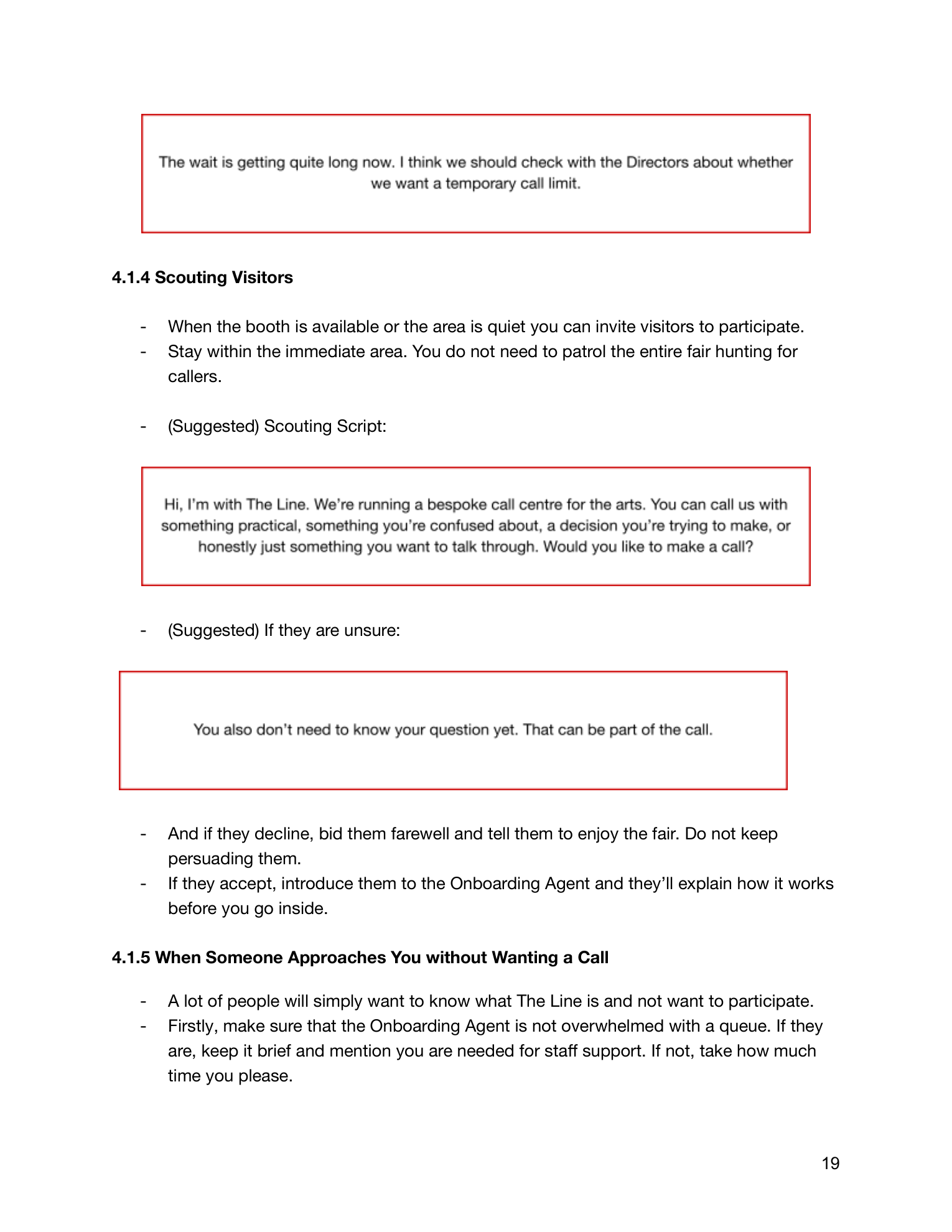
(Suggested) Scouting Script:
-
(Suggested) If they are unsure:
-
And if they decline, bid them farewell and tell them to enjoy the fair. Do not keep
persuading them.
-
If they accept, introduce them to the Onboarding Agent and they’ll explain how it works
before you go inside.
4.1.5 When Someone Approaches You without Wanting a Call
-
A lot of people will simply want to know what The Line is and not want to participate.
-
Firstly, make sure that the Onboarding Agent is not overwhelmed with a queue. If they
are, keep it brief and mention you are needed for staff support. If not, take how much
time you please.
19
-
When the booth is available or the area is quiet you can invite visitors to participate.
-
Stay within the immediate area. You do not need to patrol the entire fair hunting for
callers.
-
(Suggested) Scouting Script:
-
(Suggested) If they are unsure:
-
And if they decline, bid them farewell and tell them to enjoy the fair. Do not keep
persuading them.
-
If they accept, introduce them to the Onboarding Agent and they’ll explain how it works
before you go inside.
4.1.5 When Someone Approaches You without Wanting a Call
-
A lot of people will simply want to know what The Line is and not want to participate.
-
Firstly, make sure that the Onboarding Agent is not overwhelmed with a queue. If they
are, keep it brief and mention you are needed for staff support. If not, take how much
time you please.
19
-
Just answer the question they actually ask. You do not need to give everyone the entire
conceptual history of the work.
-
If they need a short explanation, you can say that The Line is a bespoke call centre
where visitors can speak with early-career artists about questions around art, working in
the arts, institutions, or something they are simply trying to figure out.
-
If they seem interested in trying it themselves, direct them to the Onboarding Agent,
who can take them through the process.
4.1.6 When The Line Is Temporarily Unavailable
-
During handovers, breaks, technical problems, or temporary closure, place the
sandwich board outside the Calling Booth.
-
If someone asks, just mention that The Line is temporarily offline at the moment. We
should be back in roughly [TIME]. They're very welcome to come back then.
-
Do not say exactly when it will reopen unless you actually know.
4.1.7 Supporting the Onboarding Agent
-
The Onboarding Agent should be able to handle most visitors themselves.
-
Step in when:
several people arrive at once
somebody has a lot of questions
a visitor needs extra assistance
somebody comes out of the booth while another person is being onboarded
the Onboarding Agent needs a break
somebody becomes difficult or inappropriate
offboarding and onboarding are happening at the same time
-
If the Onboarding Agent needs to leave unexpectedly, either cover the position yourself
or contact the Directors for cover.
4.1.8 Supporting Offboarding
-
When the Onboarding Agent is busy, Floor Manager 1 can handle offboarding.
-
Check how the call went and whether the visitor has completed the payment. If
everything is done, thank them for calling The Line and offer them a pamphlet and
business card to take with them.
-
Ask if they need any further information. If they do not, leave them be.
4.1.9 Non-Payment
20
Just answer the question they actually ask. You do not need to give everyone the entire
conceptual history of the work.
-
If they need a short explanation, you can say that The Line is a bespoke call centre
where visitors can speak with early-career artists about questions around art, working in
the arts, institutions, or something they are simply trying to figure out.
-
If they seem interested in trying it themselves, direct them to the Onboarding Agent,
who can take them through the process.
4.1.6 When The Line Is Temporarily Unavailable
-
During handovers, breaks, technical problems, or temporary closure, place the
sandwich board outside the Calling Booth.
-
If someone asks, just mention that The Line is temporarily offline at the moment. We
should be back in roughly [TIME]. They're very welcome to come back then.
-
Do not say exactly when it will reopen unless you actually know.
4.1.7 Supporting the Onboarding Agent
-
The Onboarding Agent should be able to handle most visitors themselves.
-
Step in when:
several people arrive at once
somebody has a lot of questions
a visitor needs extra assistance
somebody comes out of the booth while another person is being onboarded
the Onboarding Agent needs a break
somebody becomes difficult or inappropriate
offboarding and onboarding are happening at the same time
-
If the Onboarding Agent needs to leave unexpectedly, either cover the position yourself
or contact the Directors for cover.
4.1.8 Supporting Offboarding
-
When the Onboarding Agent is busy, Floor Manager 1 can handle offboarding.
-
Check how the call went and whether the visitor has completed the payment. If
everything is done, thank them for calling The Line and offer them a pamphlet and
business card to take with them.
-
Ask if they need any further information. If they do not, leave them be.
4.1.9 Non-Payment
20
-
If the visitor does not want to pay, they compensate The Line with their time instead.
This means completing a short non-payment questionnaire, which Floor Manager 1 has
access to, and taking five pamphlets with them. They are encouraged to pass these on
to other people who might be interested in The Line.
-
If the call was unexpectedly cut, there was a technical issue, or something went wrong
on our side, the visitor can be given a 5-minute free-call coupon. Use your judgment
depending on what happened. If the situation warrants it, you can give them more than
one.
4.1.10 Abrupt Exit
-
If somebody suddenly leaves the Calling Booth, check in with them and ask if they are
okay or if they simply wanted to stop the call.
-
Do not force them to explain themselves.
-
If something seems concerning or like something serious may have happened during
the call, let Floor Manager 2 know and contact a Director immediately.
-
If they simply wanted to stop, that is fine. Just complete whatever offboarding is still
necessary. If they have not paid, the normal non-payment process applies.
4.1.11 Tour Requests
-
If somebody seems especially curious about The Line or wants to know more about
how it works, you can mention that we also do small tours.
-
If they are interested, check the tour list and write down their name. Tours are generally
limited to five people because of the size of the space, but if there is a particular
situation, check with the Directors and see what is possible.
-
Be a little discerning with the tour list. There are only a limited number of tours across
the fair, so try to keep the spaces for people who are genuinely interested in seeing
more of the work.
-
The Floor Managers organise the tour list. The Directors conduct the tours.
4.1.12 If Someone Wants a Director
-
If somebody asks to speak with a Director, first find out what they need.
-
If it is something the team can easily deal with, offer to help them yourself.
-
If they still need a Director, or it is clearly something that should go to one, just contact
them. No need to overcomplicate it.
4.1.13 When to Contact a Director
-
Contact a Director when:
21
If the visitor does not want to pay, they compensate The Line with their time instead.
This means completing a short non-payment questionnaire, which Floor Manager 1 has
access to, and taking five pamphlets with them. They are encouraged to pass these on
to other people who might be interested in The Line.
-
If the call was unexpectedly cut, there was a technical issue, or something went wrong
on our side, the visitor can be given a 5-minute free-call coupon. Use your judgment
depending on what happened. If the situation warrants it, you can give them more than
one.
4.1.10 Abrupt Exit
-
If somebody suddenly leaves the Calling Booth, check in with them and ask if they are
okay or if they simply wanted to stop the call.
-
Do not force them to explain themselves.
-
If something seems concerning or like something serious may have happened during
the call, let Floor Manager 2 know and contact a Director immediately.
-
If they simply wanted to stop, that is fine. Just complete whatever offboarding is still
necessary. If they have not paid, the normal non-payment process applies.
4.1.11 Tour Requests
-
If somebody seems especially curious about The Line or wants to know more about
how it works, you can mention that we also do small tours.
-
If they are interested, check the tour list and write down their name. Tours are generally
limited to five people because of the size of the space, but if there is a particular
situation, check with the Directors and see what is possible.
-
Be a little discerning with the tour list. There are only a limited number of tours across
the fair, so try to keep the spaces for people who are genuinely interested in seeing
more of the work.
-
The Floor Managers organise the tour list. The Directors conduct the tours.
4.1.12 If Someone Wants a Director
-
If somebody asks to speak with a Director, first find out what they need.
-
If it is something the team can easily deal with, offer to help them yourself.
-
If they still need a Director, or it is clearly something that should go to one, just contact
them. No need to overcomplicate it.
4.1.13 When to Contact a Director
-
Contact a Director when:
21
the visitor asks for an official decision
something falls outside the normal rules
there is a serious complaint
there has been an incident
somebody feels unsafe
somebody becomes aggressive or discriminatory
a visitor needs to be removed
there is a major payment dispute
the booth may need to close
the Onboarding Agent cannot continue
the queue requires a larger operational decision
NAP+ staff need an official answer
you genuinely do not know what to do
4.1.14 Forms and Resources
-
Floor Manager 1 should have access to:
staff schedule
rotation and break schedule
tour schedule
tour sign-up list
waiting list
pamphlets
business cards
refusal questionnaires
5-minute call vouchers
general visitor information
current tariff information
Director contact details
staff contact list
Floor Manager 2 stays closer to the Agent Booth. Your job is to protect the working space
around the Agents and make it easier for them to remain focused on the calls. Visitors should
22
something falls outside the normal rules
there is a serious complaint
there has been an incident
somebody feels unsafe
somebody becomes aggressive or discriminatory
a visitor needs to be removed
there is a major payment dispute
the booth may need to close
the Onboarding Agent cannot continue
the queue requires a larger operational decision
NAP+ staff need an official answer
you genuinely do not know what to do
4.1.14 Forms and Resources
-
Floor Manager 1 should have access to:
staff schedule
rotation and break schedule
tour schedule
tour sign-up list
waiting list
pamphlets
business cards
refusal questionnaires
5-minute call vouchers
general visitor information
current tariff information
Director contact details
staff contact list
Floor Manager 2 stays closer to the Agent Booth. Your job is to protect the working space
around the Agents and make it easier for them to remain focused on the calls. Visitors should
22
not generally be walking directly up to the Agents while they are working. You are the
intermediary.
4.2.1 Before the work day commences
Make sure:
all three Agent positions are ready
the Agents have the correct forms
Agent 2 has a working technical device and Wi-Fi
the sales folder is available
the works and prices folder is up to date
complaint forms are available to Agent 1
the call log is working
Agents know their starting roles
Agents know the first rotation time
technical contacts are available
Director contact details are available
the payment device is working
you know the tour schedule
you know whether anyone needs early cover or a changed break
4.2.2 Protecting the Agent Booth
-
If somebody approaches an Agent directly, do not make them feel like they have done
anything wrong. Just step in and redirect the conversation towards yourself. Ask what
they need and help them if you can.
-
If they want to make a call, direct them towards the Calling Booth, where Floor Manager
1 or the Onboarding Agent can help them get started.
4.2.3 Supporting the Agents
-
Keep an eye on how the Agents are doing. They should not have to wait until they are
completely overwhelmed before asking for help.
-
If someone looks like they need a break, check in with them and see what they need. If
they want to step away, arrange cover.
-
A Director can temporarily take over their position. The Agent can leave the booth, take
a smoke, walk around, or just stay in the booth and listen without actively working.
-
The point is simply to make sure nobody feels like they have to push through because
they are technically still on shift.
4.2.4 When the Agents Need Help With a Call
23
intermediary.
4.2.1 Before the work day commences
Make sure:
all three Agent positions are ready
the Agents have the correct forms
Agent 2 has a working technical device and Wi-Fi
the sales folder is available
the works and prices folder is up to date
complaint forms are available to Agent 1
the call log is working
Agents know their starting roles
Agents know the first rotation time
technical contacts are available
Director contact details are available
the payment device is working
you know the tour schedule
you know whether anyone needs early cover or a changed break
4.2.2 Protecting the Agent Booth
-
If somebody approaches an Agent directly, do not make them feel like they have done
anything wrong. Just step in and redirect the conversation towards yourself. Ask what
they need and help them if you can.
-
If they want to make a call, direct them towards the Calling Booth, where Floor Manager
1 or the Onboarding Agent can help them get started.
4.2.3 Supporting the Agents
-
Keep an eye on how the Agents are doing. They should not have to wait until they are
completely overwhelmed before asking for help.
-
If someone looks like they need a break, check in with them and see what they need. If
they want to step away, arrange cover.
-
A Director can temporarily take over their position. The Agent can leave the booth, take
a smoke, walk around, or just stay in the booth and listen without actively working.
-
The point is simply to make sure nobody feels like they have to push through because
they are technically still on shift.
4.2.4 When the Agents Need Help With a Call
23
-
If the problem is conversational, let the Agents discuss it among themselves first.
Agents can put the caller on hold while they do this.
-
If they still need help, Floor Manager 2 can step in and help them think through what to
do next.
-
If a Floor Manager needs to temporarily take over for one of the Agents, they can sit at
that Agent’s desk and continue from there while the Agent takes a break.
-
If the issue still cannot be resolved, contact a Director and let them take over from
there.
4.2.5 Shared Calls
-
Sometimes two Agents, or all three, will want to be part of the same conversation. That
is completely fine.
-
Floor Manager 2 does not need to step in unless the Agents ask for help or it starts
creating another practical problem.
-
If all three Agents are occupied with one call and another Agent is needed elsewhere,
Floor Manager 2 can help arrange cover.
4.2.6 Queue Communication
-
Floor Manager 1 will let Floor Manager 2 know when the queue outside the Calling
Booth is starting to build, usually through WhatsApp.
-
Floor Manager 2 should then pass that information on to Agent 1 without making the
current caller feel rushed.
-
If the queue keeps becoming a problem, Floor Manager 1, Floor Manager 2 and the
Directors can decide whether a temporary suggested call limit is needed for new callers.
-
Depending on how busy the day is, the Directors may suggest an approximate
maximum call length somewhere between 30 minutes and 1 hour.
-
This is not an automatic rule. If a conversation genuinely needs longer, use judgment.
-
The caller should never suddenly discover that they have thirty seconds left because
somebody outside got impatient.
-
Keep an eye on Whatsapp throughout the shift so this kind of information does not get
missed.
4.2.7 Research, Field and Practical Questions
-
If Agent 2 needs information about something elsewhere at the fair, they should first
check with the other Agents and see whether anybody already knows.
-
If they still need help, they can ask Floor Manager 2.
-
First decide whether the information is actually necessary for the call. If it is, contact a
Director and explain clearly what Agent 2 needs.
24
If the problem is conversational, let the Agents discuss it among themselves first.
Agents can put the caller on hold while they do this.
-
If they still need help, Floor Manager 2 can step in and help them think through what to
do next.
-
If a Floor Manager needs to temporarily take over for one of the Agents, they can sit at
that Agent’s desk and continue from there while the Agent takes a break.
-
If the issue still cannot be resolved, contact a Director and let them take over from
there.
4.2.5 Shared Calls
-
Sometimes two Agents, or all three, will want to be part of the same conversation. That
is completely fine.
-
Floor Manager 2 does not need to step in unless the Agents ask for help or it starts
creating another practical problem.
-
If all three Agents are occupied with one call and another Agent is needed elsewhere,
Floor Manager 2 can help arrange cover.
4.2.6 Queue Communication
-
Floor Manager 1 will let Floor Manager 2 know when the queue outside the Calling
Booth is starting to build, usually through WhatsApp.
-
Floor Manager 2 should then pass that information on to Agent 1 without making the
current caller feel rushed.
-
If the queue keeps becoming a problem, Floor Manager 1, Floor Manager 2 and the
Directors can decide whether a temporary suggested call limit is needed for new callers.
-
Depending on how busy the day is, the Directors may suggest an approximate
maximum call length somewhere between 30 minutes and 1 hour.
-
This is not an automatic rule. If a conversation genuinely needs longer, use judgment.
-
The caller should never suddenly discover that they have thirty seconds left because
somebody outside got impatient.
-
Keep an eye on Whatsapp throughout the shift so this kind of information does not get
missed.
4.2.7 Research, Field and Practical Questions
-
If Agent 2 needs information about something elsewhere at the fair, they should first
check with the other Agents and see whether anybody already knows.
-
If they still need help, they can ask Floor Manager 2.
-
First decide whether the information is actually necessary for the call. If it is, contact a
Director and explain clearly what Agent 2 needs.
24
-
The Director can then gather the information, visit the relevant booth if needed, and
return it to Floor Manager 2, who passes it back to Agent 2. If it makes more sense
because of the urgency or timing of the call, the Director can also join the call directly.
-
The Agents should stay in the Agent Booth during their working period rather than
leaving to conduct research themselves.
4.2.8 Technical Problems
-
When an Agent reports a technical problem, first find out exactly what is not working
and whether the call can still continue.
-
If it is something simple, try the basic fix. If it cannot be fixed quickly, contact the
Directors and technical team and explain clearly what is wrong and what has already
been tried.
-
Do not let a technical problem quietly continue for twenty minutes without telling
anyone.
4.2.9 When The Line May Need to Go Offline
-
Contact the Directors if the technical problem is serious enough that The Line cannot
properly continue.
-
This includes calls not connecting, recording failing in a way that affects consent, the
interface or call log becoming unusable, essential power going down, a serious fault
with the question display, Agent 2 losing access to something essential, payment
problems, or the Agents no longer being able to reasonably continue working.
-
The Directors then decide whether The Line can keep running with a temporary solution
or needs to go offline
4.2.10 Tour Requests
-
Floor Manager 2 can also take tour requests from people around the Agent Booth. If
someone seems genuinely interested in seeing more of how The Line works, let them
know that small tours are sometimes available and add their name to the tour list.
-
Tours are generally limited to five people and are conducted by the Directors. If a tour
looks full but somebody is particularly interested, check with the Directors and see what
is possible.
-
There is no need to interrupt the Agents or give somebody an impromptu tour while
they are working.
4.2.11 Breaks, Rotation and Cover
-
Keep an eye on the Agents and when rotations are approaching. If someone is still on a
call, let them finish. Do not rotate people in the middle of a conversation.
25
The Director can then gather the information, visit the relevant booth if needed, and
return it to Floor Manager 2, who passes it back to Agent 2. If it makes more sense
because of the urgency or timing of the call, the Director can also join the call directly.
-
The Agents should stay in the Agent Booth during their working period rather than
leaving to conduct research themselves.
4.2.8 Technical Problems
-
When an Agent reports a technical problem, first find out exactly what is not working
and whether the call can still continue.
-
If it is something simple, try the basic fix. If it cannot be fixed quickly, contact the
Directors and technical team and explain clearly what is wrong and what has already
been tried.
-
Do not let a technical problem quietly continue for twenty minutes without telling
anyone.
4.2.9 When The Line May Need to Go Offline
-
Contact the Directors if the technical problem is serious enough that The Line cannot
properly continue.
-
This includes calls not connecting, recording failing in a way that affects consent, the
interface or call log becoming unusable, essential power going down, a serious fault
with the question display, Agent 2 losing access to something essential, payment
problems, or the Agents no longer being able to reasonably continue working.
-
The Directors then decide whether The Line can keep running with a temporary solution
or needs to go offline
4.2.10 Tour Requests
-
Floor Manager 2 can also take tour requests from people around the Agent Booth. If
someone seems genuinely interested in seeing more of how The Line works, let them
know that small tours are sometimes available and add their name to the tour list.
-
Tours are generally limited to five people and are conducted by the Directors. If a tour
looks full but somebody is particularly interested, check with the Directors and see what
is possible.
-
There is no need to interrupt the Agents or give somebody an impromptu tour while
they are working.
4.2.11 Breaks, Rotation and Cover
-
Keep an eye on the Agents and when rotations are approaching. If someone is still on a
call, let them finish. Do not rotate people in the middle of a conversation.
25
-
When the Agents are ready to switch, communicate with Floor Manager 1, usually
through WhatsApp, so no new visitor is sent into the Calling Booth. Agent 1 can put the
system temporarily offline and Floor Manager 1 can place the sandwich board.
-
Allow around five to ten minutes for everyone to hand over and settle into their new
positions before reopening.
-
If an Agent needs a longer break, help arrange cover. A Floor Manager or Director can
temporarily sit at their desk while they step away.
-
Reopen once everyone is ready.
4.2.11 Staff Conflict or Interpersonal Tension
-
If you notice tension between the Agents, check in rather than letting it quietly build.
-
We have a transparency rule, so nobody needs to pretend everything is fine just to keep
the booth running smoothly.
-
If it seems like something small, give them a chance to talk it through or take a minute.
If somebody wants a private conversation, or the issue is not resolving easily, contact a
Director and let them take it from there.
-
The point is simply to deal with things early rather than letting them sit there for the rest
of the shift.
4.2.12 When to Contact a Director
-
Contact a Director when:
a purchase needs approval
a rate or payment issue falls outside normal procedure
an Agent needs Director cover
a serious complaint has been made
a complaint concerns a staff member
there is an incident
somebody feels unsafe
there is discriminatory, aggressive, or harmful behaviour
an Agent needs information gathered elsewhere at the fair
there is a technical problem that may affect operations
The Line may need to close temporarily
the panic procedure might be needed
there is an interpersonal issue requiring Director support
a visitor needs an official answer
a gallery, institution, press representative, or NAP+ staff member makes an
official request
26
When the Agents are ready to switch, communicate with Floor Manager 1, usually
through WhatsApp, so no new visitor is sent into the Calling Booth. Agent 1 can put the
system temporarily offline and Floor Manager 1 can place the sandwich board.
-
Allow around five to ten minutes for everyone to hand over and settle into their new
positions before reopening.
-
If an Agent needs a longer break, help arrange cover. A Floor Manager or Director can
temporarily sit at their desk while they step away.
-
Reopen once everyone is ready.
4.2.11 Staff Conflict or Interpersonal Tension
-
If you notice tension between the Agents, check in rather than letting it quietly build.
-
We have a transparency rule, so nobody needs to pretend everything is fine just to keep
the booth running smoothly.
-
If it seems like something small, give them a chance to talk it through or take a minute.
If somebody wants a private conversation, or the issue is not resolving easily, contact a
Director and let them take it from there.
-
The point is simply to deal with things early rather than letting them sit there for the rest
of the shift.
4.2.12 When to Contact a Director
-
Contact a Director when:
a purchase needs approval
a rate or payment issue falls outside normal procedure
an Agent needs Director cover
a serious complaint has been made
a complaint concerns a staff member
there is an incident
somebody feels unsafe
there is discriminatory, aggressive, or harmful behaviour
an Agent needs information gathered elsewhere at the fair
there is a technical problem that may affect operations
The Line may need to close temporarily
the panic procedure might be needed
there is an interpersonal issue requiring Director support
a visitor needs an official answer
a gallery, institution, press representative, or NAP+ staff member makes an
official request
26
you reach a situation the normal procedures do not cover
4.2.13 Forms and Resources
-
Floor Manager 2 should have access to:
Staff and Operations
staff schedule
rotation schedule
break schedule
Director contact details
staff contact list
technical contacts
daily changes or updates
Calls
call flow reference
complaint forms
incident forms
technical escalation form
current tariff information
Sales
full sales folder
Blind Box inventory
intake forms
payment instructions
SumUp / payment device
letters of acquisition
Tours and Public Information
tour schedule
tour sign-up list
pamphlets
business cards
27
4.2.13 Forms and Resources
-
Floor Manager 2 should have access to:
Staff and Operations
staff schedule
rotation schedule
break schedule
Director contact details
staff contact list
technical contacts
daily changes or updates
Calls
call flow reference
complaint forms
incident forms
technical escalation form
current tariff information
Sales
full sales folder
Blind Box inventory
intake forms
payment instructions
SumUp / payment device
letters of acquisition
Tours and Public Information
tour schedule
tour sign-up list
pamphlets
business cards
27
The Onboarding Agent is responsible for the visitor before they enter the Calling Booth and,
when possible, when they come back out. Your job is to welcome them, explain what they are
entering, make sure they understand the conditions of the call and remain nearby if they need
help.
If it gets busy, Floor Manager 1 can help with onboarding or take over the offboarding.
5.1 Before the Day
Make sure you have:
pamphlets
business cards
refusal questionnaires
5-minute call vouchers,
current tariff information
recording and consent information
the Floor Manager 1 contact
Director contact information
the CURRENTLY UNAVAILABLE, PLEASE COME BACK LATER sandwich board nearby
Make sure the Calling Booth is ready before each visitor enters.
5.2 The Onboarding Script
-
You do not have to repeat this word for word every single time, but this contains
everything the visitor needs to know before entering:
28
when possible, when they come back out. Your job is to welcome them, explain what they are
entering, make sure they understand the conditions of the call and remain nearby if they need
help.
If it gets busy, Floor Manager 1 can help with onboarding or take over the offboarding.
5.1 Before the Day
Make sure you have:
pamphlets
business cards
refusal questionnaires
5-minute call vouchers,
current tariff information
recording and consent information
the Floor Manager 1 contact
Director contact information
the CURRENTLY UNAVAILABLE, PLEASE COME BACK LATER sandwich board nearby
Make sure the Calling Booth is ready before each visitor enters.
5.2 The Onboarding Script
-
You do not have to repeat this word for word every single time, but this contains
everything the visitor needs to know before entering:
28
5.3 Basic Do’s and Don’ts
-
Visitors can:
arrive without a clear question
change their question during the call
29
-
Visitors can:
arrive without a clear question
change their question during the call
29
disagree with an Agent
ask for clarification
say that they cannot afford the provisional rate
stop the conversation if they no longer want to continue
-
Visitors cannot:
treat the Agents as mental health professionals
personally attack or harass staff
use discriminatory or threatening language
deliberately damage the equipment
continue without agreeing to the basic conditions of the call
-
If anything feels wrong or moves outside your role, ask Floor Manager 1.
5.4 While They Are Inside
-
You do not need to hover while somebody is in the Calling Booth. Stay generally nearby
and let them get on with it.
-
If they come out needing help, just ask what the problem is. If you can solve it, help
them. If you cannot, contact Floor Manager 1.
-
Floor Manager 1 can then decide whether the issue needs a Director or the technical
team.
-
If you need to leave the area yourself, let Floor Manager 1 know first.
5.5 Offboarding
-
When the visitor comes out after a completed call, check in briefly and ask how it went.
You do not need to turn this into another consultation.
-
You can usually see whether the payment has been completed. If everything is fine,
thank them for calling The Line, offer them a pamphlet and business card, and ask if
they need any further information. If they do not, leave them be.
5.6 Payment
-
Before the visitor leaves, the Onboarding Agent should quickly double-check that the
payment has actually been completed. Just have a quick look inside the booth or at the
payment confirmation.
-
Then ask whether everything went through properly. If it has, thank them.
-
If anything looks wrong, help them sort it out before they leave.
-
Then offer them a pamphlet and business card with some information about The Line to
take with them.
30
ask for clarification
say that they cannot afford the provisional rate
stop the conversation if they no longer want to continue
-
Visitors cannot:
treat the Agents as mental health professionals
personally attack or harass staff
use discriminatory or threatening language
deliberately damage the equipment
continue without agreeing to the basic conditions of the call
-
If anything feels wrong or moves outside your role, ask Floor Manager 1.
5.4 While They Are Inside
-
You do not need to hover while somebody is in the Calling Booth. Stay generally nearby
and let them get on with it.
-
If they come out needing help, just ask what the problem is. If you can solve it, help
them. If you cannot, contact Floor Manager 1.
-
Floor Manager 1 can then decide whether the issue needs a Director or the technical
team.
-
If you need to leave the area yourself, let Floor Manager 1 know first.
5.5 Offboarding
-
When the visitor comes out after a completed call, check in briefly and ask how it went.
You do not need to turn this into another consultation.
-
You can usually see whether the payment has been completed. If everything is fine,
thank them for calling The Line, offer them a pamphlet and business card, and ask if
they need any further information. If they do not, leave them be.
5.6 Payment
-
Before the visitor leaves, the Onboarding Agent should quickly double-check that the
payment has actually been completed. Just have a quick look inside the booth or at the
payment confirmation.
-
Then ask whether everything went through properly. If it has, thank them.
-
If anything looks wrong, help them sort it out before they leave.
-
Then offer them a pamphlet and business card with some information about The Line to
take with them.
30
5.7 If the Payment Has Not Gone Through
-
If the payment has not gone through, first check whether there was a technical problem.
-
If there was, contact Floor Manager 1 and let them help sort it out.
5.8 If They Choose Not to Pay
-
If the payment has not been completed, first check whether they were intending to pay.
-
If they do not want to pay, they compensate The Line with their time instead. Ask them
to complete the Refusal / Non-Payment Questionnaire, which Floor Manager 1 has
access to.
-
Once they are finished, thank them and give them five pamphlets to take with them.
They are encouraged to pass these on to people who might be interested in The Line.
5.9 If the Call Was Cut
-
If somebody comes out suddenly, check in and ask if they are okay or if they wanted to
stop the call.
-
If they simply chose to end it, that is fine. Complete whatever offboarding is still
necessary.
-
If the call was cut accidentally, contact Floor Manager 1 and see whether the call can
be restarted or reconnected. Because something went wrong on our side, you can also
give them as many 5-minute free-call vouchers as feels appropriate depending on how
much of the call they lost and what happened.
-
If something during the call made them uncomfortable, ask whether they want to tell
you what happened or would rather speak directly with the Floor Manager.
-
If needed, Floor Managers will need to follow the serious complaint or escalation
procedure.
5.10 Blind Box
-
If they come out wanting to ask about or purchase a Blind Box, direct them to the Floor
Managers who can take them through the process.
-
The Onboarding Agent does not conduct the sale.
-
Refer to the Blind Boxes section for the full procedure and information.
5.11 When It Is Busy
-
If somebody comes out while you are still onboarding another visitor, ask Floor
Manager 1 to take over the offboarding.
-
If several people arrive at once, stay with the visitor or group you are already
onboarding and let Floor Manager 1 manage the queue and anything happening around
the Calling Booth.
31
-
If the payment has not gone through, first check whether there was a technical problem.
-
If there was, contact Floor Manager 1 and let them help sort it out.
5.8 If They Choose Not to Pay
-
If the payment has not been completed, first check whether they were intending to pay.
-
If they do not want to pay, they compensate The Line with their time instead. Ask them
to complete the Refusal / Non-Payment Questionnaire, which Floor Manager 1 has
access to.
-
Once they are finished, thank them and give them five pamphlets to take with them.
They are encouraged to pass these on to people who might be interested in The Line.
5.9 If the Call Was Cut
-
If somebody comes out suddenly, check in and ask if they are okay or if they wanted to
stop the call.
-
If they simply chose to end it, that is fine. Complete whatever offboarding is still
necessary.
-
If the call was cut accidentally, contact Floor Manager 1 and see whether the call can
be restarted or reconnected. Because something went wrong on our side, you can also
give them as many 5-minute free-call vouchers as feels appropriate depending on how
much of the call they lost and what happened.
-
If something during the call made them uncomfortable, ask whether they want to tell
you what happened or would rather speak directly with the Floor Manager.
-
If needed, Floor Managers will need to follow the serious complaint or escalation
procedure.
5.10 Blind Box
-
If they come out wanting to ask about or purchase a Blind Box, direct them to the Floor
Managers who can take them through the process.
-
The Onboarding Agent does not conduct the sale.
-
Refer to the Blind Boxes section for the full procedure and information.
5.11 When It Is Busy
-
If somebody comes out while you are still onboarding another visitor, ask Floor
Manager 1 to take over the offboarding.
-
If several people arrive at once, stay with the visitor or group you are already
onboarding and let Floor Manager 1 manage the queue and anything happening around
the Calling Booth.
31
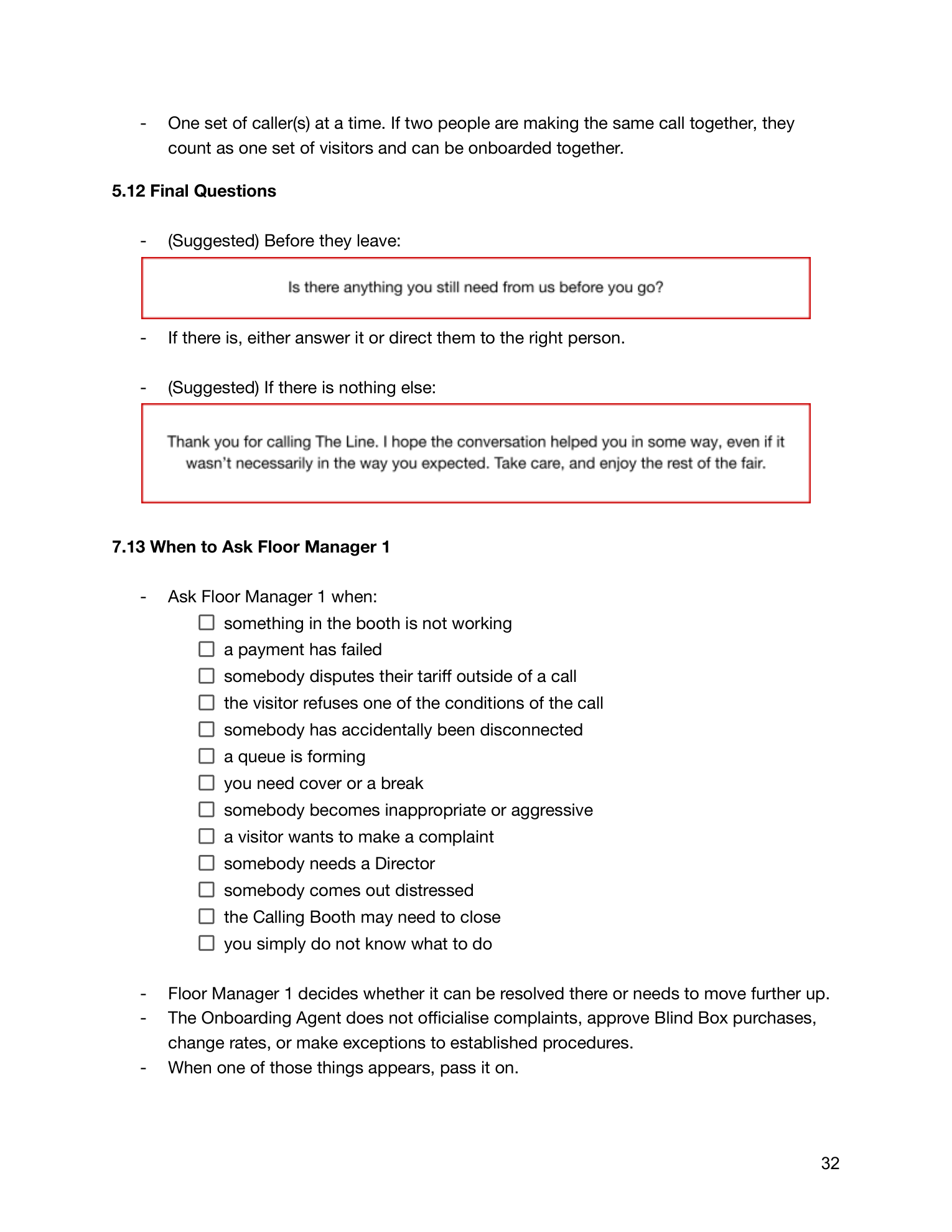
-
One set of caller(s) at a time. If two people are making the same call together, they
count as one set of visitors and can be onboarded together.
5.12 Final Questions
-
(Suggested) Before they leave:
-
If there is, either answer it or direct them to the right person.
-
(Suggested) If there is nothing else:
7.13 When to Ask Floor Manager 1
-
Ask Floor Manager 1 when:
something in the booth is not working
a payment has failed
somebody disputes their tariff outside of a call
the visitor refuses one of the conditions of the call
somebody has accidentally been disconnected
a queue is forming
you need cover or a break
somebody becomes inappropriate or aggressive
a visitor wants to make a complaint
somebody needs a Director
somebody comes out distressed
the Calling Booth may need to close
you simply do not know what to do
-
Floor Manager 1 decides whether it can be resolved there or needs to move further up.
-
The Onboarding Agent does not officialise complaints, approve Blind Box purchases,
change rates, or make exceptions to established procedures.
-
When one of those things appears, pass it on.
32
One set of caller(s) at a time. If two people are making the same call together, they
count as one set of visitors and can be onboarded together.
5.12 Final Questions
-
(Suggested) Before they leave:
-
If there is, either answer it or direct them to the right person.
-
(Suggested) If there is nothing else:
7.13 When to Ask Floor Manager 1
-
Ask Floor Manager 1 when:
something in the booth is not working
a payment has failed
somebody disputes their tariff outside of a call
the visitor refuses one of the conditions of the call
somebody has accidentally been disconnected
a queue is forming
you need cover or a break
somebody becomes inappropriate or aggressive
a visitor wants to make a complaint
somebody needs a Director
somebody comes out distressed
the Calling Booth may need to close
you simply do not know what to do
-
Floor Manager 1 decides whether it can be resolved there or needs to move further up.
-
The Onboarding Agent does not officialise complaints, approve Blind Box purchases,
change rates, or make exceptions to established procedures.
-
When one of those things appears, pass it on.
32
The three Agents work together from inside the Agent Booth.
-
Agent 1 receives every call first.
-
Agent 2 deals primarily with practical questions, factual information and research.
-
Agent 3 works with questions that need a less practical or more instinctive direction.
All Agents have access to:
the caller questionnaire
the current question field
the call log
the caller’s provisional tariff
the caller’s selected What The Line Can Do category
information about who is paying for the consultation
the relevant Agent guide and guiding materials
the shared field journal
their own personal notebook
the hold and transfer tracks, along with any other automated call tracks relevant to the
role
the internal contact route to Floor Manager 2
Depending on the role:
-
Agent 1 also has access to the complaint form and the relevant Blind Box information.
-
Agent 2 also has access to a technical device, Wi-Fi, the internet, the Agent 2 Resource
Directory, bookmarked resources, and the relevant NAP+ / artist / gallery information.
-
Agent 3 also has access to the guiding-question and reframing materials for more
abstract or instinctive conversations.
6.1 The Tariff
-
The tariff shown to the caller is provisional. Agents will be able to see it as part of the
caller information before or during the conversation.
-
The interface calculates the initial rate, so Agents do not need to work it out manually.
-
The questionnaire also shows who is paying for the consultation. Keep that in mind.
Someone paying personally and someone whose institution is paying are not
necessarily in the same position.
33
-
Agent 1 receives every call first.
-
Agent 2 deals primarily with practical questions, factual information and research.
-
Agent 3 works with questions that need a less practical or more instinctive direction.
All Agents have access to:
the caller questionnaire
the current question field
the call log
the caller’s provisional tariff
the caller’s selected What The Line Can Do category
information about who is paying for the consultation
the relevant Agent guide and guiding materials
the shared field journal
their own personal notebook
the hold and transfer tracks, along with any other automated call tracks relevant to the
role
the internal contact route to Floor Manager 2
Depending on the role:
-
Agent 1 also has access to the complaint form and the relevant Blind Box information.
-
Agent 2 also has access to a technical device, Wi-Fi, the internet, the Agent 2 Resource
Directory, bookmarked resources, and the relevant NAP+ / artist / gallery information.
-
Agent 3 also has access to the guiding-question and reframing materials for more
abstract or instinctive conversations.
6.1 The Tariff
-
The tariff shown to the caller is provisional. Agents will be able to see it as part of the
caller information before or during the conversation.
-
The interface calculates the initial rate, so Agents do not need to work it out manually.
-
The questionnaire also shows who is paying for the consultation. Keep that in mind.
Someone paying personally and someone whose institution is paying are not
necessarily in the same position.
33
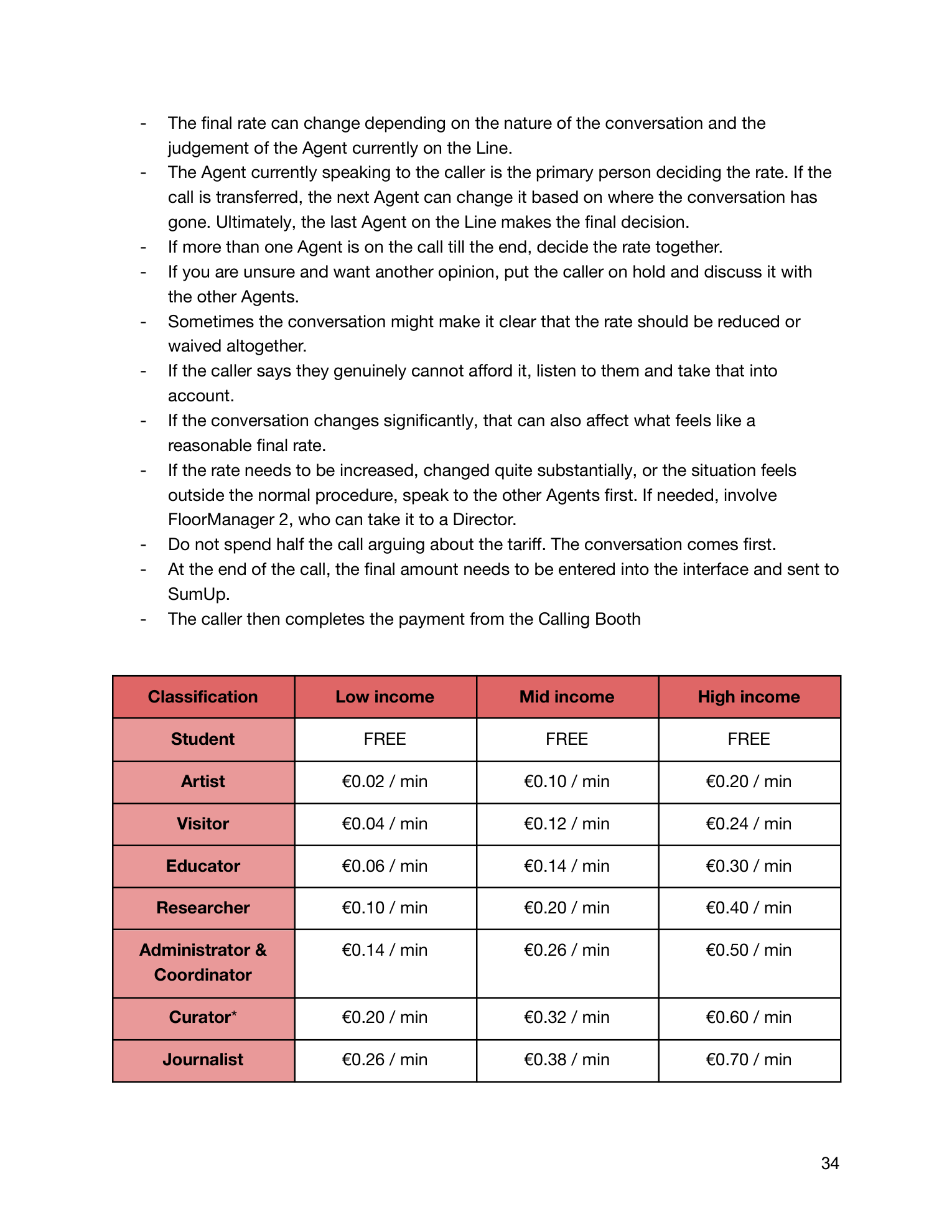
-
The final rate can change depending on the nature of the conversation and the
judgement of the Agent currently on the Line.
-
The Agent currently speaking to the caller is the primary person deciding the rate. If the
call is transferred, the next Agent can change it based on where the conversation has
gone. Ultimately, the last Agent on the Line makes the final decision.
-
If more than one Agent is on the call till the end, decide the rate together.
-
If you are unsure and want another opinion, put the caller on hold and discuss it with
the other Agents.
-
Sometimes the conversation might make it clear that the rate should be reduced or
waived altogether.
-
If the caller says they genuinely cannot afford it, listen to them and take that into
account.
-
If the conversation changes significantly, that can also affect what feels like a
reasonable final rate.
-
If the rate needs to be increased, changed quite substantially, or the situation feels
outside the normal procedure, speak to the other Agents first. If needed, involve
FloorManager 2, who can take it to a Director.
-
Do not spend half the call arguing about the tariff. The conversation comes first.
-
At the end of the call, the final amount needs to be entered into the interface and sent to
SumUp.
-
The caller then completes the payment from the Calling Booth
Classification
Low income
Mid income
High income
Student
FREE
FREE
FREE
Artist
€0.02 / min
€0.10 / min
€0.20 / min
Visitor
€0.04 / min
€0.12 / min
€0.24 / min
Educator
€0.06 / min
€0.14 / min
€0.30 / min
Researcher
€0.10 / min
€0.20 / min
€0.40 / min
Administrator &
Coordinator
€0.14 / min
€0.26 / min
€0.50 / min
Curator*
€0.20 / min
€0.32 / min
€0.60 / min
Journalist
€0.26 / min
€0.38 / min
€0.70 / min
34
The final rate can change depending on the nature of the conversation and the
judgement of the Agent currently on the Line.
-
The Agent currently speaking to the caller is the primary person deciding the rate. If the
call is transferred, the next Agent can change it based on where the conversation has
gone. Ultimately, the last Agent on the Line makes the final decision.
-
If more than one Agent is on the call till the end, decide the rate together.
-
If you are unsure and want another opinion, put the caller on hold and discuss it with
the other Agents.
-
Sometimes the conversation might make it clear that the rate should be reduced or
waived altogether.
-
If the caller says they genuinely cannot afford it, listen to them and take that into
account.
-
If the conversation changes significantly, that can also affect what feels like a
reasonable final rate.
-
If the rate needs to be increased, changed quite substantially, or the situation feels
outside the normal procedure, speak to the other Agents first. If needed, involve
FloorManager 2, who can take it to a Director.
-
Do not spend half the call arguing about the tariff. The conversation comes first.
-
At the end of the call, the final amount needs to be entered into the interface and sent to
SumUp.
-
The caller then completes the payment from the Calling Booth
Classification
Low income
Mid income
High income
Student
FREE
FREE
FREE
Artist
€0.02 / min
€0.10 / min
€0.20 / min
Visitor
€0.04 / min
€0.12 / min
€0.24 / min
Educator
€0.06 / min
€0.14 / min
€0.30 / min
Researcher
€0.10 / min
€0.20 / min
€0.40 / min
Administrator &
Coordinator
€0.14 / min
€0.26 / min
€0.50 / min
Curator*
€0.20 / min
€0.32 / min
€0.60 / min
Journalist
€0.26 / min
€0.38 / min
€0.70 / min
34
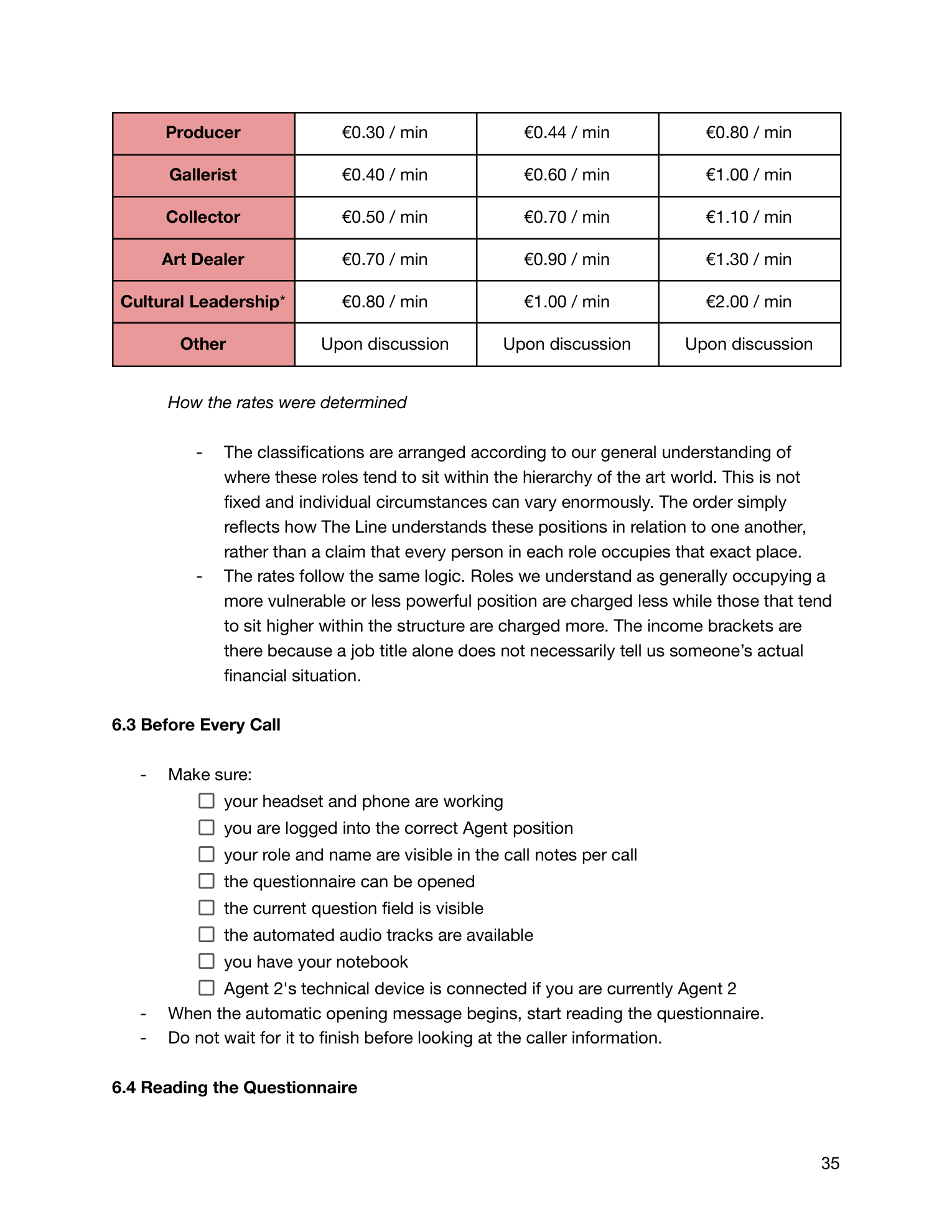
Producer
€0.30 / min
€0.44 / min
€0.80 / min
Gallerist
€0.40 / min
€0.60 / min
€1.00 / min
Collector
€0.50 / min
€0.70 / min
€1.10 / min
Art Dealer
€0.70 / min
€0.90 / min
€1.30 / min
Cultural Leadership*
€0.80 / min
€1.00 / min
€2.00 / min
Other
Upon discussion
Upon discussion
Upon discussion
How the rates were determined
-
The classifications are arranged according to our general understanding of
where these roles tend to sit within the hierarchy of the art world. This is not
fixed and individual circumstances can vary enormously. The order simply
reflects how The Line understands these positions in relation to one another,
rather than a claim that every person in each role occupies that exact place.
-
The rates follow the same logic. Roles we understand as generally occupying a
more vulnerable or less powerful position are charged less while those that tend
to sit higher within the structure are charged more. The income brackets are
there because a job title alone does not necessarily tell us someone’s actual
financial situation.
6.3 Before Every Call
-
Make sure:
your headset and phone are working
you are logged into the correct Agent position
your role and name are visible in the call notes per call
the questionnaire can be opened
the current question field is visible
the automated audio tracks are available
you have your notebook
Agent 2's technical device is connected if you are currently Agent 2
-
When the automatic opening message begins, start reading the questionnaire.
-
Do not wait for it to finish before looking at the caller information.
6.4 Reading the Questionnaire
35
€0.30 / min
€0.44 / min
€0.80 / min
Gallerist
€0.40 / min
€0.60 / min
€1.00 / min
Collector
€0.50 / min
€0.70 / min
€1.10 / min
Art Dealer
€0.70 / min
€0.90 / min
€1.30 / min
Cultural Leadership*
€0.80 / min
€1.00 / min
€2.00 / min
Other
Upon discussion
Upon discussion
Upon discussion
How the rates were determined
-
The classifications are arranged according to our general understanding of
where these roles tend to sit within the hierarchy of the art world. This is not
fixed and individual circumstances can vary enormously. The order simply
reflects how The Line understands these positions in relation to one another,
rather than a claim that every person in each role occupies that exact place.
-
The rates follow the same logic. Roles we understand as generally occupying a
more vulnerable or less powerful position are charged less while those that tend
to sit higher within the structure are charged more. The income brackets are
there because a job title alone does not necessarily tell us someone’s actual
financial situation.
6.3 Before Every Call
-
Make sure:
your headset and phone are working
you are logged into the correct Agent position
your role and name are visible in the call notes per call
the questionnaire can be opened
the current question field is visible
the automated audio tracks are available
you have your notebook
Agent 2's technical device is connected if you are currently Agent 2
-
When the automatic opening message begins, start reading the questionnaire.
-
Do not wait for it to finish before looking at the caller information.
6.4 Reading the Questionnaire
35
-
The questionnaire is a starting point.
-
Look at:
how they describe their relationship to the arts
their income category
who is funding the conversation
what they selected under What The Line Can Do
whether they entered a question
anything that immediately stands out to you
-
Do not assume that the category they selected is where the conversation will remain.
-
Sometimes the most interesting piece of information is not their stated question.
6.5 The Current Question
-
There is a current question field on the Agent interface. Every Agent is responsible for
keeping it updated while they are speaking to the caller.
-
A caller may begin by asking one thing and realise halfway through that the actual
question is something completely different. When that happens, update the question in
the interface.
-
You do not need to rewrite it every time they phrase the same thing slightly differently.
Update it when you feel the actual focus of the conversation has genuinely shifted.
-
For example, “How do I find a gallery to represent me?” might later become “Why do I
feel like having a gallery would prove that I am a real artist?” Those are different
questions so update it accordingly.
-
If the question changes again, update it again.
-
If the call is transferred, the next Agent should read the current question before
continuing and keep updating it from there.
-
The movement of the question is part of the work. Every time it changes, the updated
version appears anonymously on the screen behind the audience, without the caller’s
name or personal details. Over time, this lets people see the choreography of the
conversation itself and how a question moves from where it began to where it
eventually ends up.
6.0.10 Updating the Question
-
On the agent side of the interface, there will be a text box showing the caller’s current
question. Every agent is responsible for keeping this updated while they are speaking to
the caller.
-
A person may begin the call asking one thing and realise halfway through that the actual
question is something completely different. When that happens, update the question in
the interface. If it changes again, update it again.
36
The questionnaire is a starting point.
-
Look at:
how they describe their relationship to the arts
their income category
who is funding the conversation
what they selected under What The Line Can Do
whether they entered a question
anything that immediately stands out to you
-
Do not assume that the category they selected is where the conversation will remain.
-
Sometimes the most interesting piece of information is not their stated question.
6.5 The Current Question
-
There is a current question field on the Agent interface. Every Agent is responsible for
keeping it updated while they are speaking to the caller.
-
A caller may begin by asking one thing and realise halfway through that the actual
question is something completely different. When that happens, update the question in
the interface.
-
You do not need to rewrite it every time they phrase the same thing slightly differently.
Update it when you feel the actual focus of the conversation has genuinely shifted.
-
For example, “How do I find a gallery to represent me?” might later become “Why do I
feel like having a gallery would prove that I am a real artist?” Those are different
questions so update it accordingly.
-
If the question changes again, update it again.
-
If the call is transferred, the next Agent should read the current question before
continuing and keep updating it from there.
-
The movement of the question is part of the work. Every time it changes, the updated
version appears anonymously on the screen behind the audience, without the caller’s
name or personal details. Over time, this lets people see the choreography of the
conversation itself and how a question moves from where it began to where it
eventually ends up.
6.0.10 Updating the Question
-
On the agent side of the interface, there will be a text box showing the caller’s current
question. Every agent is responsible for keeping this updated while they are speaking to
the caller.
-
A person may begin the call asking one thing and realise halfway through that the actual
question is something completely different. When that happens, update the question in
the interface. If it changes again, update it again.
36
-
Do not keep rewriting it because somebody has simply phrased the same question
differently.
-
Update it when you feel that the actual focus of the conversation has shifted.
-
The questions entered into the interface will appear on a display inside the Agent Booth.
This allows us to trace the movement of the question across the call, from what
somebody thought they were asking when they arrived to where the conversation
eventually took them.
-
If a call is transferred, the next agent should read the current question before continuing
and keep updating it from there.
6.6 Call Log
-
Whenever you join a conversation, add your role and name to the call notes on your
interface.
-
For example: Agent 1, [NAME], Agent 3, [NAME]
-
If several Agents are involved in the same call, all of them should appear.
-
Keep the notes short and only add something if it will actually be useful to the next
person or to the team later.
-
Do not write a transcript. The call is already being recorded.
6.7 Holding a Call
-
Use hold when the Agents need a moment without the caller hearing the internal
discussion.
-
You might need to:
decide who should take the call next
disagree about the direction of the conversation
check something
discuss a difficult situation
give an Agent a moment
bring another Agent into the call
-
(Suggested) Hold Script:
-
Play the appropriate hold track.
37
Do not keep rewriting it because somebody has simply phrased the same question
differently.
-
Update it when you feel that the actual focus of the conversation has shifted.
-
The questions entered into the interface will appear on a display inside the Agent Booth.
This allows us to trace the movement of the question across the call, from what
somebody thought they were asking when they arrived to where the conversation
eventually took them.
-
If a call is transferred, the next agent should read the current question before continuing
and keep updating it from there.
6.6 Call Log
-
Whenever you join a conversation, add your role and name to the call notes on your
interface.
-
For example: Agent 1, [NAME], Agent 3, [NAME]
-
If several Agents are involved in the same call, all of them should appear.
-
Keep the notes short and only add something if it will actually be useful to the next
person or to the team later.
-
Do not write a transcript. The call is already being recorded.
6.7 Holding a Call
-
Use hold when the Agents need a moment without the caller hearing the internal
discussion.
-
You might need to:
decide who should take the call next
disagree about the direction of the conversation
check something
discuss a difficult situation
give an Agent a moment
bring another Agent into the call
-
(Suggested) Hold Script:
-
Play the appropriate hold track.
37
-
While it plays, discuss.
6.8 Transfers
-
A transfer should not feel like throwing the caller off. So before transferring tell them
what is happening.
-
(Suggested) Standard Transfer:
-
Play the transfer track.
-
While the track is playing:
1. tell the next Agent why you are transferring the call
2. point them towards the current question
3. mention anything they need to know that is not obvious from the call or the log
4. complete the transfer
-
The next Agent then takes over.
-
The process can repeat as many times as the conversation genuinely requires.
-
A caller can move: Agent 1 → Agent 2 → Agent 1 → Agent 3 → Agent 1
-
There is no requirement that they move through all three.
-
(Suggested) And when receiving the call:
-
Update the current question when necessary.
6.9 Bringing Another Agent In Without Fully Transferring
-
Sometimes you do not need to leave the conversation. You can ask another Agent to
join you.
-
The caller should already understand that the call is being heard by the Agents in the
booth. However, if you want another Agent to actively join the conversation, let the
caller know and check that they are comfortable with it first.
-
(Suggested) You can say:
38
While it plays, discuss.
6.8 Transfers
-
A transfer should not feel like throwing the caller off. So before transferring tell them
what is happening.
-
(Suggested) Standard Transfer:
-
Play the transfer track.
-
While the track is playing:
1. tell the next Agent why you are transferring the call
2. point them towards the current question
3. mention anything they need to know that is not obvious from the call or the log
4. complete the transfer
-
The next Agent then takes over.
-
The process can repeat as many times as the conversation genuinely requires.
-
A caller can move: Agent 1 → Agent 2 → Agent 1 → Agent 3 → Agent 1
-
There is no requirement that they move through all three.
-
(Suggested) And when receiving the call:
-
Update the current question when necessary.
6.9 Bringing Another Agent In Without Fully Transferring
-
Sometimes you do not need to leave the conversation. You can ask another Agent to
join you.
-
The caller should already understand that the call is being heard by the Agents in the
booth. However, if you want another Agent to actively join the conversation, let the
caller know and check that they are comfortable with it first.
-
(Suggested) You can say:
38
-
If they are comfortable with it, put them on hold if needed, briefly catch the other Agent
up, and bring them in.
-
Two Agents can speak to the caller together, and all three can join if it genuinely helps.
-
If the caller does not feel comfortable with another person joining, respect that and
continue with the call yourself.
-
Do not turn every call into a panel discussion.
6.10 If You Disagree With Another Agent
-
Be sure to say so.
-
(Suggested) If you hear a conversation moving somewhere that does not feel right:
-
Then talk to each other.
-
You are allowed to disagree about what the caller needs.
-
This is not about policing each other. The point is to keep each other accountable and
allow the conversation to contain more than one perspective.
6.11 If You Do Not Know
-
You are allowed not to know.
-
Do not manufacture information because somebody has called a hotline.
-
If it is factual, Agent 2 can research it.
-
If nobody knows and it becomes an operational question, involve Floor Manager 2.
-
If the entire chain reaches the end of what anyone knows, the Directors can decide
whether the panic procedure is needed.
6.12 If Someone Approaches the Agent Booth
-
Do not stop working to begin a second live conversation with somebody standing
outside.
-
Say:
39
If they are comfortable with it, put them on hold if needed, briefly catch the other Agent
up, and bring them in.
-
Two Agents can speak to the caller together, and all three can join if it genuinely helps.
-
If the caller does not feel comfortable with another person joining, respect that and
continue with the call yourself.
-
Do not turn every call into a panel discussion.
6.10 If You Disagree With Another Agent
-
Be sure to say so.
-
(Suggested) If you hear a conversation moving somewhere that does not feel right:
-
Then talk to each other.
-
You are allowed to disagree about what the caller needs.
-
This is not about policing each other. The point is to keep each other accountable and
allow the conversation to contain more than one perspective.
6.11 If You Do Not Know
-
You are allowed not to know.
-
Do not manufacture information because somebody has called a hotline.
-
If it is factual, Agent 2 can research it.
-
If nobody knows and it becomes an operational question, involve Floor Manager 2.
-
If the entire chain reaches the end of what anyone knows, the Directors can decide
whether the panic procedure is needed.
6.12 If Someone Approaches the Agent Booth
-
Do not stop working to begin a second live conversation with somebody standing
outside.
-
Say:
39
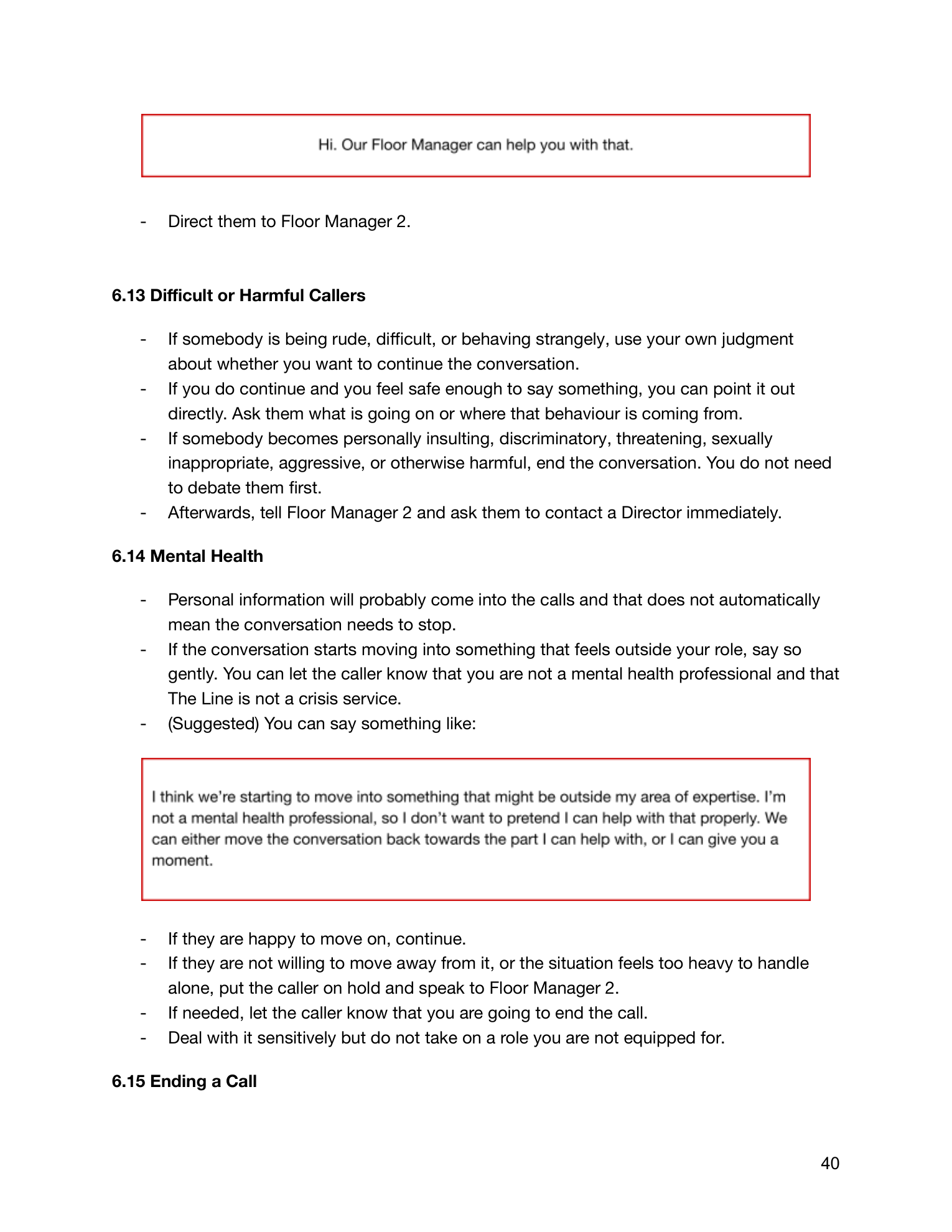
-
Direct them to Floor Manager 2.
6.13 Difficult or Harmful Callers
-
If somebody is being rude, difficult, or behaving strangely, use your own judgment
about whether you want to continue the conversation.
-
If you do continue and you feel safe enough to say something, you can point it out
directly. Ask them what is going on or where that behaviour is coming from.
-
If somebody becomes personally insulting, discriminatory, threatening, sexually
inappropriate, aggressive, or otherwise harmful, end the conversation. You do not need
to debate them first.
-
Afterwards, tell Floor Manager 2 and ask them to contact a Director immediately.
6.14 Mental Health
-
Personal information will probably come into the calls and that does not automatically
mean the conversation needs to stop.
-
If the conversation starts moving into something that feels outside your role, say so
gently. You can let the caller know that you are not a mental health professional and that
The Line is not a crisis service.
-
(Suggested) You can say something like:
-
If they are happy to move on, continue.
-
If they are not willing to move away from it, or the situation feels too heavy to handle
alone, put the caller on hold and speak to Floor Manager 2.
-
If needed, let the caller know that you are going to end the call.
-
Deal with it sensitively but do not take on a role you are not equipped for.
6.15 Ending a Call
40
Direct them to Floor Manager 2.
6.13 Difficult or Harmful Callers
-
If somebody is being rude, difficult, or behaving strangely, use your own judgment
about whether you want to continue the conversation.
-
If you do continue and you feel safe enough to say something, you can point it out
directly. Ask them what is going on or where that behaviour is coming from.
-
If somebody becomes personally insulting, discriminatory, threatening, sexually
inappropriate, aggressive, or otherwise harmful, end the conversation. You do not need
to debate them first.
-
Afterwards, tell Floor Manager 2 and ask them to contact a Director immediately.
6.14 Mental Health
-
Personal information will probably come into the calls and that does not automatically
mean the conversation needs to stop.
-
If the conversation starts moving into something that feels outside your role, say so
gently. You can let the caller know that you are not a mental health professional and that
The Line is not a crisis service.
-
(Suggested) You can say something like:
-
If they are happy to move on, continue.
-
If they are not willing to move away from it, or the situation feels too heavy to handle
alone, put the caller on hold and speak to Floor Manager 2.
-
If needed, let the caller know that you are going to end the call.
-
Deal with it sensitively but do not take on a role you are not equipped for.
6.15 Ending a Call
40
-
Every call ends as either:
1. RESOLVED
The conversation reached a natural stopping point and what the caller came
which has been addressed in some way. Resolved does not necessarily mean
solved. The caller’s intentions may have changed during the conversation and
the question will probably have shifted with them.
Sometimes resolved simply means the caller leaves with a clearer sense of what
they want to do next, or even just a clearer sense of the conversation they have
been having.
2. CUT
The conversation stopped without reaching that point.
This could happen because:
the caller disconnected
there was a technical problem
the caller chose to stop suddenly
an Agent had to end the call
harmful behaviour meant the call could not continue
Leave a brief reason in the log when a call is marked CUT.
6.16 Breaks
-
If you need a break, tell Floor Manager 2.
-
You do not need to wait until you are completely exhausted.
-
A Director can cover an Agent position.
-
You can leave the booth, have a smoke, walk around, sit somewhere else, or remain in
the booth without actively working.
-
Do not rotate roles in the middle of a call.
-
Finish the conversation first.
2.6 Rotation and Handover in the Agent Booth
-
Roles will generally rotate amongst the Agents in the Agent Booth on an hourly or
bi-hourly basis according to the staff schedule. This can change depending on how
people are feeling and what is happening in the space.
-
Do not rotate roles in the middle of a call. Finish the conversation first.
-
When it is time to rotate, Agent 1 places the system offline. The hold message is played
and no new caller enters during the changeover.
41
Every call ends as either:
1. RESOLVED
The conversation reached a natural stopping point and what the caller came
which has been addressed in some way. Resolved does not necessarily mean
solved. The caller’s intentions may have changed during the conversation and
the question will probably have shifted with them.
Sometimes resolved simply means the caller leaves with a clearer sense of what
they want to do next, or even just a clearer sense of the conversation they have
been having.
2. CUT
The conversation stopped without reaching that point.
This could happen because:
the caller disconnected
there was a technical problem
the caller chose to stop suddenly
an Agent had to end the call
harmful behaviour meant the call could not continue
Leave a brief reason in the log when a call is marked CUT.
6.16 Breaks
-
If you need a break, tell Floor Manager 2.
-
You do not need to wait until you are completely exhausted.
-
A Director can cover an Agent position.
-
You can leave the booth, have a smoke, walk around, sit somewhere else, or remain in
the booth without actively working.
-
Do not rotate roles in the middle of a call.
-
Finish the conversation first.
2.6 Rotation and Handover in the Agent Booth
-
Roles will generally rotate amongst the Agents in the Agent Booth on an hourly or
bi-hourly basis according to the staff schedule. This can change depending on how
people are feeling and what is happening in the space.
-
Do not rotate roles in the middle of a call. Finish the conversation first.
-
When it is time to rotate, Agent 1 places the system offline. The hold message is played
and no new caller enters during the changeover.
41
-
The Onboarding Agent is informed that The Line is temporarily unavailable, and the
Floor Manager places the CURRENTLY UNAVAILABLE, PLEASE COME BACK LATER
sandwich board outside the Calling Booth.
-
The handover should take around five to fifteen minutes.
-
A handover does not need to become another meeting. The main purpose is simply to
make sure nothing unfinished disappears when people change positions.
-
Mention anything that still needs attention. This might be an open complaint, someone
waiting to make a purchase, a technical issue, or something unusual that the next
person should know.
-
You can also quickly compare notes on what it felt like occupying that particular role, or
mention anything you discovered that might be useful to the person taking over.
-
Use the rest of the handover time to take a stretch, step away for a moment, or reset
before moving into the new position.
-
Once everyone is ready, move into the new roles, remove the sign and reopen The Line.
-
In the call log, it is essential that the current Agent is always identified in the notes.
Write the role and your name, for example Agent 1, [name], Agent 2, [name], or Agent 3,
[name].
-
Then switch over and start again.
2.7 Coupons
-
If a caller mentions at the beginning of the call that they have a coupon, first ask which
one they have.
-
There are two types:
5-minute coupon
These are generally given when something has gone wrong on our side such as
a technical error, a failed or interrupted call, or when the Onboarding Agent or
Floor Manager feels some compensation is appropriate.
10-minute coupon
These are given to people who have taken part in one of the tours.
-
A coupon does not automatically mean that the caller receives five or ten free minutes.
Treat it as a suggestion to take into account when deciding the final tariff. You are
completely allowed to apply it, partially account for it, or decide not to use it if that
makes more sense in the context of the call.
-
Keep the coupon in mind while the conversation is happening and have a rough sense
of how long the call has lasted. Do not let it dictate how the conversation itself unfolds.
-
At the end of the call, when you are deciding the final rate:
If you want to apply a 5-minute coupon, you can subtract five minutes from the
total chargeable call time.
42
The Onboarding Agent is informed that The Line is temporarily unavailable, and the
Floor Manager places the CURRENTLY UNAVAILABLE, PLEASE COME BACK LATER
sandwich board outside the Calling Booth.
-
The handover should take around five to fifteen minutes.
-
A handover does not need to become another meeting. The main purpose is simply to
make sure nothing unfinished disappears when people change positions.
-
Mention anything that still needs attention. This might be an open complaint, someone
waiting to make a purchase, a technical issue, or something unusual that the next
person should know.
-
You can also quickly compare notes on what it felt like occupying that particular role, or
mention anything you discovered that might be useful to the person taking over.
-
Use the rest of the handover time to take a stretch, step away for a moment, or reset
before moving into the new position.
-
Once everyone is ready, move into the new roles, remove the sign and reopen The Line.
-
In the call log, it is essential that the current Agent is always identified in the notes.
Write the role and your name, for example Agent 1, [name], Agent 2, [name], or Agent 3,
[name].
-
Then switch over and start again.
2.7 Coupons
-
If a caller mentions at the beginning of the call that they have a coupon, first ask which
one they have.
-
There are two types:
5-minute coupon
These are generally given when something has gone wrong on our side such as
a technical error, a failed or interrupted call, or when the Onboarding Agent or
Floor Manager feels some compensation is appropriate.
10-minute coupon
These are given to people who have taken part in one of the tours.
-
A coupon does not automatically mean that the caller receives five or ten free minutes.
Treat it as a suggestion to take into account when deciding the final tariff. You are
completely allowed to apply it, partially account for it, or decide not to use it if that
makes more sense in the context of the call.
-
Keep the coupon in mind while the conversation is happening and have a rough sense
of how long the call has lasted. Do not let it dictate how the conversation itself unfolds.
-
At the end of the call, when you are deciding the final rate:
If you want to apply a 5-minute coupon, you can subtract five minutes from the
total chargeable call time.
42

If you want to apply a 10-minute coupon, you can subtract ten minutes from
the total chargeable call time.
You can also decide not to apply the full suggested deduction.
-
Once you have made that decision, calculate the final amount based on the adjusted
call time and enter the tariff into the system.
43
the total chargeable call time.
You can also decide not to apply the full suggested deduction.
-
Once you have made that decision, calculate the final amount based on the adjusted
call time and enter the tariff into the system.
43
Before the call begins, the visitor fills out a short questionnaire through the digital interface in
the calling booth. The information is sent directly to the Agent Booth.
The questionnaire gives you some basic information about who is calling. It tells you what role
they occupy within the art sector (if any), what income group they fall into, who is funding the
conversation, and what they think they want from The Line. Some people will already know
exactly why they are calling while others will absolutely not. The questionnaire is there to give
us a place to start.
The visitor can choose one or more of the following options:
6.0.1 Give a Practical Answer
This usually means the caller wants something concrete. This can be a question about
fees, contracts, production, applications, professional practice, sales, funding or how
something works.
-
Agent 1 receives the call first and checks what the practical question actually is.
-
Agent 2 usually takes over once the question is clear. Agent 2 has access to the internet
and is responsible for looking into technical information when needed.
-
Agent 3 is normally not required unless the practical question turns into something else
while the conversation is happening.
-
If the question changes, the agent can transfer the call again.
6.0.2 Offer a Critical Perspective
This can go to any of the three agents depending on what kind of perspective the caller
wants.
-
Agent 1 first works out what the caller is actually asking to have looked at. If it is a
broad question and they mainly want someone to think it through with them, Agent 1
can continue the conversation.
-
If the question is about how something works within the art world, or about a system,
institution, professional situation, fee, structure, or working condition, it can move to
Agent 2.
-
If they want the situation looked at from a more abstract, philosophical, interpersonal, or
deliberately irrational angle, it can move to Agent 3.
44
the calling booth. The information is sent directly to the Agent Booth.
The questionnaire gives you some basic information about who is calling. It tells you what role
they occupy within the art sector (if any), what income group they fall into, who is funding the
conversation, and what they think they want from The Line. Some people will already know
exactly why they are calling while others will absolutely not. The questionnaire is there to give
us a place to start.
The visitor can choose one or more of the following options:
6.0.1 Give a Practical Answer
This usually means the caller wants something concrete. This can be a question about
fees, contracts, production, applications, professional practice, sales, funding or how
something works.
-
Agent 1 receives the call first and checks what the practical question actually is.
-
Agent 2 usually takes over once the question is clear. Agent 2 has access to the internet
and is responsible for looking into technical information when needed.
-
Agent 3 is normally not required unless the practical question turns into something else
while the conversation is happening.
-
If the question changes, the agent can transfer the call again.
6.0.2 Offer a Critical Perspective
This can go to any of the three agents depending on what kind of perspective the caller
wants.
-
Agent 1 first works out what the caller is actually asking to have looked at. If it is a
broad question and they mainly want someone to think it through with them, Agent 1
can continue the conversation.
-
If the question is about how something works within the art world, or about a system,
institution, professional situation, fee, structure, or working condition, it can move to
Agent 2.
-
If they want the situation looked at from a more abstract, philosophical, interpersonal, or
deliberately irrational angle, it can move to Agent 3.
44
6.0.3 Register a Complaint
A complaint can be about anything. It can be about an institution, an artist, a gallery, an
art fair, a working condition, a person, a system, or something much smaller and
possibly petty.
-
Agent 1 is responsible for registering the complaint. There will be a standard complaint
form on the Agent 1 desk. Agent 1 fills this in with the caller and makes the complaint
official within The Line. The caller may need another conversation before the complaint
is registered.
-
If the complaint is very technical, Agent 2 can speak to them first and help clarify what
has happened.
-
If the complaint is more personal, strange, philosophical, or difficult to place, Agent 3
can speak to them first.
After that, the call returns to Agent 1, who registers the complaint. The complaint form
is always handled by Agent 1.
6.0.4 Advice on a Decision
This depends on what kind of decision the caller is trying to make.
-
Agent 1 begins by narrowing down the decision. What are they actually deciding? What
is making the decision difficult? What do they want from us?
-
If they need practical information before they can make the decision, the call goes to
Agent 2.
-
If the decision is more about doubt, instinct, fear, ambition, relationships, or how they
personally understand the situation, it may go to Agent 3.
-
The caller can also stay with Agent 1 if they mainly need someone to help them lay the
situation out more clearly.
We are not necessarily making the decision for them. We are helping them understand
what the decision actually is.
6.0.5 Help Navigate a System or an Institution
This normally goes to Agent 2.
-
Agent 1 still receives the call and gets enough information to understand what system
or institution the caller is dealing with.
-
Once that is clear, the call moves to Agent 2. Agent 2 can help them work through the
structure, understand what is expected of them, look up information if needed, and
figure out what they can actually do next.
45
A complaint can be about anything. It can be about an institution, an artist, a gallery, an
art fair, a working condition, a person, a system, or something much smaller and
possibly petty.
-
Agent 1 is responsible for registering the complaint. There will be a standard complaint
form on the Agent 1 desk. Agent 1 fills this in with the caller and makes the complaint
official within The Line. The caller may need another conversation before the complaint
is registered.
-
If the complaint is very technical, Agent 2 can speak to them first and help clarify what
has happened.
-
If the complaint is more personal, strange, philosophical, or difficult to place, Agent 3
can speak to them first.
After that, the call returns to Agent 1, who registers the complaint. The complaint form
is always handled by Agent 1.
6.0.4 Advice on a Decision
This depends on what kind of decision the caller is trying to make.
-
Agent 1 begins by narrowing down the decision. What are they actually deciding? What
is making the decision difficult? What do they want from us?
-
If they need practical information before they can make the decision, the call goes to
Agent 2.
-
If the decision is more about doubt, instinct, fear, ambition, relationships, or how they
personally understand the situation, it may go to Agent 3.
-
The caller can also stay with Agent 1 if they mainly need someone to help them lay the
situation out more clearly.
We are not necessarily making the decision for them. We are helping them understand
what the decision actually is.
6.0.5 Help Navigate a System or an Institution
This normally goes to Agent 2.
-
Agent 1 still receives the call and gets enough information to understand what system
or institution the caller is dealing with.
-
Once that is clear, the call moves to Agent 2. Agent 2 can help them work through the
structure, understand what is expected of them, look up information if needed, and
figure out what they can actually do next.
45
-
If the problem turns out not to be the system/institution itself, the call can be transferred
again to another agent.
-
If they realise they are actually trying to make a decision, it can return to Agent 1.
-
If the conversation starts moving somewhere less practical, it can go to Agent 3.
6.0.6 Hold an Open Conversation
This is for callers who may not want a solution at all. They may just want to talk about
something, test an idea, say something out loud, yap about something inconsequential,
gossip, or see where the conversation goes.
-
Agent 1 starts the conversation. There is no need to immediately decide where the call
should go.
-
If something more practical appears, it can move to Agent 2.
-
If the conversation becomes more abstract, personal or starts asking for another way of
looking at the situation, it can move to Agent 3.
-
It can also simply stay with Agent 1. There does not need to be an answer at the end.
6.0.7 When More Than One Applies
The caller can select more than one option. This might be completely normal.
-
Agent 1 begins the call and works out what needs to happen first. If it is obvious that
more than one agent will be needed, Agent 1 can place the caller on hold.
-
While the caller is on hold, the agents can quickly discuss what is happening and
decide how the call should move.
-
You can decide who speaks first and whether the caller needs to come back to Agent 1
at the end. There is no fixed order beyond Agent 1 receiving the call first.
6.0.8 When None of Them Apply
There will be (many) times when none of the options will fit. The caller will not know why
they are calling or they will have selected something simply because they had to
choose something.
-
This stays with Agent 1 at first. Agent 1 should try to understand why the person
decided to call and what they are actually trying to talk about. There are guiding
questions later in the manual for this.
-
Once the question becomes clearer, Agent 1 can decide whether the call stays with
them, moves to Agent 2, or moves to Agent 3.
Do not force the caller into one of the categories if the category is not useful.
46
If the problem turns out not to be the system/institution itself, the call can be transferred
again to another agent.
-
If they realise they are actually trying to make a decision, it can return to Agent 1.
-
If the conversation starts moving somewhere less practical, it can go to Agent 3.
6.0.6 Hold an Open Conversation
This is for callers who may not want a solution at all. They may just want to talk about
something, test an idea, say something out loud, yap about something inconsequential,
gossip, or see where the conversation goes.
-
Agent 1 starts the conversation. There is no need to immediately decide where the call
should go.
-
If something more practical appears, it can move to Agent 2.
-
If the conversation becomes more abstract, personal or starts asking for another way of
looking at the situation, it can move to Agent 3.
-
It can also simply stay with Agent 1. There does not need to be an answer at the end.
6.0.7 When More Than One Applies
The caller can select more than one option. This might be completely normal.
-
Agent 1 begins the call and works out what needs to happen first. If it is obvious that
more than one agent will be needed, Agent 1 can place the caller on hold.
-
While the caller is on hold, the agents can quickly discuss what is happening and
decide how the call should move.
-
You can decide who speaks first and whether the caller needs to come back to Agent 1
at the end. There is no fixed order beyond Agent 1 receiving the call first.
6.0.8 When None of Them Apply
There will be (many) times when none of the options will fit. The caller will not know why
they are calling or they will have selected something simply because they had to
choose something.
-
This stays with Agent 1 at first. Agent 1 should try to understand why the person
decided to call and what they are actually trying to talk about. There are guiding
questions later in the manual for this.
-
Once the question becomes clearer, Agent 1 can decide whether the call stays with
them, moves to Agent 2, or moves to Agent 3.
Do not force the caller into one of the categories if the category is not useful.
46
6.0.9 The Questionnaire Is a Starting Point
The questionnaire tells you what the caller thought they wanted before the conversation
began. That can change very quickly once they start speaking.
Agent 1 should use the information as context but not treat it as a final decision about
where the call needs to go. The point is to listen first, then work out what The Line can
actually do for them. Just as a rule of thumb, the caller does not need to know which
agent they need. That is our job.
47
The questionnaire tells you what the caller thought they wanted before the conversation
began. That can change very quickly once they start speaking.
Agent 1 should use the information as context but not treat it as a final decision about
where the call needs to go. The point is to listen first, then work out what The Line can
actually do for them. Just as a rule of thumb, the caller does not need to know which
agent they need. That is our job.
47
Agent 1 is the intake position. Every call comes to you first. Your job is to get a sense of what
the caller has actually brought to The Line and where the conversation should go from there.
Sometimes you can answer the question yourself. Sometimes the caller does not really have a
question yet and you help them find one. Sometimes it becomes clear quite quickly that
another Agent would be more useful.
You do not need to transfer a call simply because another Agent exists. If you can reasonably
have the conversation yourself, go right ahead.
6.1.1 Before You Speak
-
While the automatic opening track is playing, have a quick look through the caller’s
questionnaire. Then end the transfer track and begin the call.
-
Do not only look at the question category they entered. Pay attention to anything that
seems particularly specific, unexpected, contradictory, or useful in what they have given
you.
-
Look at what they selected under What The Line Can Do, how they describe their
position in the arts, who is paying for the consultation, and whether anything seems
slightly at odds with the question they have written.
-
Some callers will give you a lot to work with. Others will give you almost nothing.
-
Find the detail that feels most distinct and start there.
-
If the questionnaire is completely unremarkable, extremely vague, or they have
essentially chosen some version of “I don’t know” wherever possible, that is also
information. You can comment on the fact that they seem unsure, evasive, or unwilling
to categorise themselves and use that as your opening. Why is always a good question.
-
You are simply looking for somewhere interesting to begin.
6.1.2 Beginning the Conversation
-
Once the opening track finishes, introduce yourself and start with what they have given
you.
-
You can ask whether they already have a question they want to begin with, or refer
directly to the question they entered and check whether it still feels relevant.
-
(Suggested) For example:
48
the caller has actually brought to The Line and where the conversation should go from there.
Sometimes you can answer the question yourself. Sometimes the caller does not really have a
question yet and you help them find one. Sometimes it becomes clear quite quickly that
another Agent would be more useful.
You do not need to transfer a call simply because another Agent exists. If you can reasonably
have the conversation yourself, go right ahead.
6.1.1 Before You Speak
-
While the automatic opening track is playing, have a quick look through the caller’s
questionnaire. Then end the transfer track and begin the call.
-
Do not only look at the question category they entered. Pay attention to anything that
seems particularly specific, unexpected, contradictory, or useful in what they have given
you.
-
Look at what they selected under What The Line Can Do, how they describe their
position in the arts, who is paying for the consultation, and whether anything seems
slightly at odds with the question they have written.
-
Some callers will give you a lot to work with. Others will give you almost nothing.
-
Find the detail that feels most distinct and start there.
-
If the questionnaire is completely unremarkable, extremely vague, or they have
essentially chosen some version of “I don’t know” wherever possible, that is also
information. You can comment on the fact that they seem unsure, evasive, or unwilling
to categorise themselves and use that as your opening. Why is always a good question.
-
You are simply looking for somewhere interesting to begin.
6.1.2 Beginning the Conversation
-
Once the opening track finishes, introduce yourself and start with what they have given
you.
-
You can ask whether they already have a question they want to begin with, or refer
directly to the question they entered and check whether it still feels relevant.
-
(Suggested) For example:
48
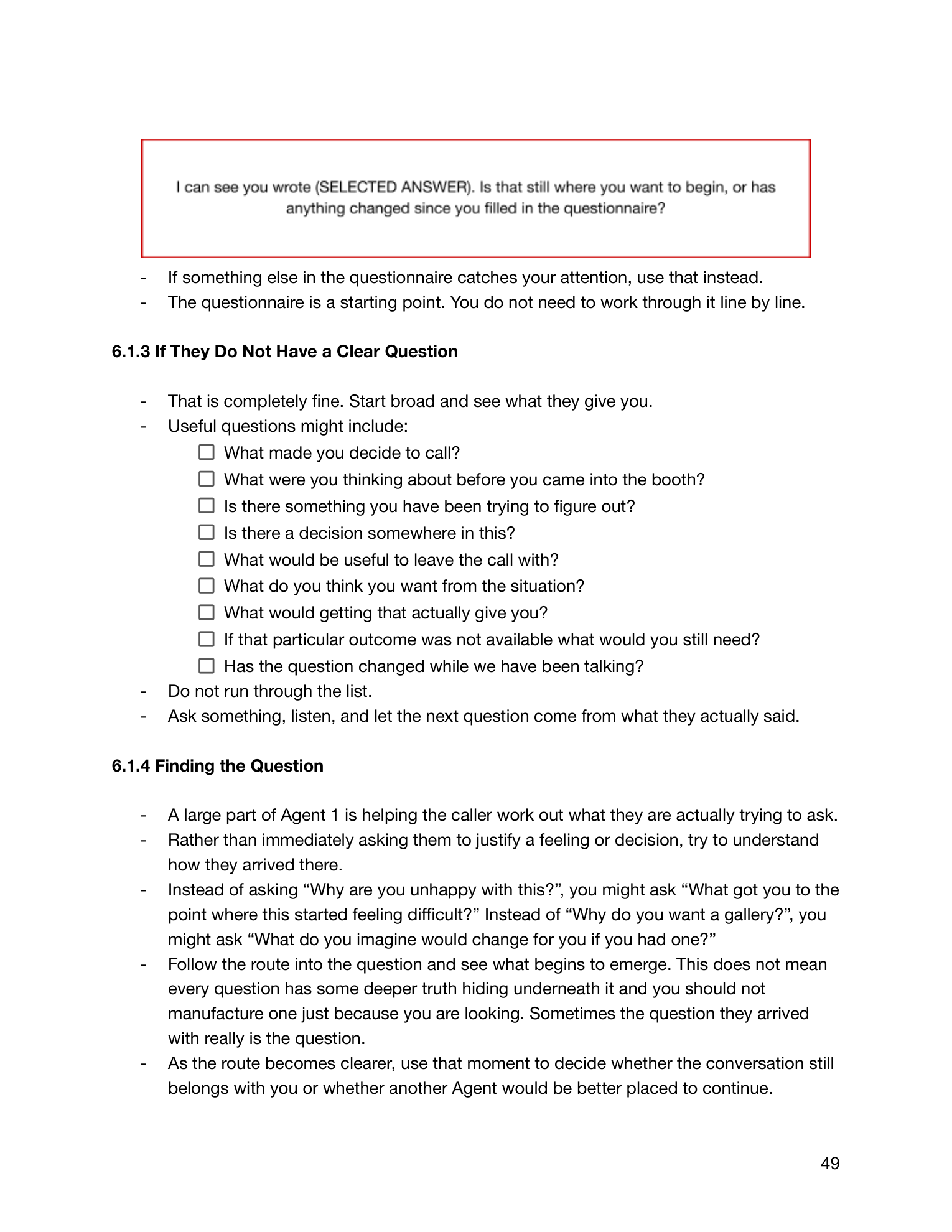
-
If something else in the questionnaire catches your attention, use that instead.
-
The questionnaire is a starting point. You do not need to work through it line by line.
6.1.3 If They Do Not Have a Clear Question
-
That is completely fine. Start broad and see what they give you.
-
Useful questions might include:
What made you decide to call?
What were you thinking about before you came into the booth?
Is there something you have been trying to figure out?
Is there a decision somewhere in this?
What would be useful to leave the call with?
What do you think you want from the situation?
What would getting that actually give you?
If that particular outcome was not available what would you still need?
Has the question changed while we have been talking?
-
Do not run through the list.
-
Ask something, listen, and let the next question come from what they actually said.
6.1.4 Finding the Question
-
A large part of Agent 1 is helping the caller work out what they are actually trying to ask.
-
Rather than immediately asking them to justify a feeling or decision, try to understand
how they arrived there.
-
Instead of asking “Why are you unhappy with this?”, you might ask “What got you to the
point where this started feeling difficult?” Instead of “Why do you want a gallery?”, you
might ask “What do you imagine would change for you if you had one?”
-
Follow the route into the question and see what begins to emerge. This does not mean
every question has some deeper truth hiding underneath it and you should not
manufacture one just because you are looking. Sometimes the question they arrived
with really is the question.
-
As the route becomes clearer, use that moment to decide whether the conversation still
belongs with you or whether another Agent would be better placed to continue.
49
If something else in the questionnaire catches your attention, use that instead.
-
The questionnaire is a starting point. You do not need to work through it line by line.
6.1.3 If They Do Not Have a Clear Question
-
That is completely fine. Start broad and see what they give you.
-
Useful questions might include:
What made you decide to call?
What were you thinking about before you came into the booth?
Is there something you have been trying to figure out?
Is there a decision somewhere in this?
What would be useful to leave the call with?
What do you think you want from the situation?
What would getting that actually give you?
If that particular outcome was not available what would you still need?
Has the question changed while we have been talking?
-
Do not run through the list.
-
Ask something, listen, and let the next question come from what they actually said.
6.1.4 Finding the Question
-
A large part of Agent 1 is helping the caller work out what they are actually trying to ask.
-
Rather than immediately asking them to justify a feeling or decision, try to understand
how they arrived there.
-
Instead of asking “Why are you unhappy with this?”, you might ask “What got you to the
point where this started feeling difficult?” Instead of “Why do you want a gallery?”, you
might ask “What do you imagine would change for you if you had one?”
-
Follow the route into the question and see what begins to emerge. This does not mean
every question has some deeper truth hiding underneath it and you should not
manufacture one just because you are looking. Sometimes the question they arrived
with really is the question.
-
As the route becomes clearer, use that moment to decide whether the conversation still
belongs with you or whether another Agent would be better placed to continue.
49
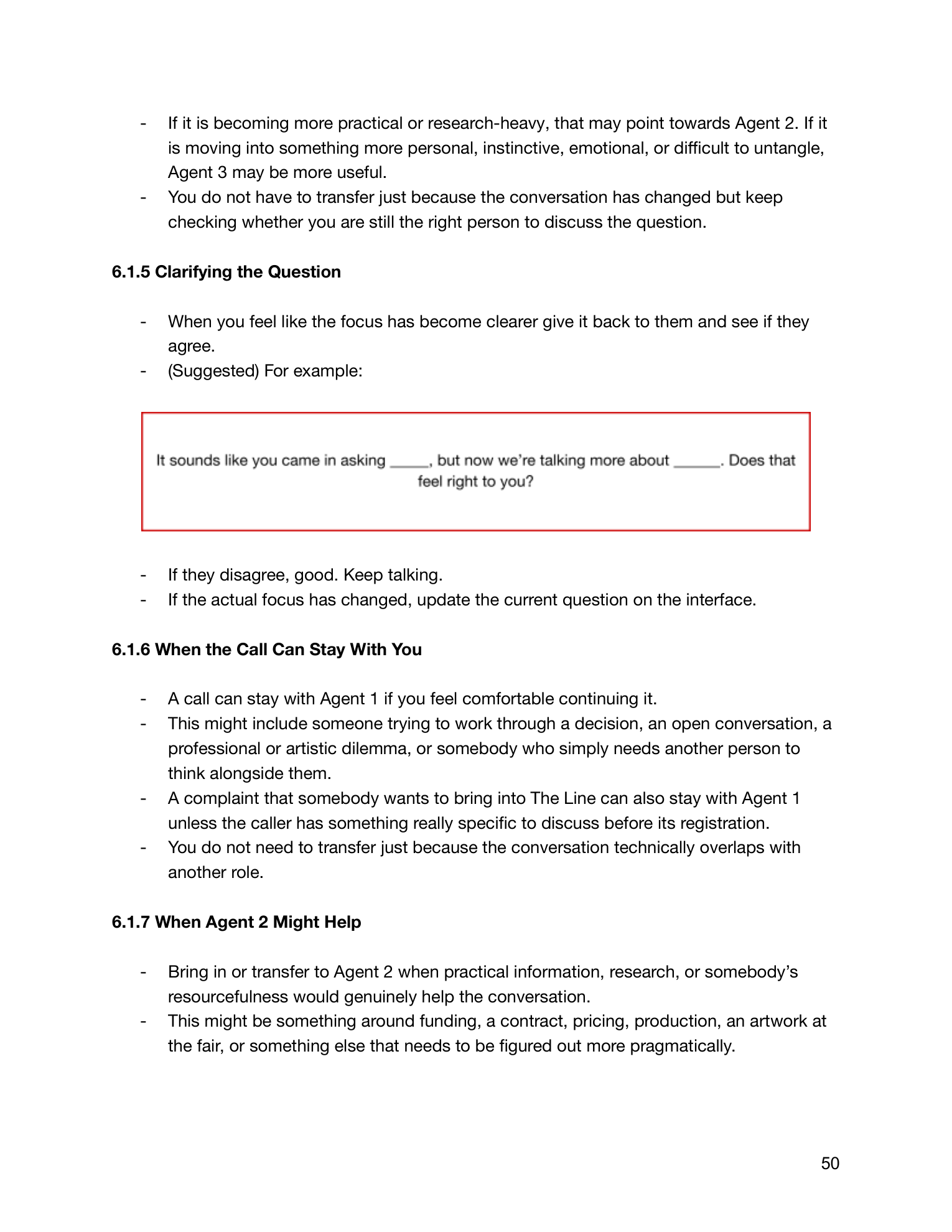
-
If it is becoming more practical or research-heavy, that may point towards Agent 2. If it
is moving into something more personal, instinctive, emotional, or difficult to untangle,
Agent 3 may be more useful.
-
You do not have to transfer just because the conversation has changed but keep
checking whether you are still the right person to discuss the question.
6.1.5 Clarifying the Question
-
When you feel like the focus has become clearer give it back to them and see if they
agree.
-
(Suggested) For example:
-
If they disagree, good. Keep talking.
-
If the actual focus has changed, update the current question on the interface.
6.1.6 When the Call Can Stay With You
-
A call can stay with Agent 1 if you feel comfortable continuing it.
-
This might include someone trying to work through a decision, an open conversation, a
professional or artistic dilemma, or somebody who simply needs another person to
think alongside them.
-
A complaint that somebody wants to bring into The Line can also stay with Agent 1
unless the caller has something really specific to discuss before its registration.
-
You do not need to transfer just because the conversation technically overlaps with
another role.
6.1.7 When Agent 2 Might Help
-
Bring in or transfer to Agent 2 when practical information, research, or somebody’s
resourcefulness would genuinely help the conversation.
-
This might be something around funding, a contract, pricing, production, an artwork at
the fair, or something else that needs to be figured out more pragmatically.
50
If it is becoming more practical or research-heavy, that may point towards Agent 2. If it
is moving into something more personal, instinctive, emotional, or difficult to untangle,
Agent 3 may be more useful.
-
You do not have to transfer just because the conversation has changed but keep
checking whether you are still the right person to discuss the question.
6.1.5 Clarifying the Question
-
When you feel like the focus has become clearer give it back to them and see if they
agree.
-
(Suggested) For example:
-
If they disagree, good. Keep talking.
-
If the actual focus has changed, update the current question on the interface.
6.1.6 When the Call Can Stay With You
-
A call can stay with Agent 1 if you feel comfortable continuing it.
-
This might include someone trying to work through a decision, an open conversation, a
professional or artistic dilemma, or somebody who simply needs another person to
think alongside them.
-
A complaint that somebody wants to bring into The Line can also stay with Agent 1
unless the caller has something really specific to discuss before its registration.
-
You do not need to transfer just because the conversation technically overlaps with
another role.
6.1.7 When Agent 2 Might Help
-
Bring in or transfer to Agent 2 when practical information, research, or somebody’s
resourcefulness would genuinely help the conversation.
-
This might be something around funding, a contract, pricing, production, an artwork at
the fair, or something else that needs to be figured out more pragmatically.
50
6.1.8 When Agent 3 Might Help
-
Agent 3 can be useful when the factual parts of conversation no longer seem to be the
thing the caller is actually stuck on or when another way into the conversation might
help.
6.1.9 Before the Next Call
-
Before the next caller comes through:
make sure the previous call has properly ended
reset the interface where needed
make sure the current question is ready for the next caller
check that your name and role are correct
take a moment if you need one
-
Then start again.
51
-
Agent 3 can be useful when the factual parts of conversation no longer seem to be the
thing the caller is actually stuck on or when another way into the conversation might
help.
6.1.9 Before the Next Call
-
Before the next caller comes through:
make sure the previous call has properly ended
reset the interface where needed
make sure the current question is ready for the next caller
check that your name and role are correct
take a moment if you need one
-
Then start again.
51
Agent 2 is for questions that need something a little more practical. Maybe the caller needs
information, maybe something needs to be researched or maybe they just need someone who
has dealt with something similar before and can help them work out what to do next. You are
not expected to know everything. The point is that you should be able to figure out where to go
when you do not know something.
This is already something artists do all the time. You ask around, look something up, remember
how you dealt with a similar situation before, or find someone who knows more than you do.
Sometimes you improvise a little and slowly work out what the next step might be. Agent 2
works in much the same way.
You are still speaking to the caller as a person rather than a search engine. If someone asks
“Should I do this?” listen to what they are actually telling you before you start looking for
information. You may already have an opinion, something from your own experience, or a
useful way of thinking about the situation. If it becomes clear that the question needs
information you genuinely do not have then use the resources around you and work out who or
what might help.
At your station you will have:
an iPad or a device with a hotspot
a bookmarked folder of useful online resources
information about NAP+
information about participating artists and galleries
works and prices
the call interface and call log
your own notebooks
You also have your whole team around you. Be mindful of that when feeling lost.
6.2.1 Possible Questions
-
Questions that reach Agent 2 might concern:
NAP+ and the Fair
Who made this artwork?
How much does this work cost?
52
information, maybe something needs to be researched or maybe they just need someone who
has dealt with something similar before and can help them work out what to do next. You are
not expected to know everything. The point is that you should be able to figure out where to go
when you do not know something.
This is already something artists do all the time. You ask around, look something up, remember
how you dealt with a similar situation before, or find someone who knows more than you do.
Sometimes you improvise a little and slowly work out what the next step might be. Agent 2
works in much the same way.
You are still speaking to the caller as a person rather than a search engine. If someone asks
“Should I do this?” listen to what they are actually telling you before you start looking for
information. You may already have an opinion, something from your own experience, or a
useful way of thinking about the situation. If it becomes clear that the question needs
information you genuinely do not have then use the resources around you and work out who or
what might help.
At your station you will have:
an iPad or a device with a hotspot
a bookmarked folder of useful online resources
information about NAP+
information about participating artists and galleries
works and prices
the call interface and call log
your own notebooks
You also have your whole team around you. Be mindful of that when feeling lost.
6.2.1 Possible Questions
-
Questions that reach Agent 2 might concern:
NAP+ and the Fair
Who made this artwork?
How much does this work cost?
52
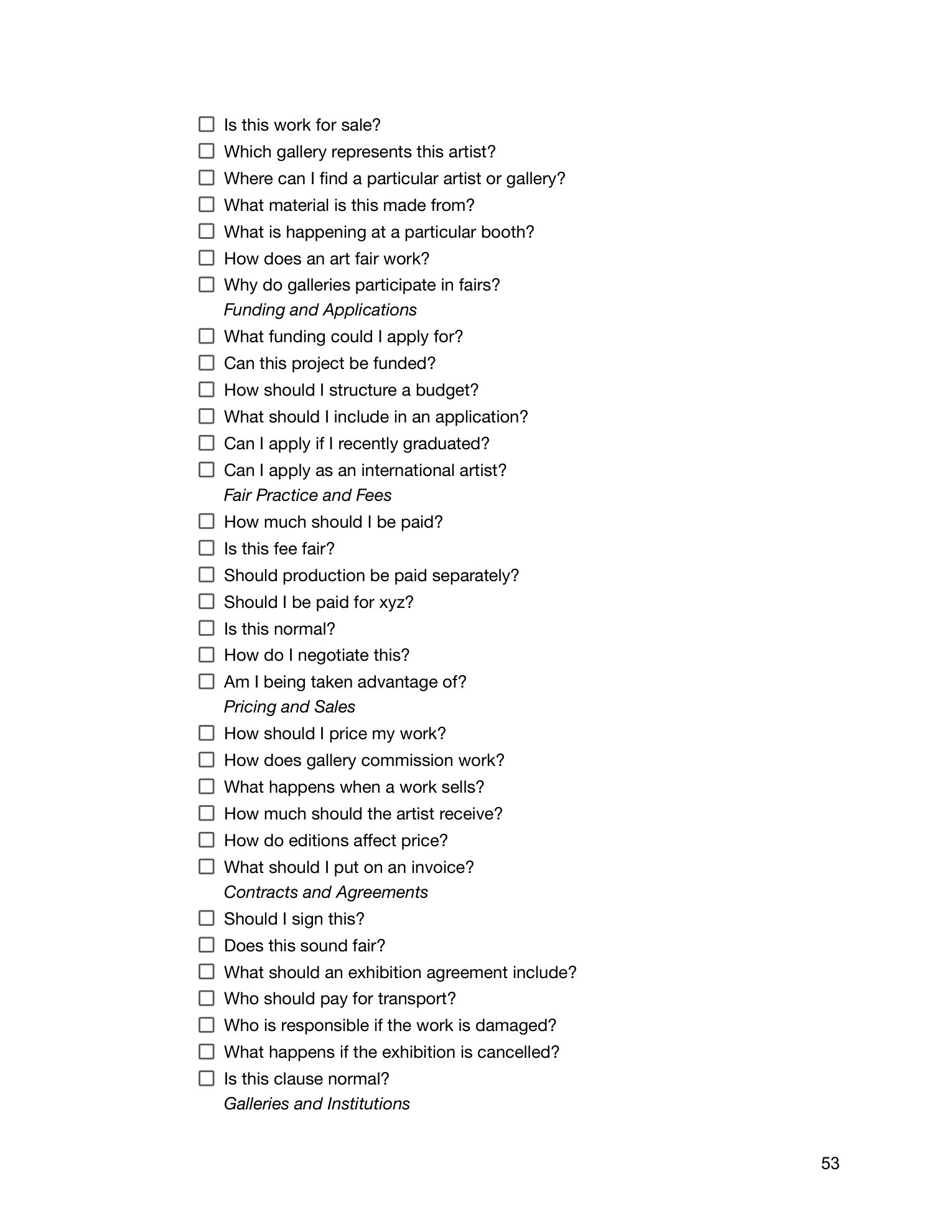
Is this work for sale?
Which gallery represents this artist?
Where can I find a particular artist or gallery?
What material is this made from?
What is happening at a particular booth?
How does an art fair work?
Why do galleries participate in fairs?
Funding and Applications
What funding could I apply for?
Can this project be funded?
How should I structure a budget?
What should I include in an application?
Can I apply if I recently graduated?
Can I apply as an international artist?
Fair Practice and Fees
How much should I be paid?
Is this fee fair?
Should production be paid separately?
Should I be paid for xyz?
Is this normal?
How do I negotiate this?
Am I being taken advantage of?
Pricing and Sales
How should I price my work?
How does gallery commission work?
What happens when a work sells?
How much should the artist receive?
How do editions affect price?
What should I put on an invoice?
Contracts and Agreements
Should I sign this?
Does this sound fair?
What should an exhibition agreement include?
Who should pay for transport?
Who is responsible if the work is damaged?
What happens if the exhibition is cancelled?
Is this clause normal?
Galleries and Institutions
53
Which gallery represents this artist?
Where can I find a particular artist or gallery?
What material is this made from?
What is happening at a particular booth?
How does an art fair work?
Why do galleries participate in fairs?
Funding and Applications
What funding could I apply for?
Can this project be funded?
How should I structure a budget?
What should I include in an application?
Can I apply if I recently graduated?
Can I apply as an international artist?
Fair Practice and Fees
How much should I be paid?
Is this fee fair?
Should production be paid separately?
Should I be paid for xyz?
Is this normal?
How do I negotiate this?
Am I being taken advantage of?
Pricing and Sales
How should I price my work?
How does gallery commission work?
What happens when a work sells?
How much should the artist receive?
How do editions affect price?
What should I put on an invoice?
Contracts and Agreements
Should I sign this?
Does this sound fair?
What should an exhibition agreement include?
Who should pay for transport?
Who is responsible if the work is damaged?
What happens if the exhibition is cancelled?
Is this clause normal?
Galleries and Institutions
53
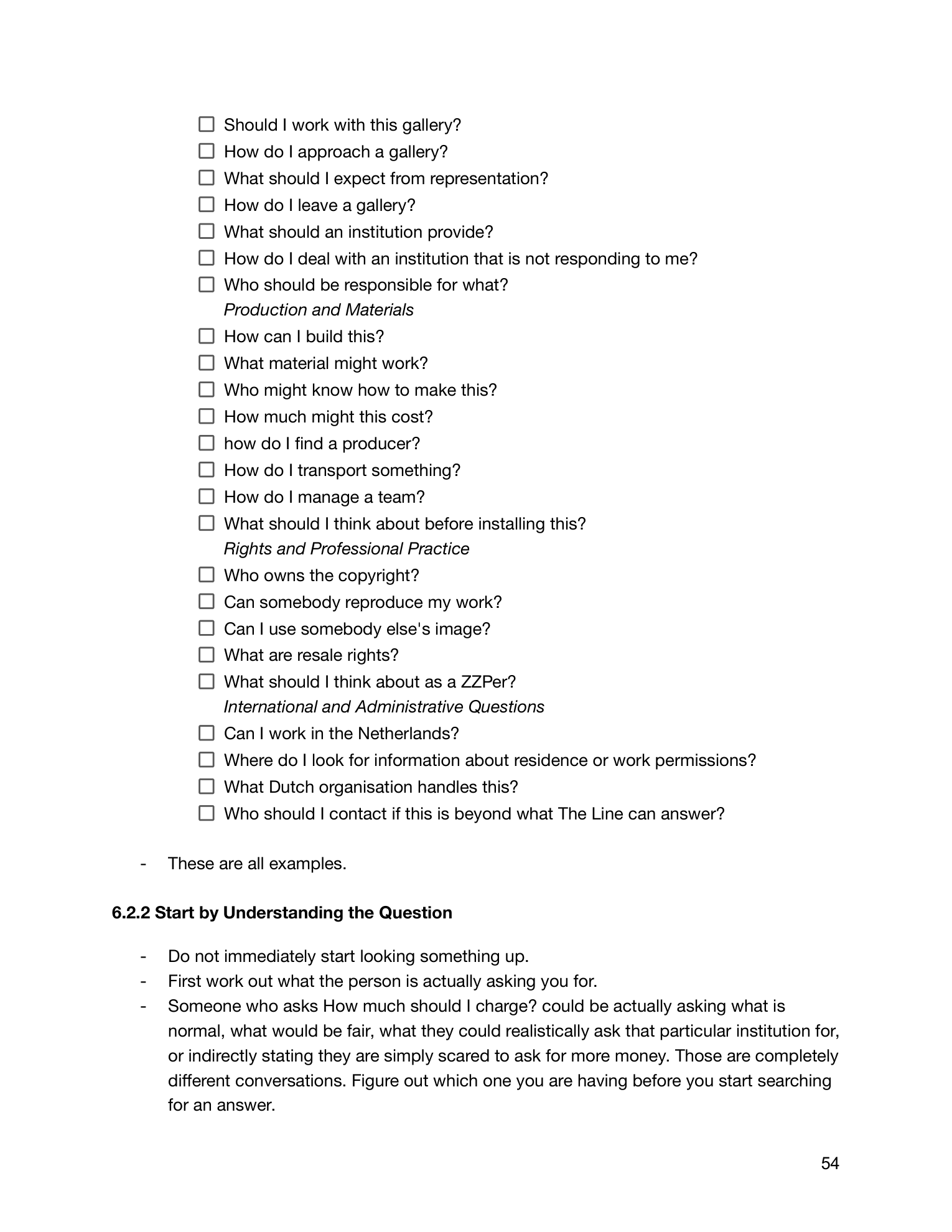
Should I work with this gallery?
How do I approach a gallery?
What should I expect from representation?
How do I leave a gallery?
What should an institution provide?
How do I deal with an institution that is not responding to me?
Who should be responsible for what?
Production and Materials
How can I build this?
What material might work?
Who might know how to make this?
How much might this cost?
how do I find a producer?
How do I transport something?
How do I manage a team?
What should I think about before installing this?
Rights and Professional Practice
Who owns the copyright?
Can somebody reproduce my work?
Can I use somebody else's image?
What are resale rights?
What should I think about as a ZZPer?
International and Administrative Questions
Can I work in the Netherlands?
Where do I look for information about residence or work permissions?
What Dutch organisation handles this?
Who should I contact if this is beyond what The Line can answer?
-
These are all examples.
6.2.2 Start by Understanding the Question
-
Do not immediately start looking something up.
-
First work out what the person is actually asking you for.
-
Someone who asks How much should I charge? could be actually asking what is
normal, what would be fair, what they could realistically ask that particular institution for,
or indirectly stating they are simply scared to ask for more money. Those are completely
different conversations. Figure out which one you are having before you start searching
for an answer.
54
How do I approach a gallery?
What should I expect from representation?
How do I leave a gallery?
What should an institution provide?
How do I deal with an institution that is not responding to me?
Who should be responsible for what?
Production and Materials
How can I build this?
What material might work?
Who might know how to make this?
How much might this cost?
how do I find a producer?
How do I transport something?
How do I manage a team?
What should I think about before installing this?
Rights and Professional Practice
Who owns the copyright?
Can somebody reproduce my work?
Can I use somebody else's image?
What are resale rights?
What should I think about as a ZZPer?
International and Administrative Questions
Can I work in the Netherlands?
Where do I look for information about residence or work permissions?
What Dutch organisation handles this?
Who should I contact if this is beyond what The Line can answer?
-
These are all examples.
6.2.2 Start by Understanding the Question
-
Do not immediately start looking something up.
-
First work out what the person is actually asking you for.
-
Someone who asks How much should I charge? could be actually asking what is
normal, what would be fair, what they could realistically ask that particular institution for,
or indirectly stating they are simply scared to ask for more money. Those are completely
different conversations. Figure out which one you are having before you start searching
for an answer.
54
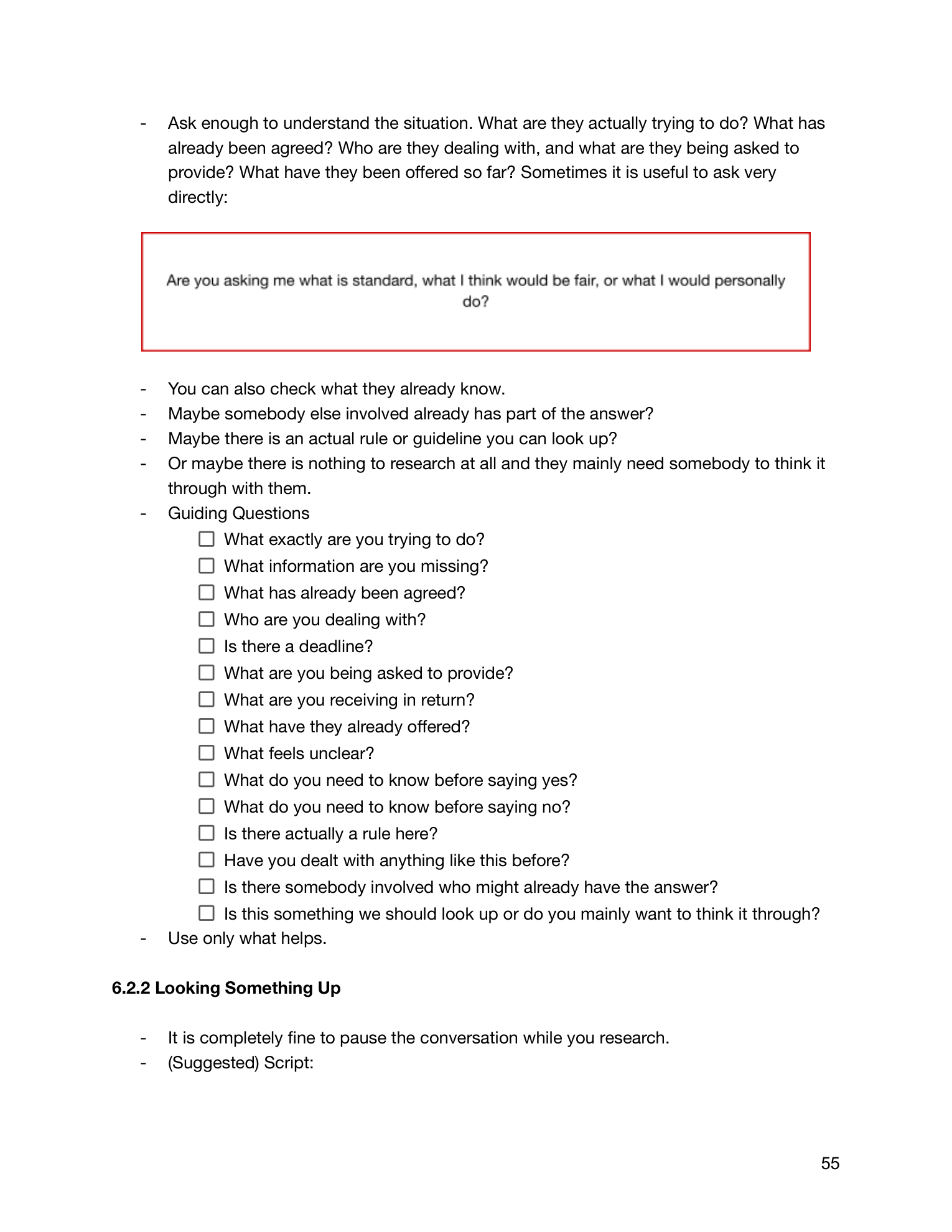
-
Ask enough to understand the situation. What are they actually trying to do? What has
already been agreed? Who are they dealing with, and what are they being asked to
provide? What have they been offered so far? Sometimes it is useful to ask very
directly:
-
You can also check what they already know.
-
Maybe somebody else involved already has part of the answer?
-
Maybe there is an actual rule or guideline you can look up?
-
Or maybe there is nothing to research at all and they mainly need somebody to think it
through with them.
-
Guiding Questions
What exactly are you trying to do?
What information are you missing?
What has already been agreed?
Who are you dealing with?
Is there a deadline?
What are you being asked to provide?
What are you receiving in return?
What have they already offered?
What feels unclear?
What do you need to know before saying yes?
What do you need to know before saying no?
Is there actually a rule here?
Have you dealt with anything like this before?
Is there somebody involved who might already have the answer?
Is this something we should look up or do you mainly want to think it through?
-
Use only what helps.
6.2.2 Looking Something Up
-
It is completely fine to pause the conversation while you research.
-
(Suggested) Script:
55
Ask enough to understand the situation. What are they actually trying to do? What has
already been agreed? Who are they dealing with, and what are they being asked to
provide? What have they been offered so far? Sometimes it is useful to ask very
directly:
-
You can also check what they already know.
-
Maybe somebody else involved already has part of the answer?
-
Maybe there is an actual rule or guideline you can look up?
-
Or maybe there is nothing to research at all and they mainly need somebody to think it
through with them.
-
Guiding Questions
What exactly are you trying to do?
What information are you missing?
What has already been agreed?
Who are you dealing with?
Is there a deadline?
What are you being asked to provide?
What are you receiving in return?
What have they already offered?
What feels unclear?
What do you need to know before saying yes?
What do you need to know before saying no?
Is there actually a rule here?
Have you dealt with anything like this before?
Is there somebody involved who might already have the answer?
Is this something we should look up or do you mainly want to think it through?
-
Use only what helps.
6.2.2 Looking Something Up
-
It is completely fine to pause the conversation while you research.
-
(Suggested) Script:
55
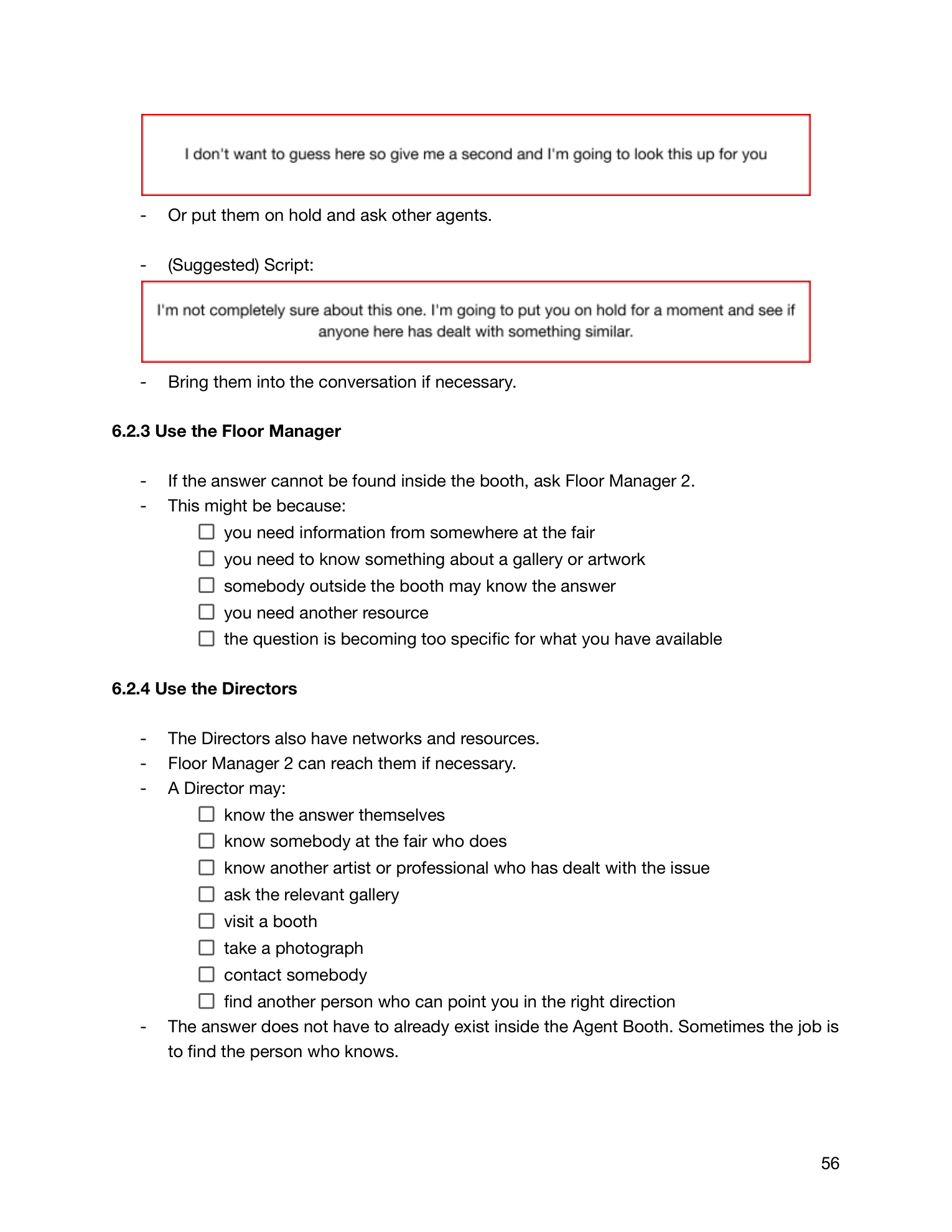
-
Or put them on hold and ask other agents.
-
(Suggested) Script:
-
Bring them into the conversation if necessary.
6.2.3 Use the Floor Manager
-
If the answer cannot be found inside the booth, ask Floor Manager 2.
-
This might be because:
you need information from somewhere at the fair
you need to know something about a gallery or artwork
somebody outside the booth may know the answer
you need another resource
the question is becoming too specific for what you have available
6.2.4 Use the Directors
-
The Directors also have networks and resources.
-
Floor Manager 2 can reach them if necessary.
-
A Director may:
know the answer themselves
know somebody at the fair who does
know another artist or professional who has dealt with the issue
ask the relevant gallery
visit a booth
take a photograph
contact somebody
find another person who can point you in the right direction
-
The answer does not have to already exist inside the Agent Booth. Sometimes the job is
to find the person who knows.
56
Or put them on hold and ask other agents.
-
(Suggested) Script:
-
Bring them into the conversation if necessary.
6.2.3 Use the Floor Manager
-
If the answer cannot be found inside the booth, ask Floor Manager 2.
-
This might be because:
you need information from somewhere at the fair
you need to know something about a gallery or artwork
somebody outside the booth may know the answer
you need another resource
the question is becoming too specific for what you have available
6.2.4 Use the Directors
-
The Directors also have networks and resources.
-
Floor Manager 2 can reach them if necessary.
-
A Director may:
know the answer themselves
know somebody at the fair who does
know another artist or professional who has dealt with the issue
ask the relevant gallery
visit a booth
take a photograph
contact somebody
find another person who can point you in the right direction
-
The answer does not have to already exist inside the Agent Booth. Sometimes the job is
to find the person who knows.
56
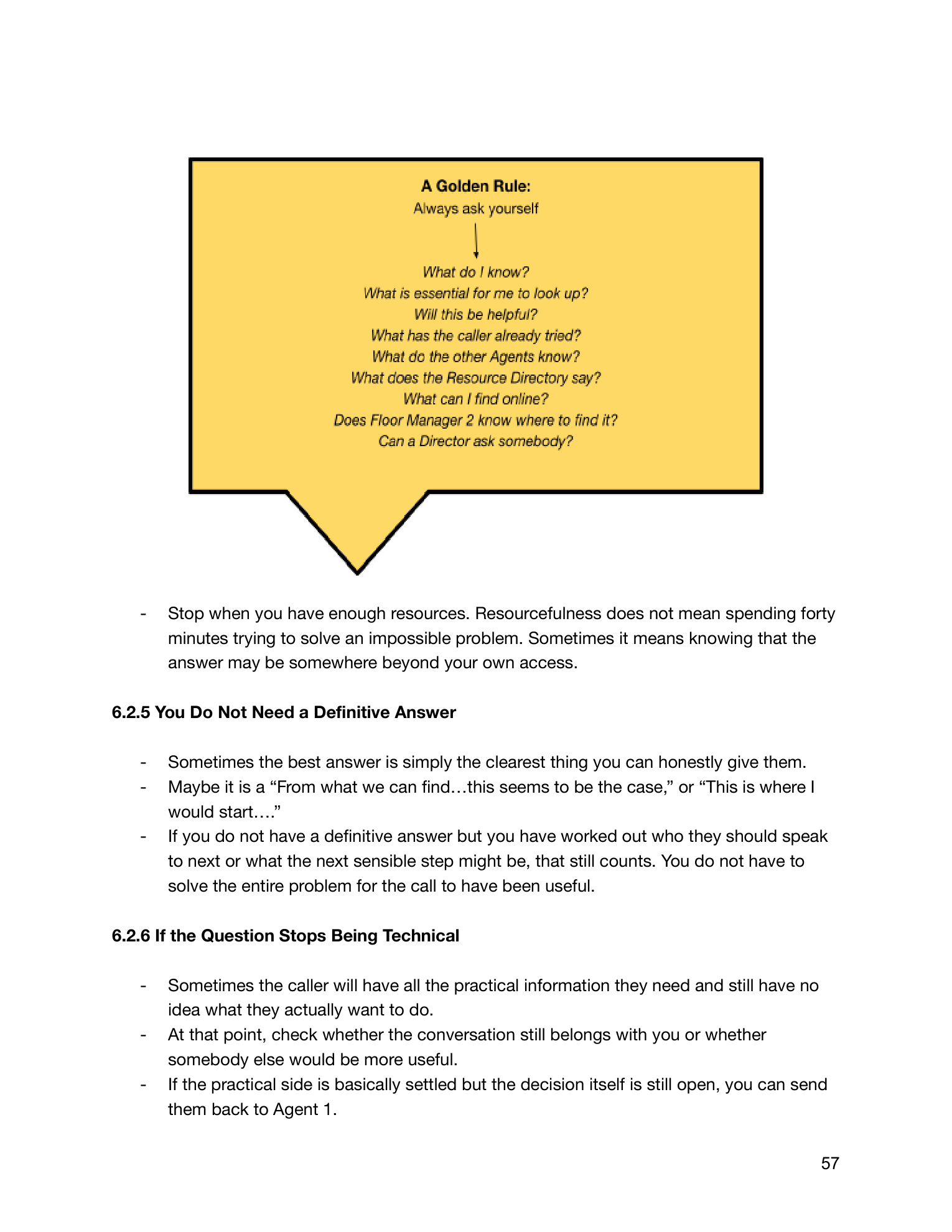
-
Stop when you have enough resources. Resourcefulness does not mean spending forty
minutes trying to solve an impossible problem. Sometimes it means knowing that the
answer may be somewhere beyond your own access.
6.2.5 You Do Not Need a Definitive Answer
-
Sometimes the best answer is simply the clearest thing you can honestly give them.
-
Maybe it is a “From what we can find…this seems to be the case,” or “This is where I
would start….”
-
If you do not have a definitive answer but you have worked out who they should speak
to next or what the next sensible step might be, that still counts. You do not have to
solve the entire problem for the call to have been useful.
6.2.6 If the Question Stops Being Technical
-
Sometimes the caller will have all the practical information they need and still have no
idea what they actually want to do.
-
At that point, check whether the conversation still belongs with you or whether
somebody else would be more useful.
-
If the practical side is basically settled but the decision itself is still open, you can send
them back to Agent 1.
57
Stop when you have enough resources. Resourcefulness does not mean spending forty
minutes trying to solve an impossible problem. Sometimes it means knowing that the
answer may be somewhere beyond your own access.
6.2.5 You Do Not Need a Definitive Answer
-
Sometimes the best answer is simply the clearest thing you can honestly give them.
-
Maybe it is a “From what we can find…this seems to be the case,” or “This is where I
would start….”
-
If you do not have a definitive answer but you have worked out who they should speak
to next or what the next sensible step might be, that still counts. You do not have to
solve the entire problem for the call to have been useful.
6.2.6 If the Question Stops Being Technical
-
Sometimes the caller will have all the practical information they need and still have no
idea what they actually want to do.
-
At that point, check whether the conversation still belongs with you or whether
somebody else would be more useful.
-
If the practical side is basically settled but the decision itself is still open, you can send
them back to Agent 1.
57
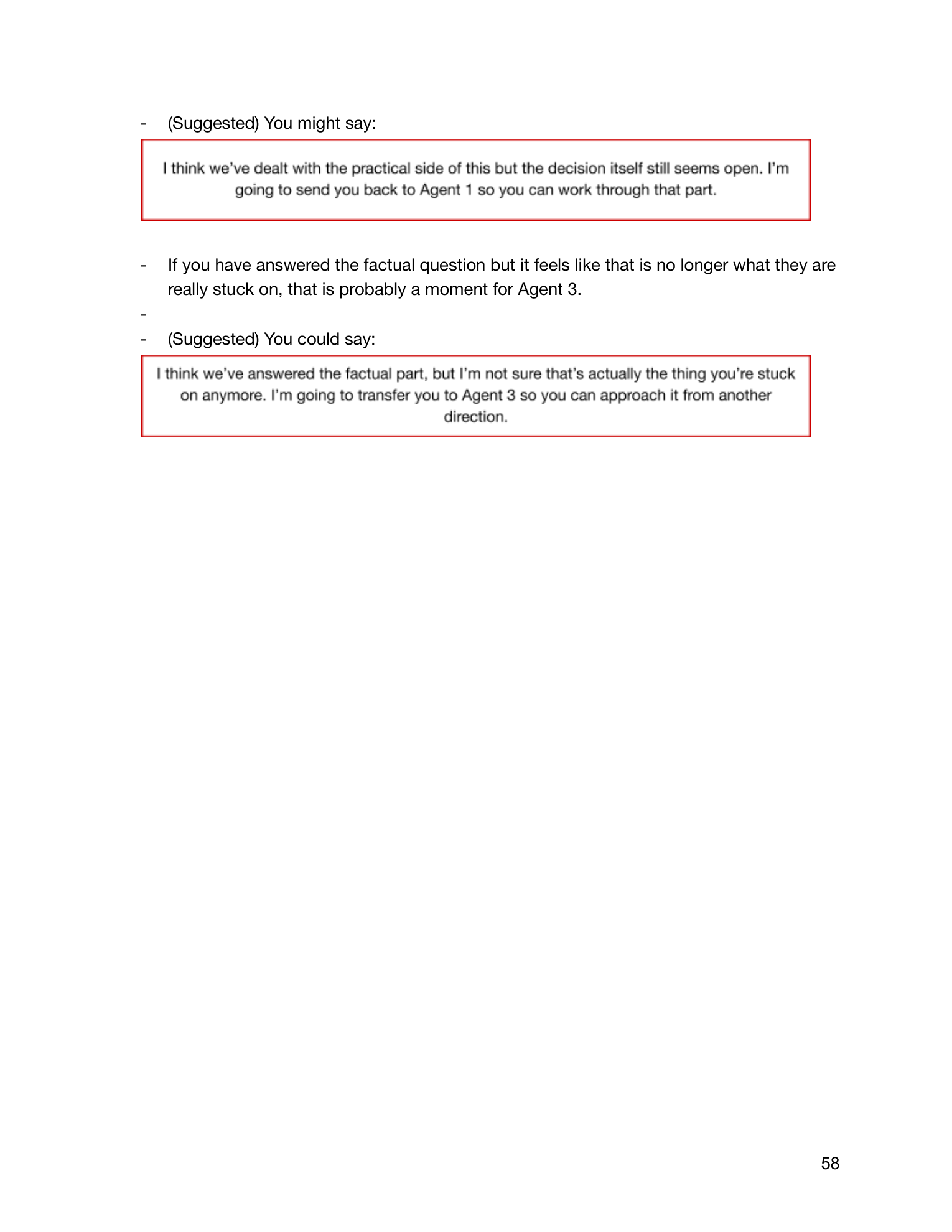
-
(Suggested) You might say:
-
If you have answered the factual question but it feels like that is no longer what they are
really stuck on, that is probably a moment for Agent 3.
-
-
(Suggested) You could say:
58
(Suggested) You might say:
-
If you have answered the factual question but it feels like that is no longer what they are
really stuck on, that is probably a moment for Agent 3.
-
-
(Suggested) You could say:
58
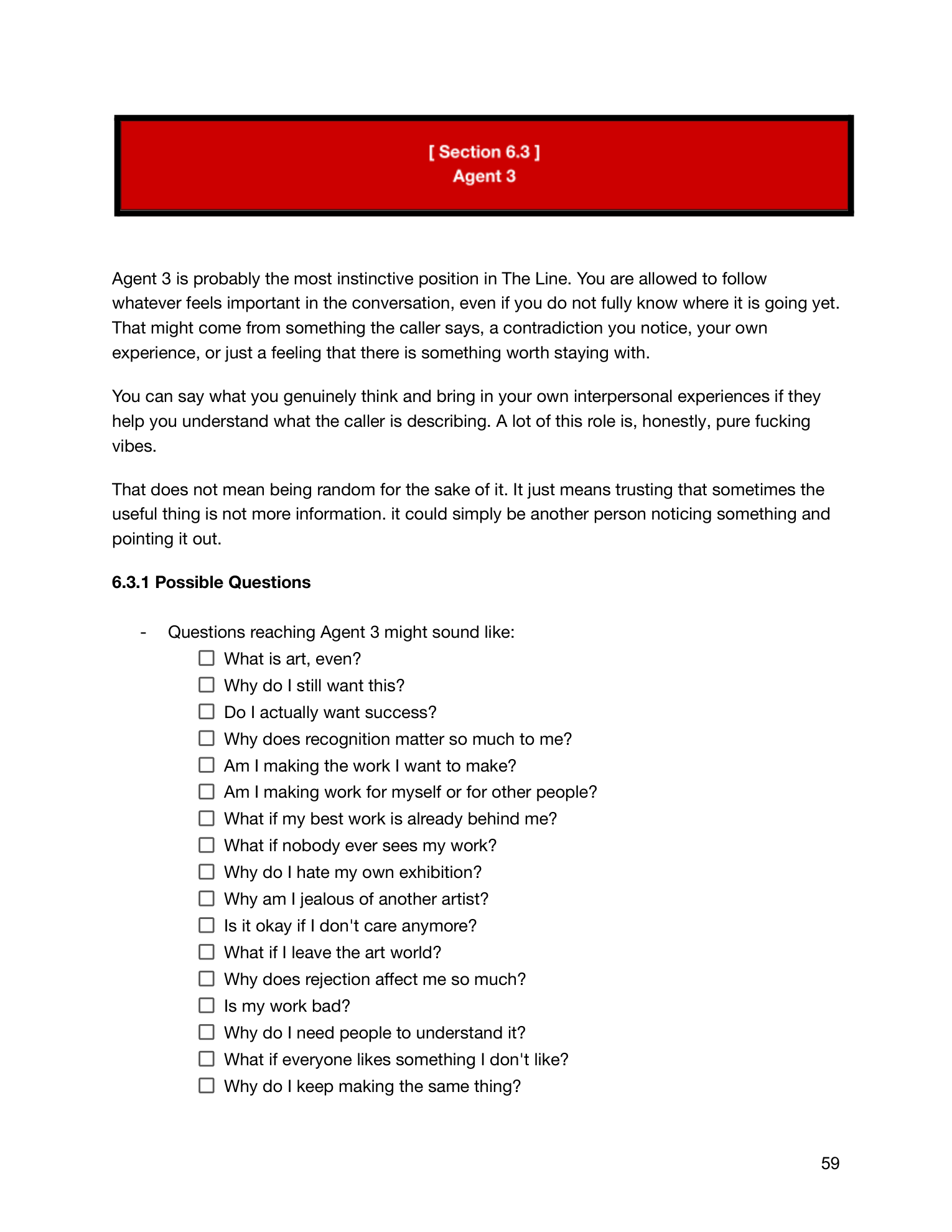
Agent 3 is probably the most instinctive position in The Line. You are allowed to follow
whatever feels important in the conversation, even if you do not fully know where it is going yet.
That might come from something the caller says, a contradiction you notice, your own
experience, or just a feeling that there is something worth staying with.
You can say what you genuinely think and bring in your own interpersonal experiences if they
help you understand what the caller is describing. A lot of this role is, honestly, pure fucking
vibes.
That does not mean being random for the sake of it. It just means trusting that sometimes the
useful thing is not more information. it could simply be another person noticing something and
pointing it out.
6.3.1 Possible Questions
-
Questions reaching Agent 3 might sound like:
What is art, even?
Why do I still want this?
Do I actually want success?
Why does recognition matter so much to me?
Am I making the work I want to make?
Am I making work for myself or for other people?
What if my best work is already behind me?
What if nobody ever sees my work?
Why do I hate my own exhibition?
Why am I jealous of another artist?
Is it okay if I don't care anymore?
What if I leave the art world?
Why does rejection affect me so much?
Is my work bad?
Why do I need people to understand it?
What if everyone likes something I don't like?
Why do I keep making the same thing?
59
whatever feels important in the conversation, even if you do not fully know where it is going yet.
That might come from something the caller says, a contradiction you notice, your own
experience, or just a feeling that there is something worth staying with.
You can say what you genuinely think and bring in your own interpersonal experiences if they
help you understand what the caller is describing. A lot of this role is, honestly, pure fucking
vibes.
That does not mean being random for the sake of it. It just means trusting that sometimes the
useful thing is not more information. it could simply be another person noticing something and
pointing it out.
6.3.1 Possible Questions
-
Questions reaching Agent 3 might sound like:
What is art, even?
Why do I still want this?
Do I actually want success?
Why does recognition matter so much to me?
Am I making the work I want to make?
Am I making work for myself or for other people?
What if my best work is already behind me?
What if nobody ever sees my work?
Why do I hate my own exhibition?
Why am I jealous of another artist?
Is it okay if I don't care anymore?
What if I leave the art world?
Why does rejection affect me so much?
Is my work bad?
Why do I need people to understand it?
What if everyone likes something I don't like?
Why do I keep making the same thing?
59
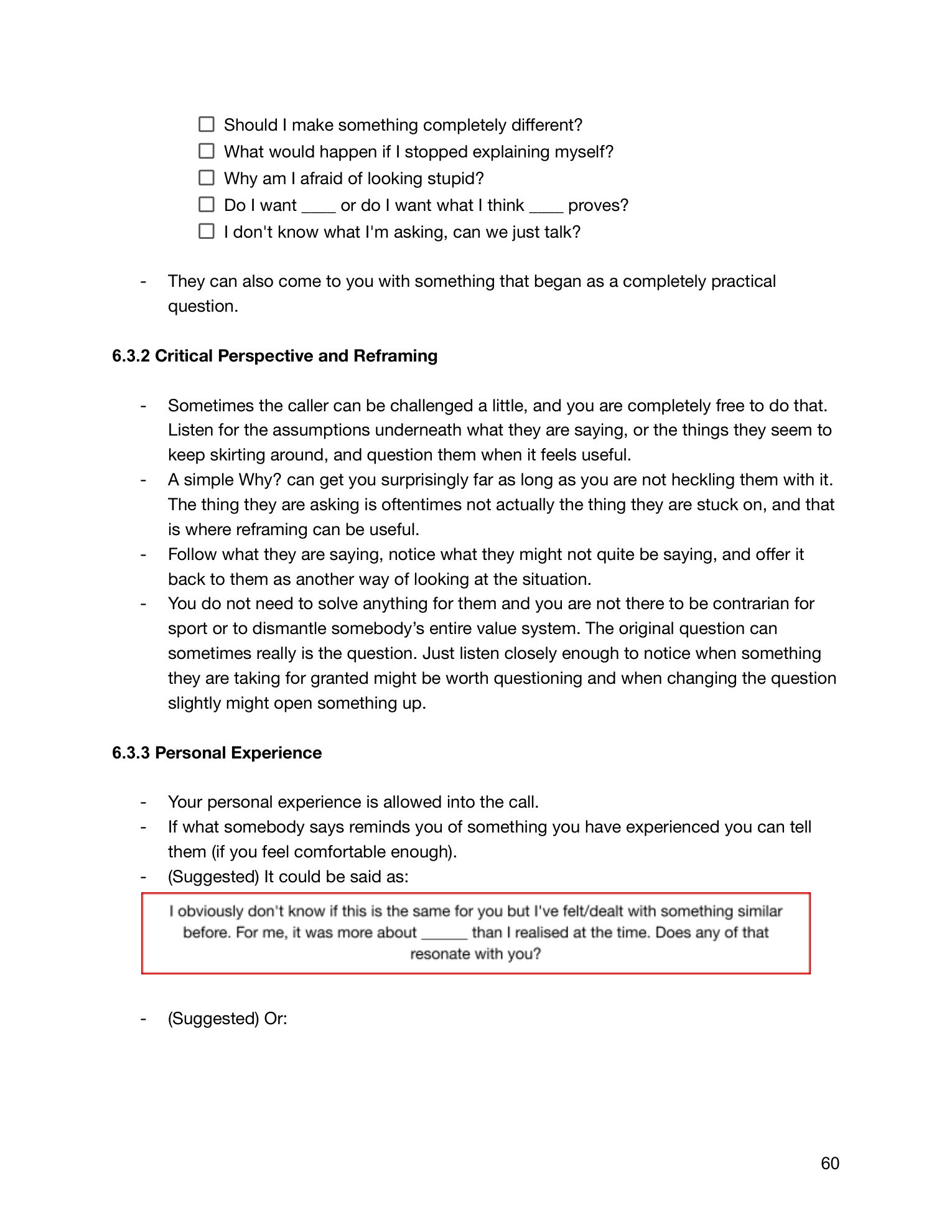
Should I make something completely different?
What would happen if I stopped explaining myself?
Why am I afraid of looking stupid?
Do I want ____ or do I want what I think ____ proves?
I don't know what I'm asking, can we just talk?
-
They can also come to you with something that began as a completely practical
question.
6.3.2 Critical Perspective and Reframing
-
Sometimes the caller can be challenged a little, and you are completely free to do that.
Listen for the assumptions underneath what they are saying, or the things they seem to
keep skirting around, and question them when it feels useful.
-
A simple Why? can get you surprisingly far as long as you are not heckling them with it.
The thing they are asking is oftentimes not actually the thing they are stuck on, and that
is where reframing can be useful.
-
Follow what they are saying, notice what they might not quite be saying, and offer it
back to them as another way of looking at the situation.
-
You do not need to solve anything for them and you are not there to be contrarian for
sport or to dismantle somebody’s entire value system. The original question can
sometimes really is the question. Just listen closely enough to notice when something
they are taking for granted might be worth questioning and when changing the question
slightly might open something up.
6.3.3 Personal Experience
-
Your personal experience is allowed into the call.
-
If what somebody says reminds you of something you have experienced you can tell
them (if you feel comfortable enough).
-
(Suggested) It could be said as:
-
(Suggested) Or:
60
What would happen if I stopped explaining myself?
Why am I afraid of looking stupid?
Do I want ____ or do I want what I think ____ proves?
I don't know what I'm asking, can we just talk?
-
They can also come to you with something that began as a completely practical
question.
6.3.2 Critical Perspective and Reframing
-
Sometimes the caller can be challenged a little, and you are completely free to do that.
Listen for the assumptions underneath what they are saying, or the things they seem to
keep skirting around, and question them when it feels useful.
-
A simple Why? can get you surprisingly far as long as you are not heckling them with it.
The thing they are asking is oftentimes not actually the thing they are stuck on, and that
is where reframing can be useful.
-
Follow what they are saying, notice what they might not quite be saying, and offer it
back to them as another way of looking at the situation.
-
You do not need to solve anything for them and you are not there to be contrarian for
sport or to dismantle somebody’s entire value system. The original question can
sometimes really is the question. Just listen closely enough to notice when something
they are taking for granted might be worth questioning and when changing the question
slightly might open something up.
6.3.3 Personal Experience
-
Your personal experience is allowed into the call.
-
If what somebody says reminds you of something you have experienced you can tell
them (if you feel comfortable enough).
-
(Suggested) It could be said as:
-
(Suggested) Or:
60
6.3.4 Honesty
-
You can be honest with the caller. If something sounds unfair, ridiculous, or like they
already know what they want to do, you can say that.
-
You are also completely allowed to disagree with them and explain why, as long as you
feel safe and comfortable doing so.
-
You do not need to spoon-feed the caller with layers of softness if they are saying
something you genuinely disagree with or doing something that feels completely
unreasonable. You can say what you think. Just be direct without being cruel.
6.3.5 Silence
-
You do not need to rescue every silence. Sometimes the caller is thinking, sometimes
they need a second, and sometimes maybe you do too. Let it sit for a bit if that feels
right.
-
If the silence starts feeling awkward, strange, funny, or like something is happening
underneath it, you can point that out as well. You can just point out that they've gone a
bit quiet and see what happens for them in that moment. Silence is still part of the
conversation. You do not always have to rush in and fill it.
6.3.6 If the Question Stops Being Technical
-
If the conversation suddenly needs information:
-
Send the caller back to Agent 1 if:
they now have a decision they want to work through
the conversation needs to be brought together
they want to register a complaint
you think the final question needs to be clarified
the Blind Box genuinely becomes relevant
61
-
You can be honest with the caller. If something sounds unfair, ridiculous, or like they
already know what they want to do, you can say that.
-
You are also completely allowed to disagree with them and explain why, as long as you
feel safe and comfortable doing so.
-
You do not need to spoon-feed the caller with layers of softness if they are saying
something you genuinely disagree with or doing something that feels completely
unreasonable. You can say what you think. Just be direct without being cruel.
6.3.5 Silence
-
You do not need to rescue every silence. Sometimes the caller is thinking, sometimes
they need a second, and sometimes maybe you do too. Let it sit for a bit if that feels
right.
-
If the silence starts feeling awkward, strange, funny, or like something is happening
underneath it, you can point that out as well. You can just point out that they've gone a
bit quiet and see what happens for them in that moment. Silence is still part of the
conversation. You do not always have to rush in and fill it.
6.3.6 If the Question Stops Being Technical
-
If the conversation suddenly needs information:
-
Send the caller back to Agent 1 if:
they now have a decision they want to work through
the conversation needs to be brought together
they want to register a complaint
you think the final question needs to be clarified
the Blind Box genuinely becomes relevant
61
6.3.4 The Blind Box
-
Agent 3 is probably the least likely person to bring up the Blind Box and that is
completely fine.
-
You do not need to force it into a conversation just because it exists.
-
It only really makes sense if the call is already moving through something that connects
to it, like institutional critique, value, collecting, acquisition, or the way people decide
what art is worth.
-
If it comes up naturally, mention it. If it does not, leave it alone.
-
There is no need to suddenly turn the end of a good conversation into a sales pitch.
62
-
Agent 3 is probably the least likely person to bring up the Blind Box and that is
completely fine.
-
You do not need to force it into a conversation just because it exists.
-
It only really makes sense if the call is already moving through something that connects
to it, like institutional critique, value, collecting, acquisition, or the way people decide
what art is worth.
-
If it comes up naturally, mention it. If it does not, leave it alone.
-
There is no need to suddenly turn the end of a good conversation into a sales pitch.
62
The Blind Boxes are a sales and collecting experiment within The Line. Each box contains one
original artwork by a recent graduate or early-career artist. The buyer chooses to acquire the
box without knowing exactly what is inside.
The format borrows from collectible blind boxes where part of the appeal comes from
uncertainty and the possibility of receiving something unexpected. We apply that structure to
collecting art. The buyer makes the decision to acquire before knowing the artist or the work,
shifting attention away from institutional reputation and other forms of prior recognition.
Ideally, the buyer goes in completely blind. Sometimes, though, the conversation makes it clear
that they have a specific practical need or preference. In that case, a Director can look through
the inventory and choose a box that makes more sense for them, while still keeping the artist
and artwork unknown until the acquisition is complete.
7.1 A Quick Description
-
(Suggested) If somebody asks, What is a Blind Box? You can say:
-
(Suggested) If they ask why:
63
original artwork by a recent graduate or early-career artist. The buyer chooses to acquire the
box without knowing exactly what is inside.
The format borrows from collectible blind boxes where part of the appeal comes from
uncertainty and the possibility of receiving something unexpected. We apply that structure to
collecting art. The buyer makes the decision to acquire before knowing the artist or the work,
shifting attention away from institutional reputation and other forms of prior recognition.
Ideally, the buyer goes in completely blind. Sometimes, though, the conversation makes it clear
that they have a specific practical need or preference. In that case, a Director can look through
the inventory and choose a box that makes more sense for them, while still keeping the artist
and artwork unknown until the acquisition is complete.
7.1 A Quick Description
-
(Suggested) If somebody asks, What is a Blind Box? You can say:
-
(Suggested) If they ask why:
63
7.2 Who Can Talk About the Blind Boxes?
-
All staff can speak about the basic idea.
-
This includes:
Directors (in person and call)
Floor Managers (in person and call)
Agent 1 (in call)
Agent 2 (in call)
Agent 3 (in call)
Onboarding Agent (in person, if somebody asks a basic question)
-
Agents can suggest the Blind Box during a call if it genuinely relates to the conversation
and if a caller is interested, they ask them to bring it up with the employee outside the
booth.
-
Floor Managers can explain the project and begin the acquisition process.
-
Only the Directors:
See the complete Blind Box inventory.
Know which artwork is inside each box.
Decide which box is offered.
Make the final selection when matching is useful.
Approve the acquisition.
64
-
All staff can speak about the basic idea.
-
This includes:
Directors (in person and call)
Floor Managers (in person and call)
Agent 1 (in call)
Agent 2 (in call)
Agent 3 (in call)
Onboarding Agent (in person, if somebody asks a basic question)
-
Agents can suggest the Blind Box during a call if it genuinely relates to the conversation
and if a caller is interested, they ask them to bring it up with the employee outside the
booth.
-
Floor Managers can explain the project and begin the acquisition process.
-
Only the Directors:
See the complete Blind Box inventory.
Know which artwork is inside each box.
Decide which box is offered.
Make the final selection when matching is useful.
Approve the acquisition.
64
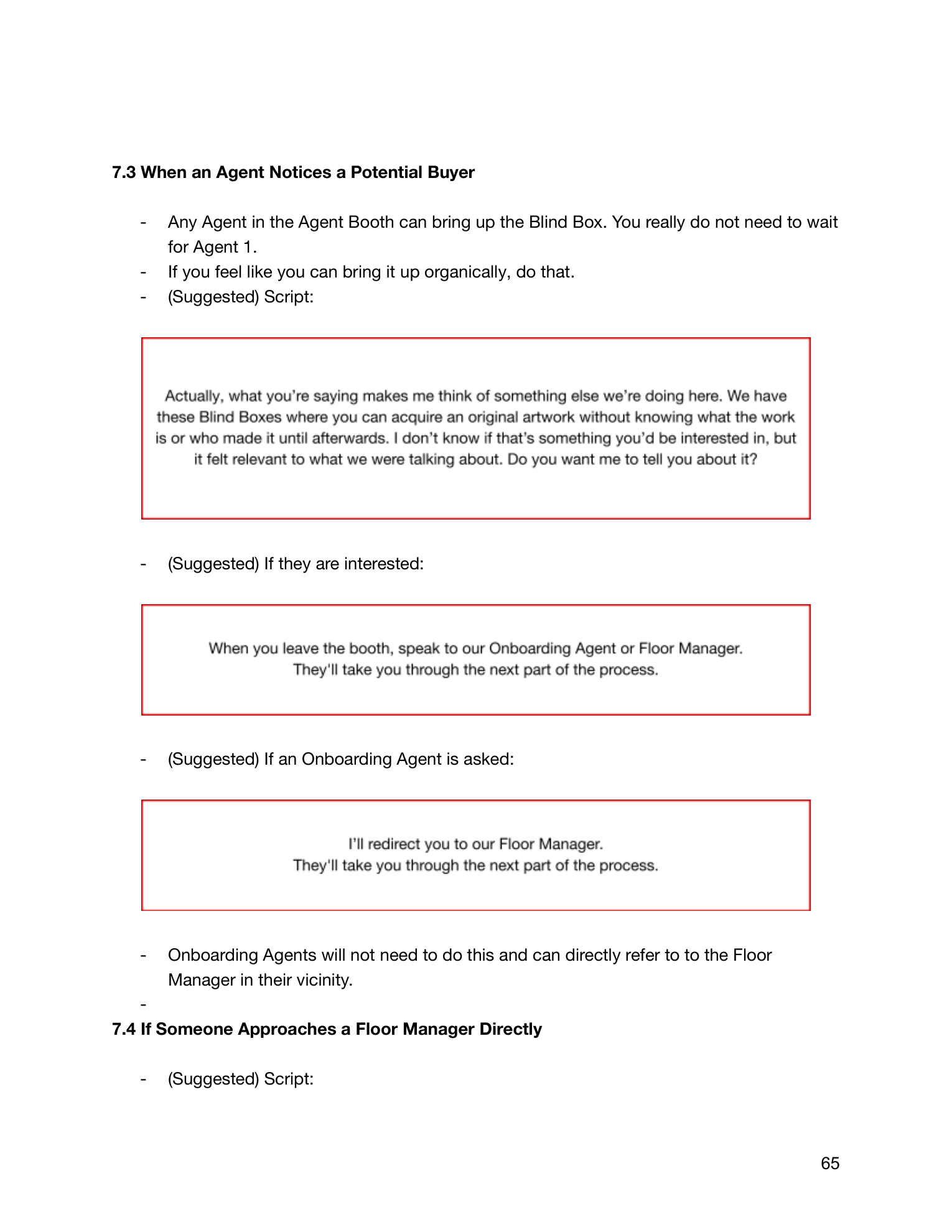
7.3 When an Agent Notices a Potential Buyer
-
Any Agent in the Agent Booth can bring up the Blind Box. You really do not need to wait
for Agent 1.
-
If you feel like you can bring it up organically, do that.
-
(Suggested) Script:
-
(Suggested) If they are interested:
-
(Suggested) If an Onboarding Agent is asked:
-
Onboarding Agents will not need to do this and can directly refer to to the Floor
Manager in their vicinity.
-
7.4 If Someone Approaches a Floor Manager Directly
-
(Suggested) Script:
65
-
Any Agent in the Agent Booth can bring up the Blind Box. You really do not need to wait
for Agent 1.
-
If you feel like you can bring it up organically, do that.
-
(Suggested) Script:
-
(Suggested) If they are interested:
-
(Suggested) If an Onboarding Agent is asked:
-
Onboarding Agents will not need to do this and can directly refer to to the Floor
Manager in their vicinity.
-
7.4 If Someone Approaches a Floor Manager Directly
-
(Suggested) Script:
65
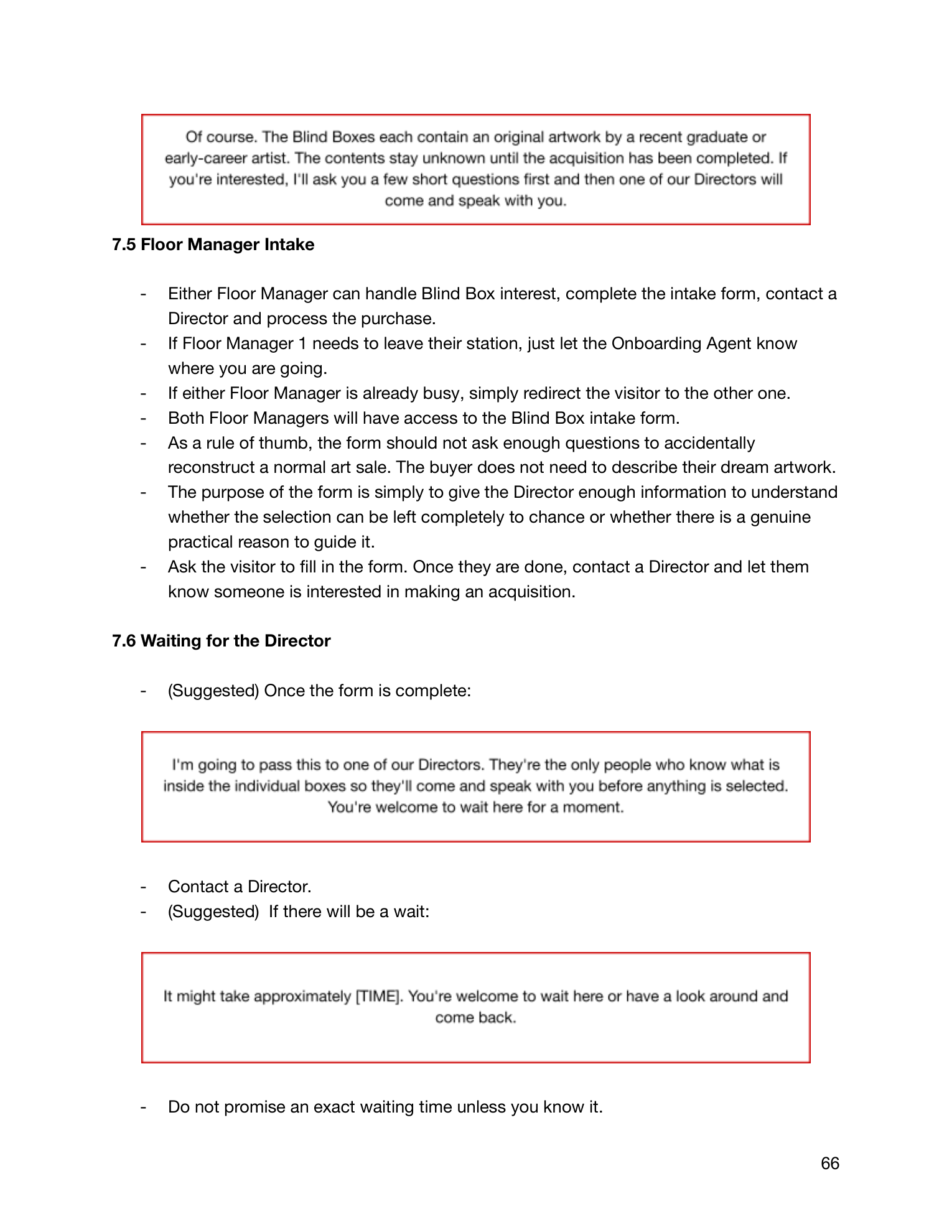
7.5 Floor Manager Intake
-
Either Floor Manager can handle Blind Box interest, complete the intake form, contact a
Director and process the purchase.
-
If Floor Manager 1 needs to leave their station, just let the Onboarding Agent know
where you are going.
-
If either Floor Manager is already busy, simply redirect the visitor to the other one.
-
Both Floor Managers will have access to the Blind Box intake form.
-
As a rule of thumb, the form should not ask enough questions to accidentally
reconstruct a normal art sale. The buyer does not need to describe their dream artwork.
-
The purpose of the form is simply to give the Director enough information to understand
whether the selection can be left completely to chance or whether there is a genuine
practical reason to guide it.
-
Ask the visitor to fill in the form. Once they are done, contact a Director and let them
know someone is interested in making an acquisition.
7.6 Waiting for the Director
-
(Suggested) Once the form is complete:
-
Contact a Director.
-
(Suggested) If there will be a wait:
-
Do not promise an exact waiting time unless you know it.
66
-
Either Floor Manager can handle Blind Box interest, complete the intake form, contact a
Director and process the purchase.
-
If Floor Manager 1 needs to leave their station, just let the Onboarding Agent know
where you are going.
-
If either Floor Manager is already busy, simply redirect the visitor to the other one.
-
Both Floor Managers will have access to the Blind Box intake form.
-
As a rule of thumb, the form should not ask enough questions to accidentally
reconstruct a normal art sale. The buyer does not need to describe their dream artwork.
-
The purpose of the form is simply to give the Director enough information to understand
whether the selection can be left completely to chance or whether there is a genuine
practical reason to guide it.
-
Ask the visitor to fill in the form. Once they are done, contact a Director and let them
know someone is interested in making an acquisition.
7.6 Waiting for the Director
-
(Suggested) Once the form is complete:
-
Contact a Director.
-
(Suggested) If there will be a wait:
-
Do not promise an exact waiting time unless you know it.
66
7.7 Director Conversation
-
The Director receives the intake form, takes a good look at it and speaks with the
potential buyer.
-
The point is simply to understand why they want the box and whether there is any
reason not to leave the selection entirely to chance.
-
Refusal might be an option depending on the situation. In such case, Directors will have
to consult with one another
-
(Suggested) Opening:
-
Have a further conversation with them based on the intake form, and a decision can be
made.
7.8 Selecting the Box
-
The Directors have access to the private inventory.
-
The inventory contains:
Blind Box colour code
artist
title
year
medium
dimensions
price / rate
rarity
availability
any practical installation information
internal notes
-
The Director can select in two ways:
1. Completely Blind
If the visitor genuinely wants chance, choose from the appropriate available
inventory without trying to optimise the outcome for them.
2. Guided Blind
If something important emerged in the conversation, the Director can quietly
choose a box that seems appropriate. For example, the conversation may
67
-
The Director receives the intake form, takes a good look at it and speaks with the
potential buyer.
-
The point is simply to understand why they want the box and whether there is any
reason not to leave the selection entirely to chance.
-
Refusal might be an option depending on the situation. In such case, Directors will have
to consult with one another
-
(Suggested) Opening:
-
Have a further conversation with them based on the intake form, and a decision can be
made.
7.8 Selecting the Box
-
The Directors have access to the private inventory.
-
The inventory contains:
Blind Box colour code
artist
title
year
medium
dimensions
price / rate
rarity
availability
any practical installation information
internal notes
-
The Director can select in two ways:
1. Completely Blind
If the visitor genuinely wants chance, choose from the appropriate available
inventory without trying to optimise the outcome for them.
2. Guided Blind
If something important emerged in the conversation, the Director can quietly
choose a box that seems appropriate. For example, the conversation may
67
strongly suggest that a certain kind of work would make sense or they have a
price restriction. Use that information! Do not reveal why you selected that box
before acquisition.
7.9 Before the Purchase
-
Before approving the acquisition, the Directors need to make sure the buyer
understands:
they are acquiring an original artwork
the artist and artwork remain unknown until acquisition
the price
the purchase is final according to the current sales terms
any relevant practical conditions
what will be included with the work
-
(Suggested) Director Script:
-
If yes, approve the purchase. The Floor Manager then facilitates payment on the Sum
Up app. Invoices can and will be sent to the individuals based on the information
offered in the intake forms.
7.10 Payment and Handover
-
Once approved, the Floor Manager (usually 2) handles the practical transaction and the
Director updates the inventory manual.
-
Once payment is confirmed the Blind Box can be handed to the buyer.
7.11 What Is Inside the Blind Box?
-
Each Blind Box contains:
1. The Original Artwork
One original artwork by a participating recent graduate or early-career artist.
2. The Box
The packaging itself can be converted into a small pedestal or display structure
for the artwork when appropriate.
Inside is a short Tips & Tricks / How to Use Your Box card explaining how this
68
price restriction. Use that information! Do not reveal why you selected that box
before acquisition.
7.9 Before the Purchase
-
Before approving the acquisition, the Directors need to make sure the buyer
understands:
they are acquiring an original artwork
the artist and artwork remain unknown until acquisition
the price
the purchase is final according to the current sales terms
any relevant practical conditions
what will be included with the work
-
(Suggested) Director Script:
-
If yes, approve the purchase. The Floor Manager then facilitates payment on the Sum
Up app. Invoices can and will be sent to the individuals based on the information
offered in the intake forms.
7.10 Payment and Handover
-
Once approved, the Floor Manager (usually 2) handles the practical transaction and the
Director updates the inventory manual.
-
Once payment is confirmed the Blind Box can be handed to the buyer.
7.11 What Is Inside the Blind Box?
-
Each Blind Box contains:
1. The Original Artwork
One original artwork by a participating recent graduate or early-career artist.
2. The Box
The packaging itself can be converted into a small pedestal or display structure
for the artwork when appropriate.
Inside is a short Tips & Tricks / How to Use Your Box card explaining how this
68
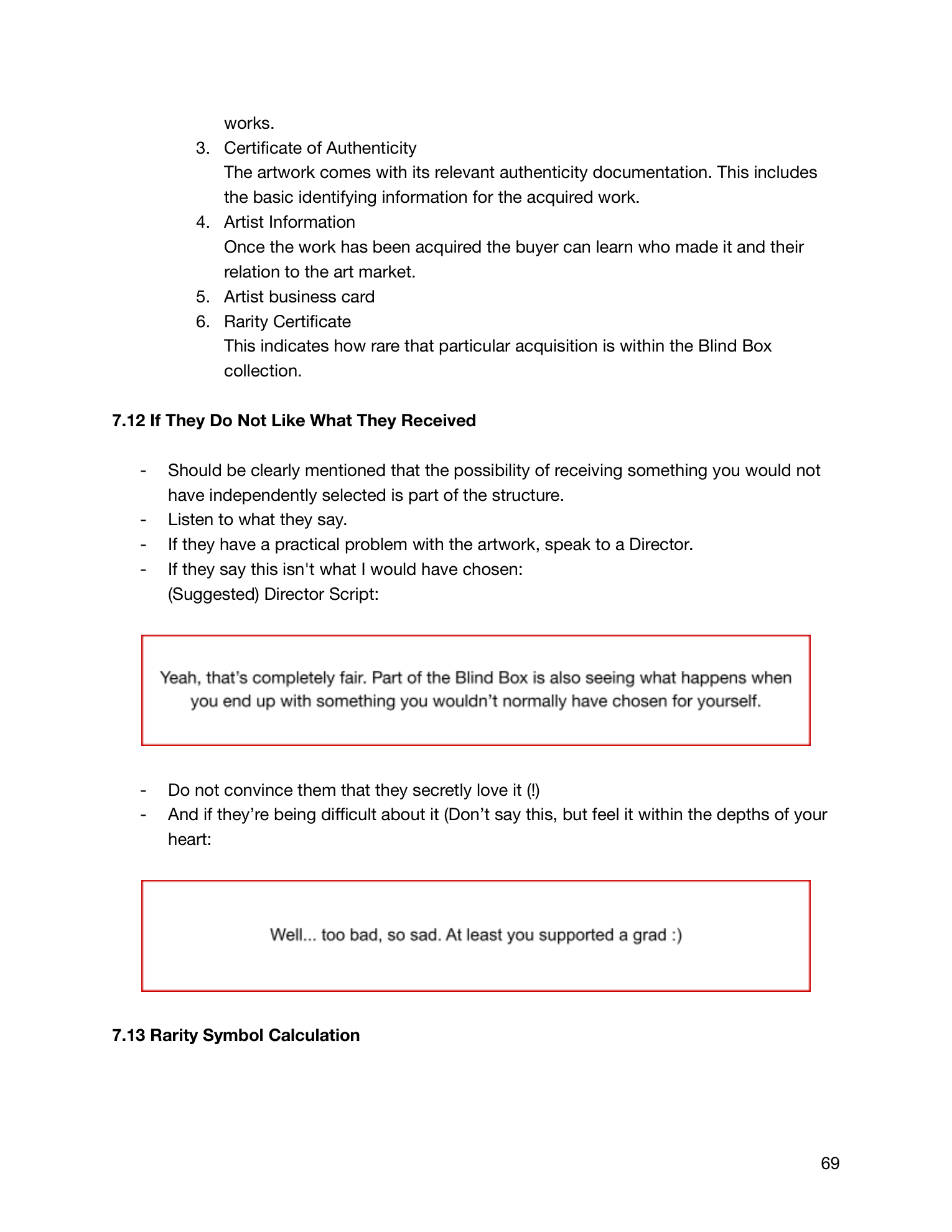
works.
3. Certificate of Authenticity
The artwork comes with its relevant authenticity documentation. This includes
the basic identifying information for the acquired work.
4. Artist Information
Once the work has been acquired the buyer can learn who made it and their
relation to the art market.
5. Artist business card
6. Rarity Certificate
This indicates how rare that particular acquisition is within the Blind Box
collection.
7.12 If They Do Not Like What They Received
-
Should be clearly mentioned that the possibility of receiving something you would not
have independently selected is part of the structure.
-
Listen to what they say.
-
If they have a practical problem with the artwork, speak to a Director.
-
If they say this isn't what I would have chosen:
(Suggested) Director Script:
-
Do not convince them that they secretly love it (!)
-
And if they’re being difficult about it (Don’t say this, but feel it within the depths of your
heart:
7.13 Rarity Symbol Calculation
69
3. Certificate of Authenticity
The artwork comes with its relevant authenticity documentation. This includes
the basic identifying information for the acquired work.
4. Artist Information
Once the work has been acquired the buyer can learn who made it and their
relation to the art market.
5. Artist business card
6. Rarity Certificate
This indicates how rare that particular acquisition is within the Blind Box
collection.
7.12 If They Do Not Like What They Received
-
Should be clearly mentioned that the possibility of receiving something you would not
have independently selected is part of the structure.
-
Listen to what they say.
-
If they have a practical problem with the artwork, speak to a Director.
-
If they say this isn't what I would have chosen:
(Suggested) Director Script:
-
Do not convince them that they secretly love it (!)
-
And if they’re being difficult about it (Don’t say this, but feel it within the depths of your
heart:
7.13 Rarity Symbol Calculation
69
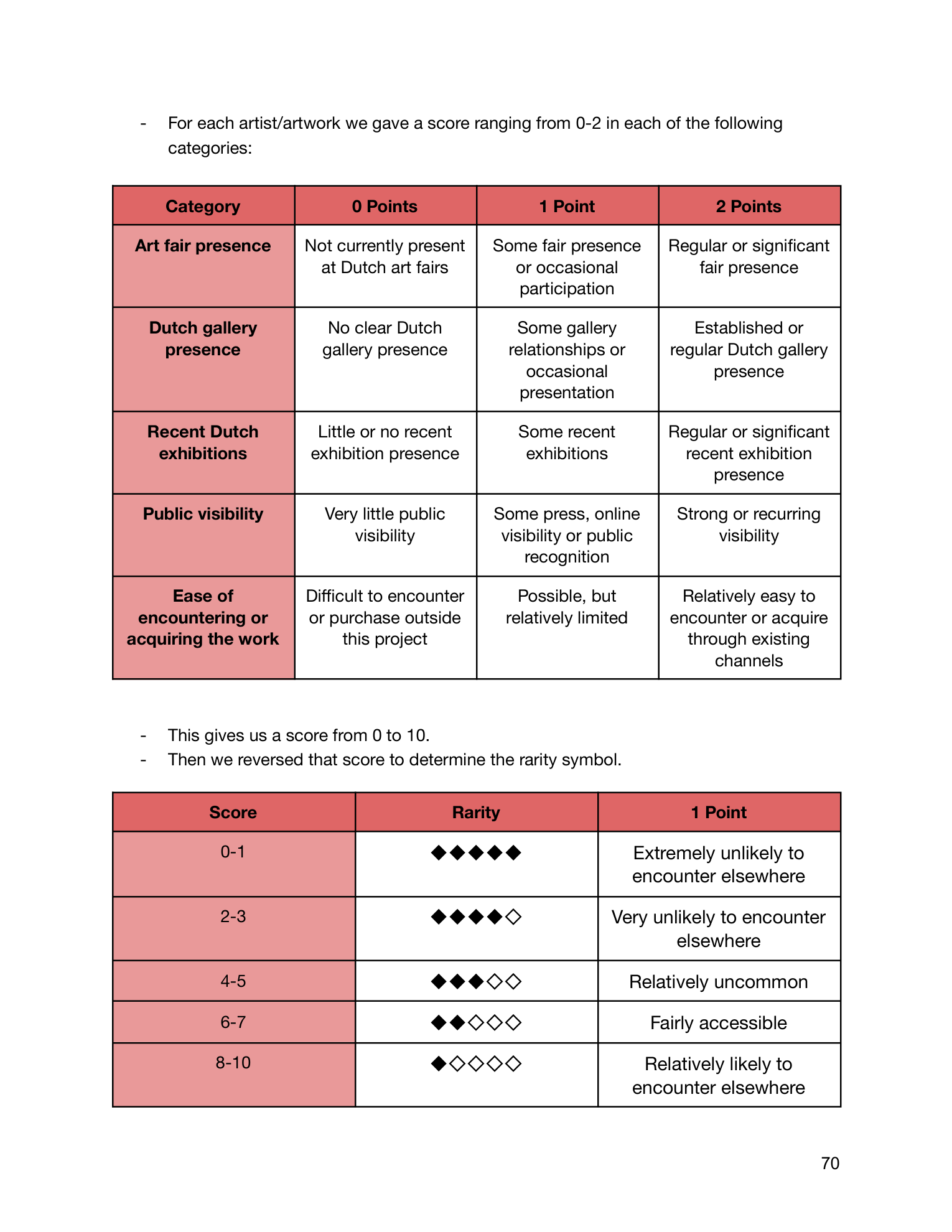
-
For each artist/artwork we gave a score ranging from 0-2 in each of the following
categories:
Category
0 Points
1 Point
2 Points
Art fair presence
Not currently present
at Dutch art fairs
Some fair presence
or occasional
participation
Regular or significant
fair presence
Dutch gallery
presence
No clear Dutch
gallery presence
Some gallery
relationships or
occasional
presentation
Established or
regular Dutch gallery
presence
Recent Dutch
exhibitions
Little or no recent
exhibition presence
Some recent
exhibitions
Regular or significant
recent exhibition
presence
Public visibility
Very little public
visibility
Some press, online
visibility or public
recognition
Strong or recurring
visibility
Ease of
encountering or
acquiring the work
Difficult to encounter
or purchase outside
this project
Possible, but
relatively limited
Relatively easy to
encounter or acquire
through existing
channels
-
This gives us a score from 0 to 10.
-
Then we reversed that score to determine the rarity symbol.
Score
Rarity
1 Point
0-1
◆◆◆◆◆
Extremely unlikely to
encounter elsewhere
2-3
◆◆◆◆◇
Very unlikely to encounter
elsewhere
4-5
◆◆◆◇◇
Relatively uncommon
6-7
◆◆◇◇◇
Fairly accessible
8-10
◆◇◇◇◇
Relatively likely to
encounter elsewhere
70
For each artist/artwork we gave a score ranging from 0-2 in each of the following
categories:
Category
0 Points
1 Point
2 Points
Art fair presence
Not currently present
at Dutch art fairs
Some fair presence
or occasional
participation
Regular or significant
fair presence
Dutch gallery
presence
No clear Dutch
gallery presence
Some gallery
relationships or
occasional
presentation
Established or
regular Dutch gallery
presence
Recent Dutch
exhibitions
Little or no recent
exhibition presence
Some recent
exhibitions
Regular or significant
recent exhibition
presence
Public visibility
Very little public
visibility
Some press, online
visibility or public
recognition
Strong or recurring
visibility
Ease of
encountering or
acquiring the work
Difficult to encounter
or purchase outside
this project
Possible, but
relatively limited
Relatively easy to
encounter or acquire
through existing
channels
-
This gives us a score from 0 to 10.
-
Then we reversed that score to determine the rarity symbol.
Score
Rarity
1 Point
0-1
◆◆◆◆◆
Extremely unlikely to
encounter elsewhere
2-3
◆◆◆◆◇
Very unlikely to encounter
elsewhere
4-5
◆◆◆◇◇
Relatively uncommon
6-7
◆◆◇◇◇
Fairly accessible
8-10
◆◇◇◇◇
Relatively likely to
encounter elsewhere
70

-
So, for example, someone with almost zero exposure or gallery representation might
receive a ◆◆◆◆◆ whereas someone whose work already circulates regularly
through these spaces might receive a ◆◇◇◇◇
71
So, for example, someone with almost zero exposure or gallery representation might
receive a ◆◆◆◆◆ whereas someone whose work already circulates regularly
through these spaces might receive a ◆◇◇◇◇
71
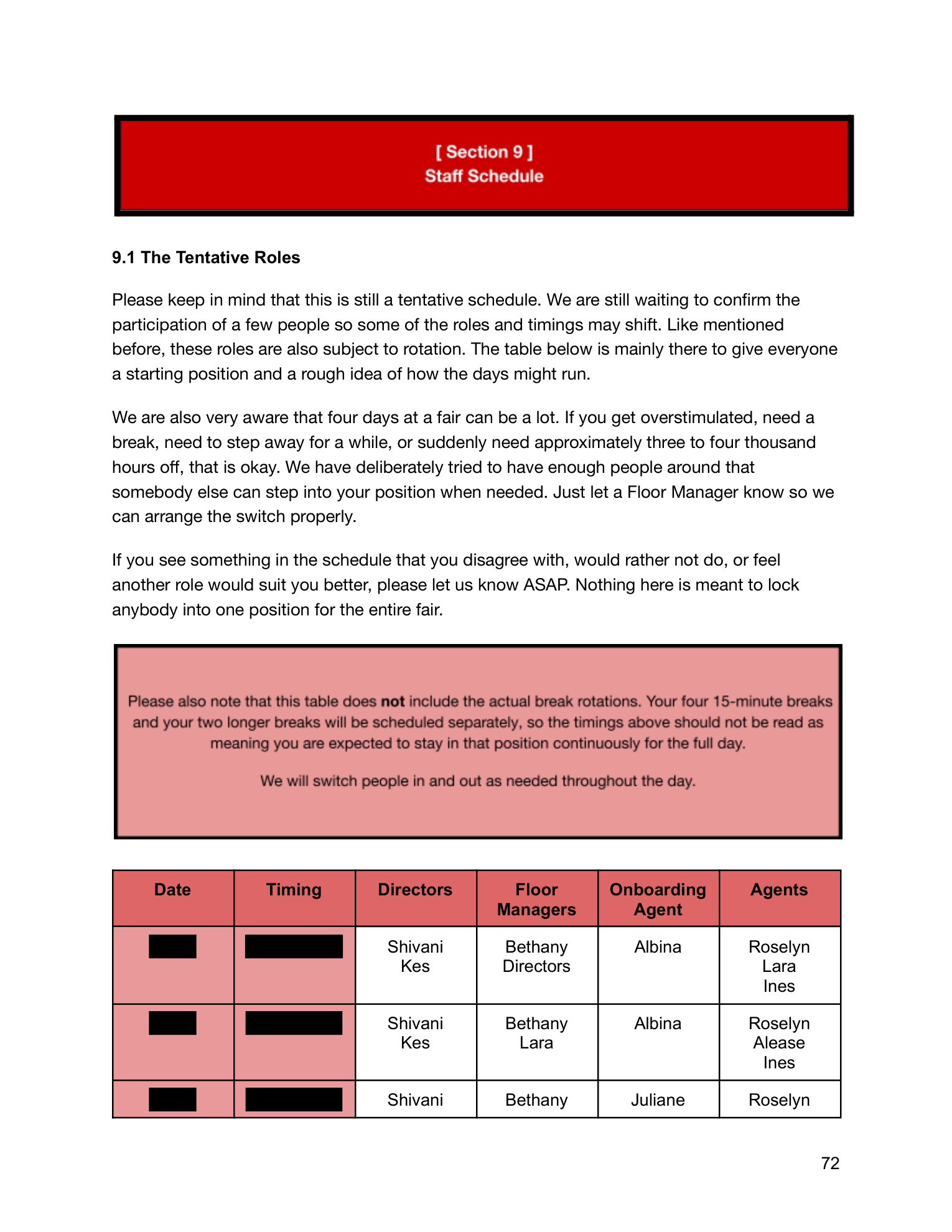
9.1 The Tentative Roles
Please keep in mind that this is still a tentative schedule. We are still waiting to confirm the
participation of a few people so some of the roles and timings may shift. Like mentioned
before, these roles are also subject to rotation. The table below is mainly there to give everyone
a starting position and a rough idea of how the days might run.
We are also very aware that four days at a fair can be a lot. If you get overstimulated, need a
break, need to step away for a while, or suddenly need approximately three to four thousand
hours off, that is okay. We have deliberately tried to have enough people around that
somebody else can step into your position when needed. Just let a Floor Manager know so we
can arrange the switch properly.
If you see something in the schedule that you disagree with, would rather not do, or feel
another role would suit you better, please let us know ASAP. Nothing here is meant to lock
anybody into one position for the entire fair.
Date
Timing
Directors
Floor
Managers
Onboarding
Agent
Agents
Shivani
Kes
Bethany
Directors
Albina
Roselyn
Lara
Ines
Shivani
Kes
Bethany
Lara
Albina
Roselyn
Alease
Ines
Shivani
Bethany
Juliane
Roselyn
72
[Personal information redacted on this page.]
Please keep in mind that this is still a tentative schedule. We are still waiting to confirm the
participation of a few people so some of the roles and timings may shift. Like mentioned
before, these roles are also subject to rotation. The table below is mainly there to give everyone
a starting position and a rough idea of how the days might run.
We are also very aware that four days at a fair can be a lot. If you get overstimulated, need a
break, need to step away for a while, or suddenly need approximately three to four thousand
hours off, that is okay. We have deliberately tried to have enough people around that
somebody else can step into your position when needed. Just let a Floor Manager know so we
can arrange the switch properly.
If you see something in the schedule that you disagree with, would rather not do, or feel
another role would suit you better, please let us know ASAP. Nothing here is meant to lock
anybody into one position for the entire fair.
Date
Timing
Directors
Floor
Managers
Onboarding
Agent
Agents
Shivani
Kes
Bethany
Directors
Albina
Roselyn
Lara
Ines
Shivani
Kes
Bethany
Lara
Albina
Roselyn
Alease
Ines
Shivani
Bethany
Juliane
Roselyn
72
[Personal information redacted on this page.]
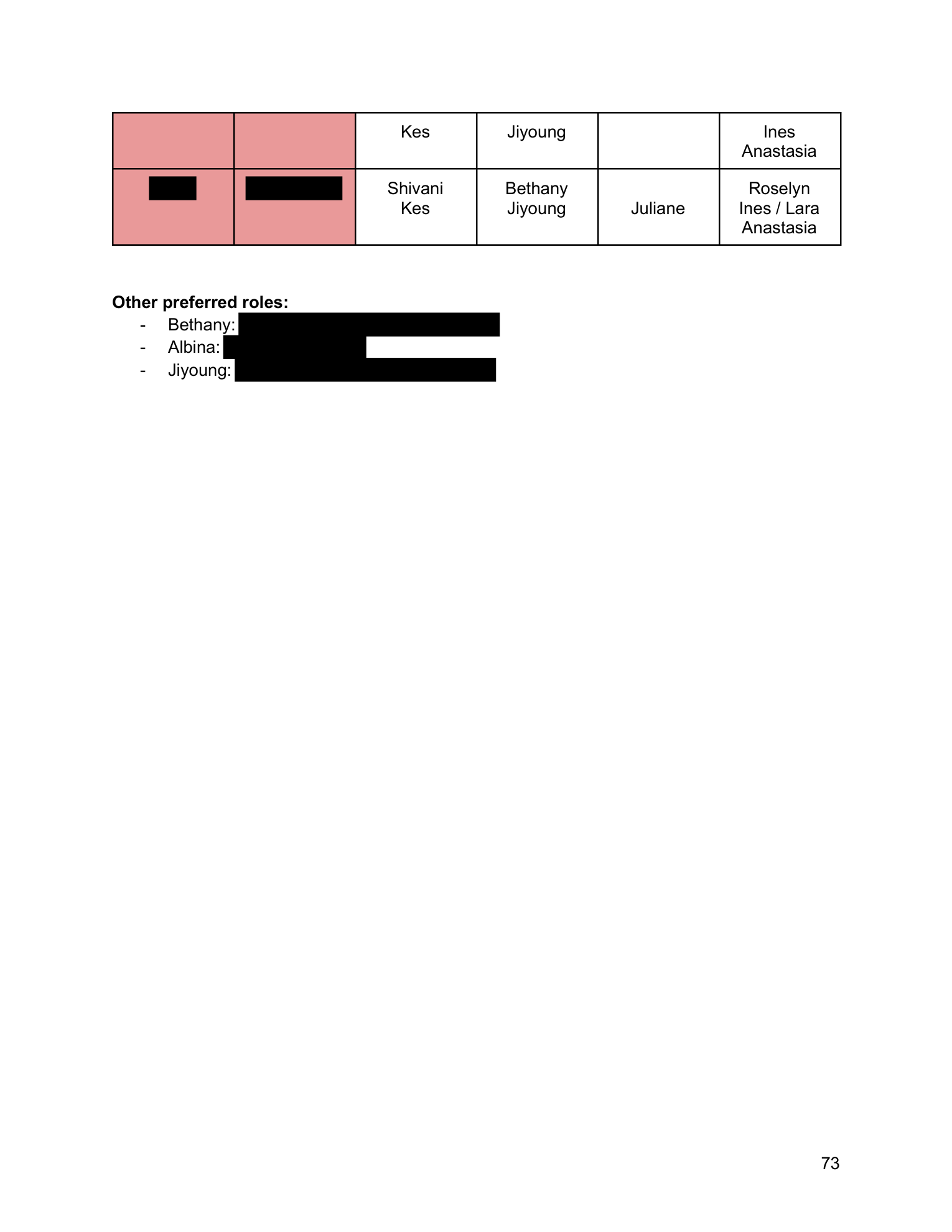
Kes
Jiyoung
Ines
Anastasia
Shivani
Kes
Bethany
Jiyoung
Juliane
Roselyn
Ines / Lara
Anastasia
Other preferred roles:
-
Bethany:
-
Albina:
-
Jiyoung:
73
[Personal information redacted on this page.]
Jiyoung
Ines
Anastasia
Shivani
Kes
Bethany
Jiyoung
Juliane
Roselyn
Ines / Lara
Anastasia
Other preferred roles:
-
Bethany:
-
Albina:
-
Jiyoung:
73
[Personal information redacted on this page.]
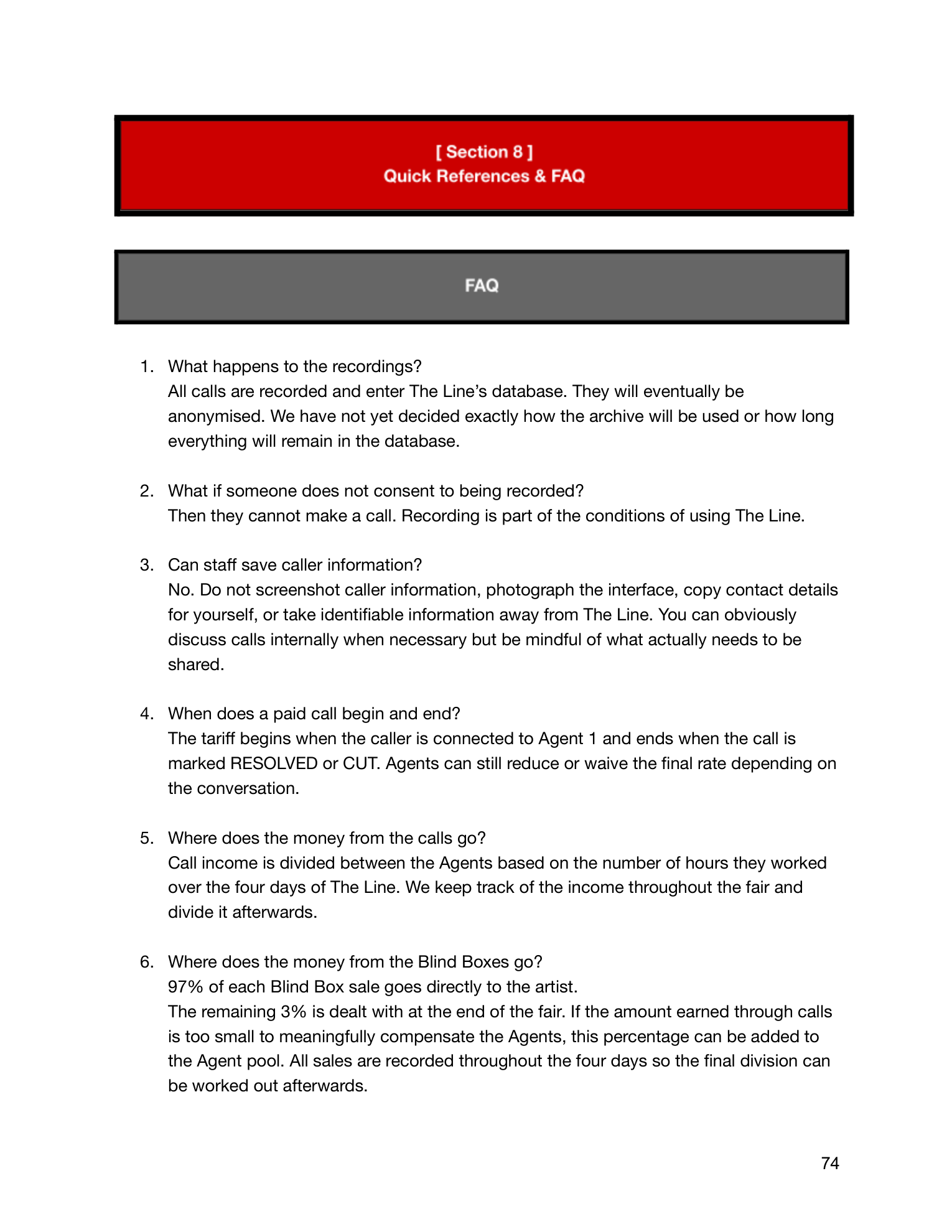
1. What happens to the recordings?
All calls are recorded and enter The Line’s database. They will eventually be
anonymised. We have not yet decided exactly how the archive will be used or how long
everything will remain in the database.
2. What if someone does not consent to being recorded?
Then they cannot make a call. Recording is part of the conditions of using The Line.
3. Can staff save caller information?
No. Do not screenshot caller information, photograph the interface, copy contact details
for yourself, or take identifiable information away from The Line. You can obviously
discuss calls internally when necessary but be mindful of what actually needs to be
shared.
4. When does a paid call begin and end?
The tariff begins when the caller is connected to Agent 1 and ends when the call is
marked RESOLVED or CUT. Agents can still reduce or waive the final rate depending on
the conversation.
5. Where does the money from the calls go?
Call income is divided between the Agents based on the number of hours they worked
over the four days of The Line. We keep track of the income throughout the fair and
divide it afterwards.
6. Where does the money from the Blind Boxes go?
97% of each Blind Box sale goes directly to the artist.
The remaining 3% is dealt with at the end of the fair. If the amount earned through calls
is too small to meaningfully compensate the Agents, this percentage can be added to
the Agent pool. All sales are recorded throughout the four days so the final division can
be worked out afterwards.
74
All calls are recorded and enter The Line’s database. They will eventually be
anonymised. We have not yet decided exactly how the archive will be used or how long
everything will remain in the database.
2. What if someone does not consent to being recorded?
Then they cannot make a call. Recording is part of the conditions of using The Line.
3. Can staff save caller information?
No. Do not screenshot caller information, photograph the interface, copy contact details
for yourself, or take identifiable information away from The Line. You can obviously
discuss calls internally when necessary but be mindful of what actually needs to be
shared.
4. When does a paid call begin and end?
The tariff begins when the caller is connected to Agent 1 and ends when the call is
marked RESOLVED or CUT. Agents can still reduce or waive the final rate depending on
the conversation.
5. Where does the money from the calls go?
Call income is divided between the Agents based on the number of hours they worked
over the four days of The Line. We keep track of the income throughout the fair and
divide it afterwards.
6. Where does the money from the Blind Boxes go?
97% of each Blind Box sale goes directly to the artist.
The remaining 3% is dealt with at the end of the fair. If the amount earned through calls
is too small to meaningfully compensate the Agents, this percentage can be added to
the Agent pool. All sales are recorded throughout the four days so the final division can
be worked out afterwards.
74
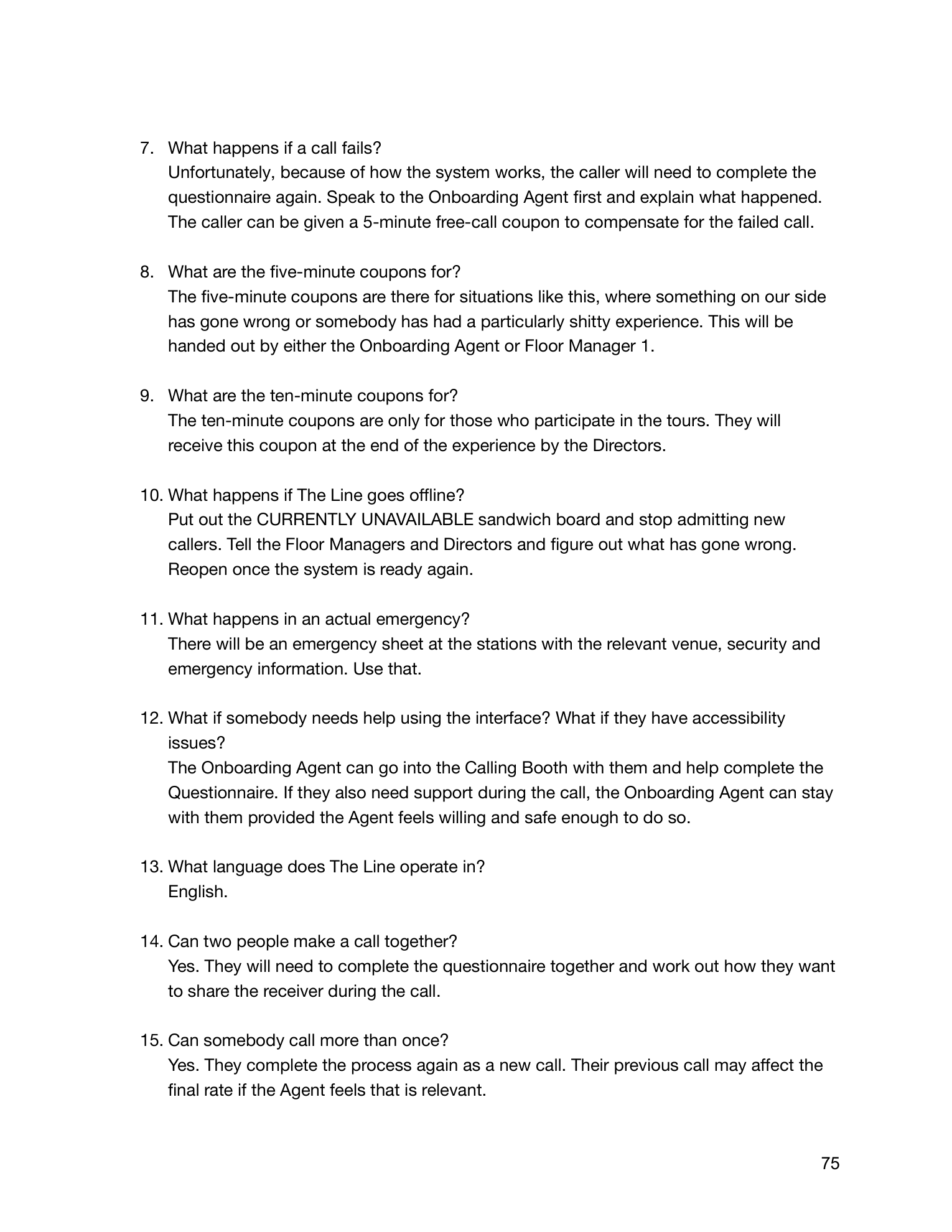
7. What happens if a call fails?
Unfortunately, because of how the system works, the caller will need to complete the
questionnaire again. Speak to the Onboarding Agent first and explain what happened.
The caller can be given a 5-minute free-call coupon to compensate for the failed call.
8. What are the five-minute coupons for?
The five-minute coupons are there for situations like this, where something on our side
has gone wrong or somebody has had a particularly shitty experience. This will be
handed out by either the Onboarding Agent or Floor Manager 1.
9. What are the ten-minute coupons for?
The ten-minute coupons are only for those who participate in the tours. They will
receive this coupon at the end of the experience by the Directors.
10.What happens if The Line goes offline?
Put out the CURRENTLY UNAVAILABLE sandwich board and stop admitting new
callers. Tell the Floor Managers and Directors and figure out what has gone wrong.
Reopen once the system is ready again.
11.What happens in an actual emergency?
There will be an emergency sheet at the stations with the relevant venue, security and
emergency information. Use that.
12.What if somebody needs help using the interface? What if they have accessibility
issues?
The Onboarding Agent can go into the Calling Booth with them and help complete the
Questionnaire. If they also need support during the call, the Onboarding Agent can stay
with them provided the Agent feels willing and safe enough to do so.
13.What language does The Line operate in?
English.
14.Can two people make a call together?
Yes. They will need to complete the questionnaire together and work out how they want
to share the receiver during the call.
15.Can somebody call more than once?
Yes. They complete the process again as a new call. Their previous call may affect the
final rate if the Agent feels that is relevant.
75
Unfortunately, because of how the system works, the caller will need to complete the
questionnaire again. Speak to the Onboarding Agent first and explain what happened.
The caller can be given a 5-minute free-call coupon to compensate for the failed call.
8. What are the five-minute coupons for?
The five-minute coupons are there for situations like this, where something on our side
has gone wrong or somebody has had a particularly shitty experience. This will be
handed out by either the Onboarding Agent or Floor Manager 1.
9. What are the ten-minute coupons for?
The ten-minute coupons are only for those who participate in the tours. They will
receive this coupon at the end of the experience by the Directors.
10.What happens if The Line goes offline?
Put out the CURRENTLY UNAVAILABLE sandwich board and stop admitting new
callers. Tell the Floor Managers and Directors and figure out what has gone wrong.
Reopen once the system is ready again.
11.What happens in an actual emergency?
There will be an emergency sheet at the stations with the relevant venue, security and
emergency information. Use that.
12.What if somebody needs help using the interface? What if they have accessibility
issues?
The Onboarding Agent can go into the Calling Booth with them and help complete the
Questionnaire. If they also need support during the call, the Onboarding Agent can stay
with them provided the Agent feels willing and safe enough to do so.
13.What language does The Line operate in?
English.
14.Can two people make a call together?
Yes. They will need to complete the questionnaire together and work out how they want
to share the receiver during the call.
15.Can somebody call more than once?
Yes. They complete the process again as a new call. Their previous call may affect the
final rate if the Agent feels that is relevant.
75
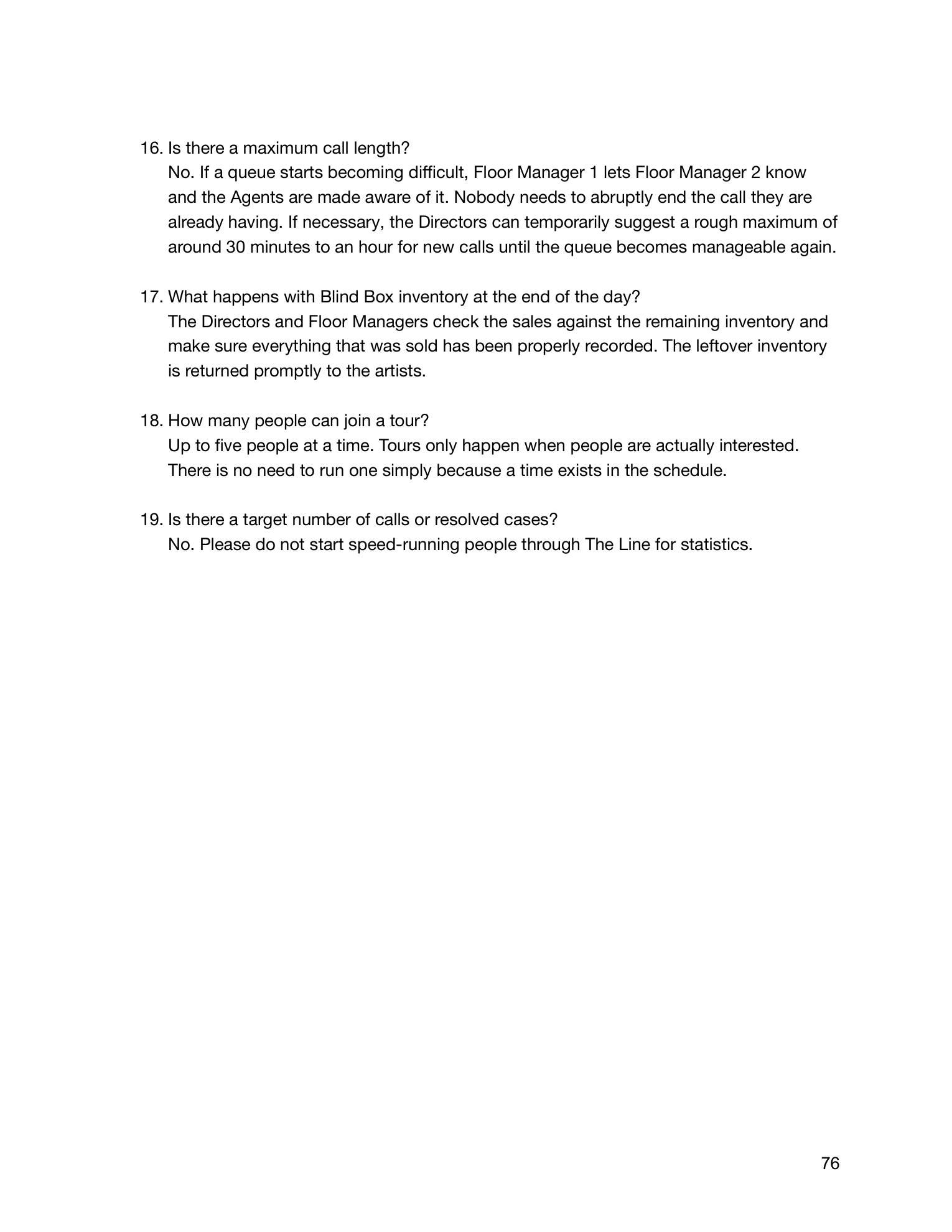
16.Is there a maximum call length?
No. If a queue starts becoming difficult, Floor Manager 1 lets Floor Manager 2 know
and the Agents are made aware of it. Nobody needs to abruptly end the call they are
already having. If necessary, the Directors can temporarily suggest a rough maximum of
around 30 minutes to an hour for new calls until the queue becomes manageable again.
17.What happens with Blind Box inventory at the end of the day?
The Directors and Floor Managers check the sales against the remaining inventory and
make sure everything that was sold has been properly recorded. The leftover inventory
is returned promptly to the artists.
18.How many people can join a tour?
Up to five people at a time. Tours only happen when people are actually interested.
There is no need to run one simply because a time exists in the schedule.
19.Is there a target number of calls or resolved cases?
No. Please do not start speed-running people through The Line for statistics.
76
No. If a queue starts becoming difficult, Floor Manager 1 lets Floor Manager 2 know
and the Agents are made aware of it. Nobody needs to abruptly end the call they are
already having. If necessary, the Directors can temporarily suggest a rough maximum of
around 30 minutes to an hour for new calls until the queue becomes manageable again.
17.What happens with Blind Box inventory at the end of the day?
The Directors and Floor Managers check the sales against the remaining inventory and
make sure everything that was sold has been properly recorded. The leftover inventory
is returned promptly to the artists.
18.How many people can join a tour?
Up to five people at a time. Tours only happen when people are actually interested.
There is no need to run one simply because a time exists in the schedule.
19.Is there a target number of calls or resolved cases?
No. Please do not start speed-running people through The Line for statistics.
76
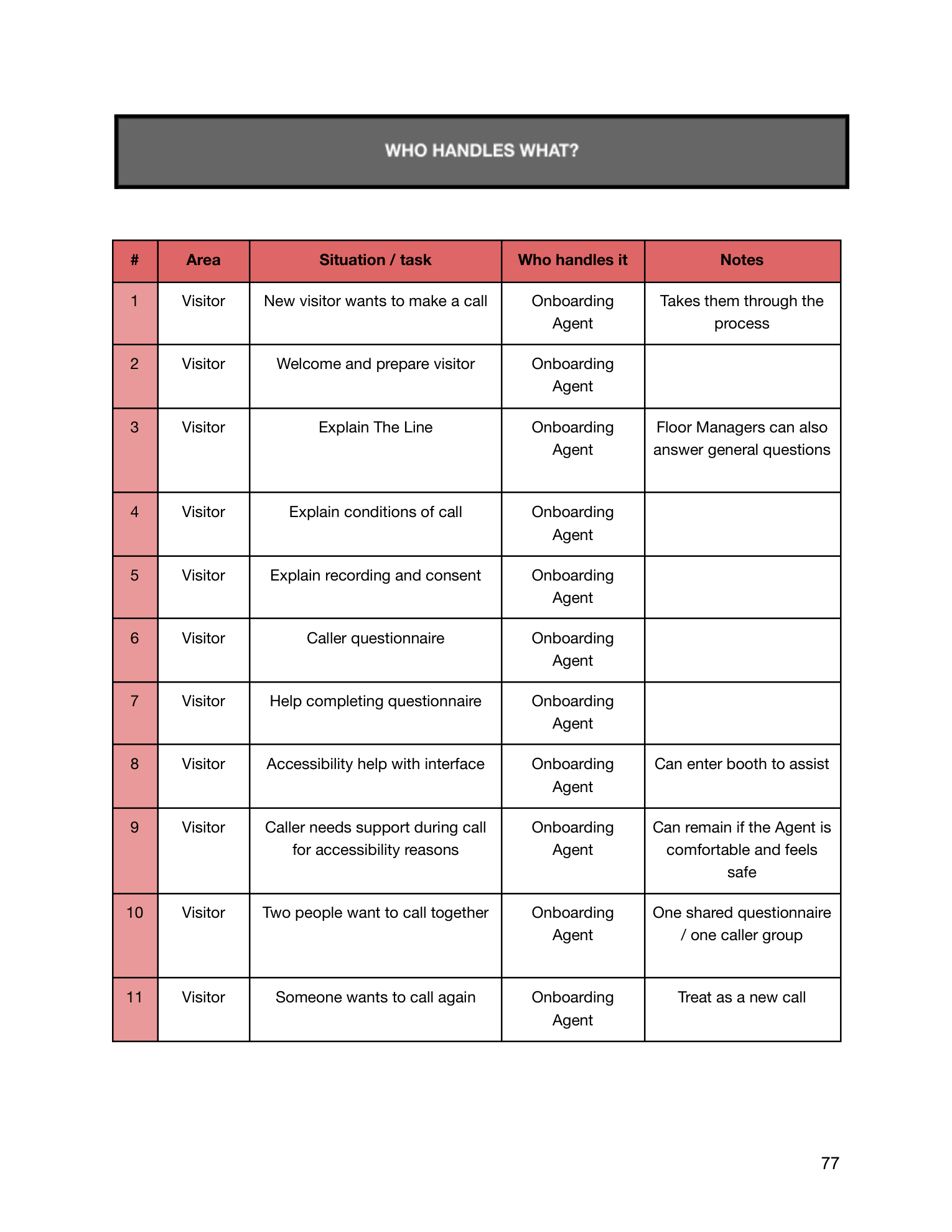
#
Area
Situation / task
Who handles it
Notes
1
Visitor
New visitor wants to make a call
Onboarding
Agent
Takes them through the
process
2
Visitor
Welcome and prepare visitor
Onboarding
Agent
3
Visitor
Explain The Line
Onboarding
Agent
Floor Managers can also
answer general questions
4
Visitor
Explain conditions of call
Onboarding
Agent
5
Visitor
Explain recording and consent
Onboarding
Agent
6
Visitor
Caller questionnaire
Onboarding
Agent
7
Visitor
Help completing questionnaire
Onboarding
Agent
8
Visitor
Accessibility help with interface
Onboarding
Agent
Can enter booth to assist
9
Visitor
Caller needs support during call
for accessibility reasons
Onboarding
Agent
Can remain if the Agent is
comfortable and feels
safe
10
Visitor
Two people want to call together
Onboarding
Agent
One shared questionnaire
/ one caller group
11
Visitor
Someone wants to call again
Onboarding
Agent
Treat as a new call
77
Area
Situation / task
Who handles it
Notes
1
Visitor
New visitor wants to make a call
Onboarding
Agent
Takes them through the
process
2
Visitor
Welcome and prepare visitor
Onboarding
Agent
3
Visitor
Explain The Line
Onboarding
Agent
Floor Managers can also
answer general questions
4
Visitor
Explain conditions of call
Onboarding
Agent
5
Visitor
Explain recording and consent
Onboarding
Agent
6
Visitor
Caller questionnaire
Onboarding
Agent
7
Visitor
Help completing questionnaire
Onboarding
Agent
8
Visitor
Accessibility help with interface
Onboarding
Agent
Can enter booth to assist
9
Visitor
Caller needs support during call
for accessibility reasons
Onboarding
Agent
Can remain if the Agent is
comfortable and feels
safe
10
Visitor
Two people want to call together
Onboarding
Agent
One shared questionnaire
/ one caller group
11
Visitor
Someone wants to call again
Onboarding
Agent
Treat as a new call
77
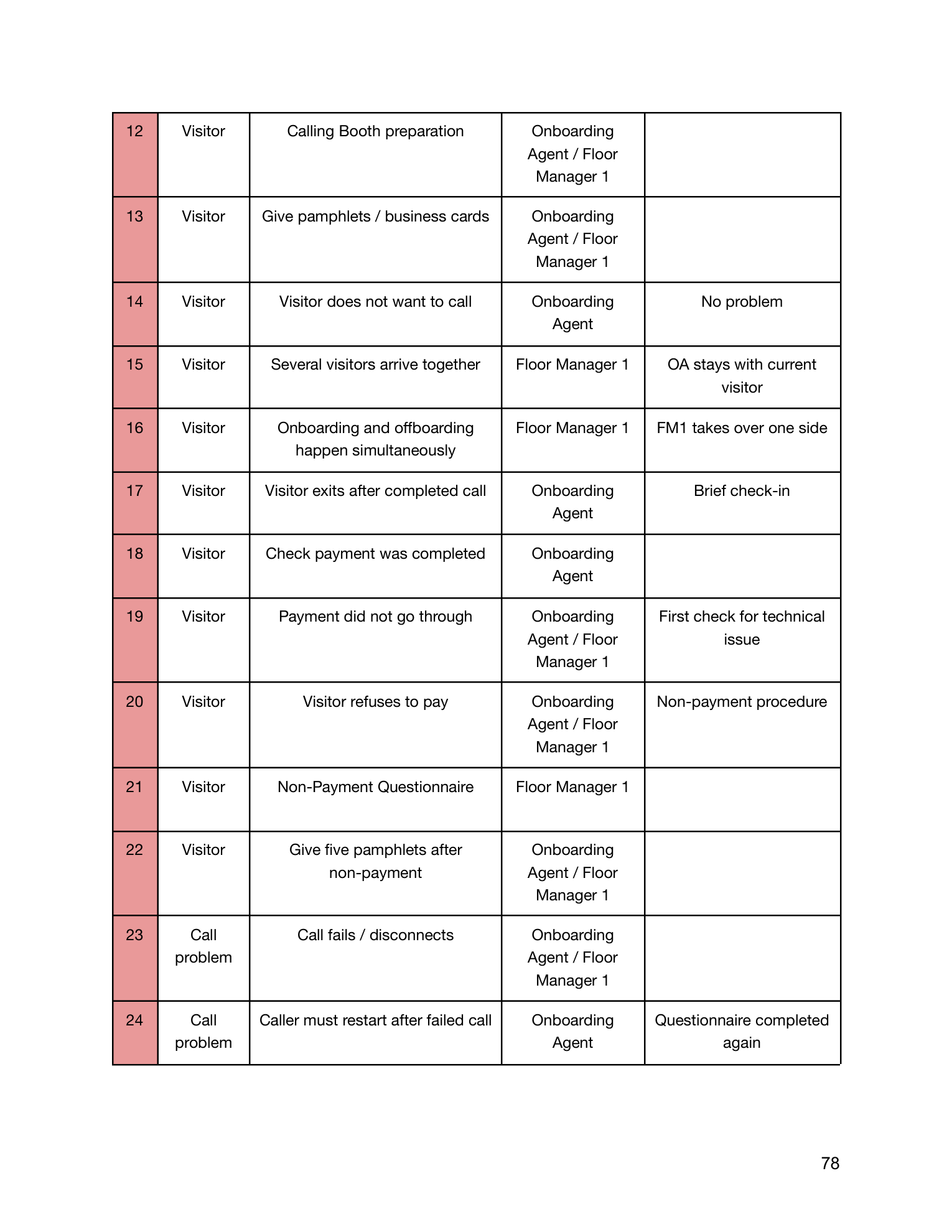
12
Visitor
Calling Booth preparation
Onboarding
Agent / Floor
Manager 1
13
Visitor
Give pamphlets / business cards
Onboarding
Agent / Floor
Manager 1
14
Visitor
Visitor does not want to call
Onboarding
Agent
No problem
15
Visitor
Several visitors arrive together
Floor Manager 1
OA stays with current
visitor
16
Visitor
Onboarding and offboarding
happen simultaneously
Floor Manager 1
FM1 takes over one side
17
Visitor
Visitor exits after completed call
Onboarding
Agent
Brief check-in
18
Visitor
Check payment was completed
Onboarding
Agent
19
Visitor
Payment did not go through
Onboarding
Agent / Floor
Manager 1
First check for technical
issue
20
Visitor
Visitor refuses to pay
Onboarding
Agent / Floor
Manager 1
Non-payment procedure
21
Visitor
Non-Payment Questionnaire
Floor Manager 1
22
Visitor
Give five pamphlets after
non-payment
Onboarding
Agent / Floor
Manager 1
23
Call
problem
Call fails / disconnects
Onboarding
Agent / Floor
Manager 1
24
Call
problem
Caller must restart after failed call
Onboarding
Agent
Questionnaire completed
again
78
Visitor
Calling Booth preparation
Onboarding
Agent / Floor
Manager 1
13
Visitor
Give pamphlets / business cards
Onboarding
Agent / Floor
Manager 1
14
Visitor
Visitor does not want to call
Onboarding
Agent
No problem
15
Visitor
Several visitors arrive together
Floor Manager 1
OA stays with current
visitor
16
Visitor
Onboarding and offboarding
happen simultaneously
Floor Manager 1
FM1 takes over one side
17
Visitor
Visitor exits after completed call
Onboarding
Agent
Brief check-in
18
Visitor
Check payment was completed
Onboarding
Agent
19
Visitor
Payment did not go through
Onboarding
Agent / Floor
Manager 1
First check for technical
issue
20
Visitor
Visitor refuses to pay
Onboarding
Agent / Floor
Manager 1
Non-payment procedure
21
Visitor
Non-Payment Questionnaire
Floor Manager 1
22
Visitor
Give five pamphlets after
non-payment
Onboarding
Agent / Floor
Manager 1
23
Call
problem
Call fails / disconnects
Onboarding
Agent / Floor
Manager 1
24
Call
problem
Caller must restart after failed call
Onboarding
Agent
Questionnaire completed
again
78
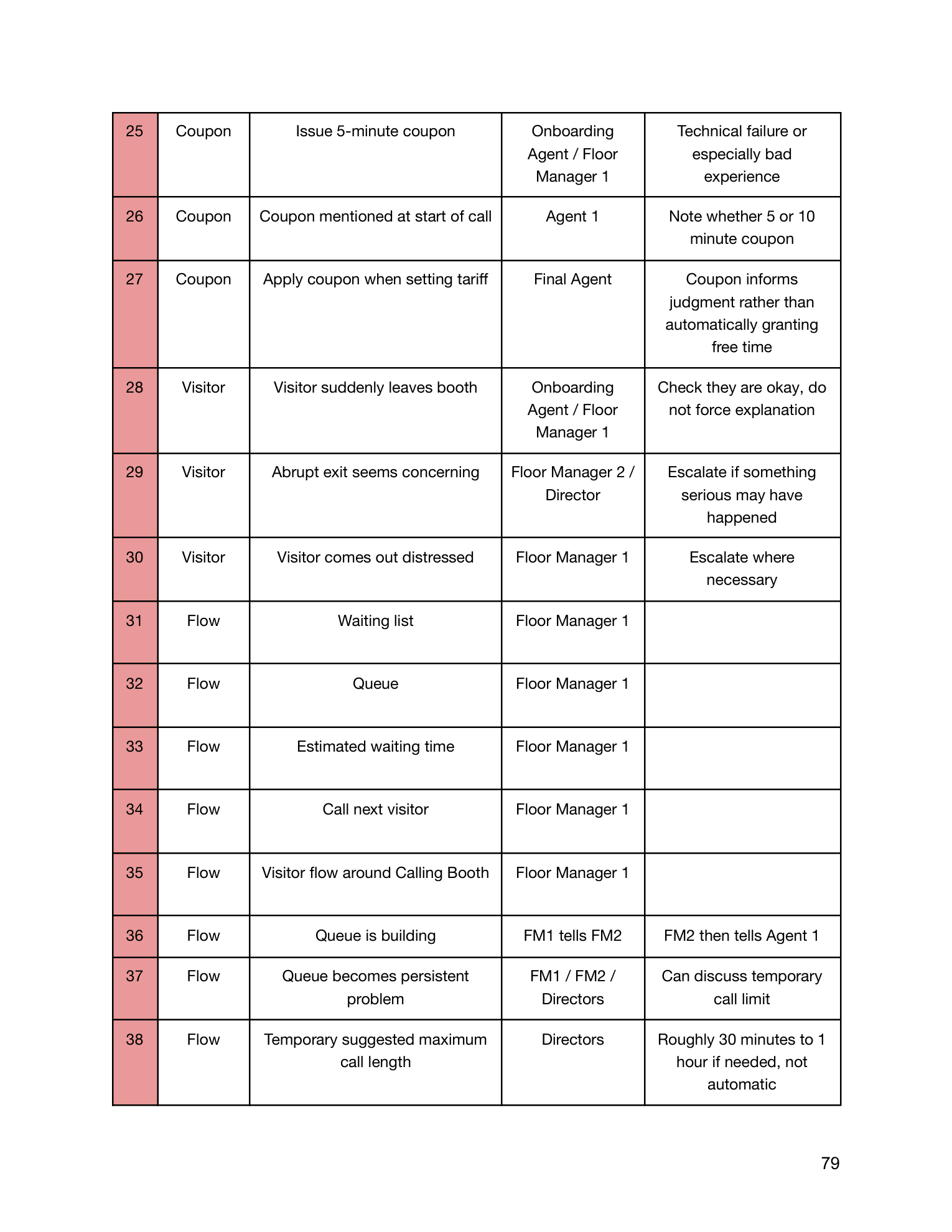
25
Coupon
Issue 5-minute coupon
Onboarding
Agent / Floor
Manager 1
Technical failure or
especially bad
experience
26
Coupon
Coupon mentioned at start of call
Agent 1
Note whether 5 or 10
minute coupon
27
Coupon
Apply coupon when setting tariff
Final Agent
Coupon informs
judgment rather than
automatically granting
free time
28
Visitor
Visitor suddenly leaves booth
Onboarding
Agent / Floor
Manager 1
Check they are okay, do
not force explanation
29
Visitor
Abrupt exit seems concerning
Floor Manager 2 /
Director
Escalate if something
serious may have
happened
30
Visitor
Visitor comes out distressed
Floor Manager 1
Escalate where
necessary
31
Flow
Waiting list
Floor Manager 1
32
Flow
Queue
Floor Manager 1
33
Flow
Estimated waiting time
Floor Manager 1
34
Flow
Call next visitor
Floor Manager 1
35
Flow
Visitor flow around Calling Booth
Floor Manager 1
36
Flow
Queue is building
FM1 tells FM2
FM2 then tells Agent 1
37
Flow
Queue becomes persistent
problem
FM1 / FM2 /
Directors
Can discuss temporary
call limit
38
Flow
Temporary suggested maximum
call length
Directors
Roughly 30 minutes to 1
hour if needed, not
automatic
79
Coupon
Issue 5-minute coupon
Onboarding
Agent / Floor
Manager 1
Technical failure or
especially bad
experience
26
Coupon
Coupon mentioned at start of call
Agent 1
Note whether 5 or 10
minute coupon
27
Coupon
Apply coupon when setting tariff
Final Agent
Coupon informs
judgment rather than
automatically granting
free time
28
Visitor
Visitor suddenly leaves booth
Onboarding
Agent / Floor
Manager 1
Check they are okay, do
not force explanation
29
Visitor
Abrupt exit seems concerning
Floor Manager 2 /
Director
Escalate if something
serious may have
happened
30
Visitor
Visitor comes out distressed
Floor Manager 1
Escalate where
necessary
31
Flow
Waiting list
Floor Manager 1
32
Flow
Queue
Floor Manager 1
33
Flow
Estimated waiting time
Floor Manager 1
34
Flow
Call next visitor
Floor Manager 1
35
Flow
Visitor flow around Calling Booth
Floor Manager 1
36
Flow
Queue is building
FM1 tells FM2
FM2 then tells Agent 1
37
Flow
Queue becomes persistent
problem
FM1 / FM2 /
Directors
Can discuss temporary
call limit
38
Flow
Temporary suggested maximum
call length
Directors
Roughly 30 minutes to 1
hour if needed, not
automatic
79
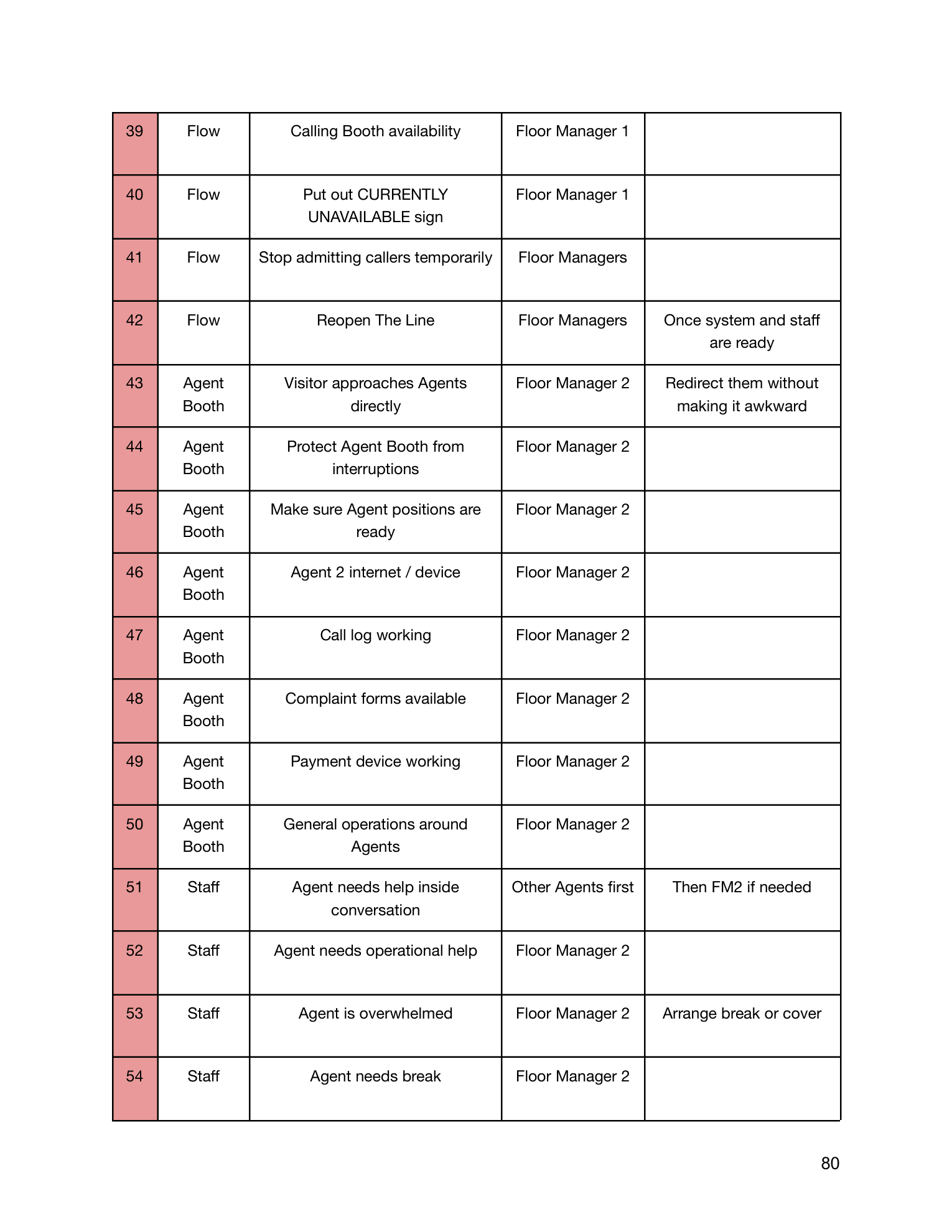
39
Flow
Calling Booth availability
Floor Manager 1
40
Flow
Put out CURRENTLY
UNAVAILABLE sign
Floor Manager 1
41
Flow
Stop admitting callers temporarily
Floor Managers
42
Flow
Reopen The Line
Floor Managers
Once system and staff
are ready
43
Agent
Booth
Visitor approaches Agents
directly
Floor Manager 2
Redirect them without
making it awkward
44
Agent
Booth
Protect Agent Booth from
interruptions
Floor Manager 2
45
Agent
Booth
Make sure Agent positions are
ready
Floor Manager 2
46
Agent
Booth
Agent 2 internet / device
Floor Manager 2
47
Agent
Booth
Call log working
Floor Manager 2
48
Agent
Booth
Complaint forms available
Floor Manager 2
49
Agent
Booth
Payment device working
Floor Manager 2
50
Agent
Booth
General operations around
Agents
Floor Manager 2
51
Staff
Agent needs help inside
conversation
Other Agents first
Then FM2 if needed
52
Staff
Agent needs operational help
Floor Manager 2
53
Staff
Agent is overwhelmed
Floor Manager 2
Arrange break or cover
54
Staff
Agent needs break
Floor Manager 2
80
Flow
Calling Booth availability
Floor Manager 1
40
Flow
Put out CURRENTLY
UNAVAILABLE sign
Floor Manager 1
41
Flow
Stop admitting callers temporarily
Floor Managers
42
Flow
Reopen The Line
Floor Managers
Once system and staff
are ready
43
Agent
Booth
Visitor approaches Agents
directly
Floor Manager 2
Redirect them without
making it awkward
44
Agent
Booth
Protect Agent Booth from
interruptions
Floor Manager 2
45
Agent
Booth
Make sure Agent positions are
ready
Floor Manager 2
46
Agent
Booth
Agent 2 internet / device
Floor Manager 2
47
Agent
Booth
Call log working
Floor Manager 2
48
Agent
Booth
Complaint forms available
Floor Manager 2
49
Agent
Booth
Payment device working
Floor Manager 2
50
Agent
Booth
General operations around
Agents
Floor Manager 2
51
Staff
Agent needs help inside
conversation
Other Agents first
Then FM2 if needed
52
Staff
Agent needs operational help
Floor Manager 2
53
Staff
Agent is overwhelmed
Floor Manager 2
Arrange break or cover
54
Staff
Agent needs break
Floor Manager 2
80
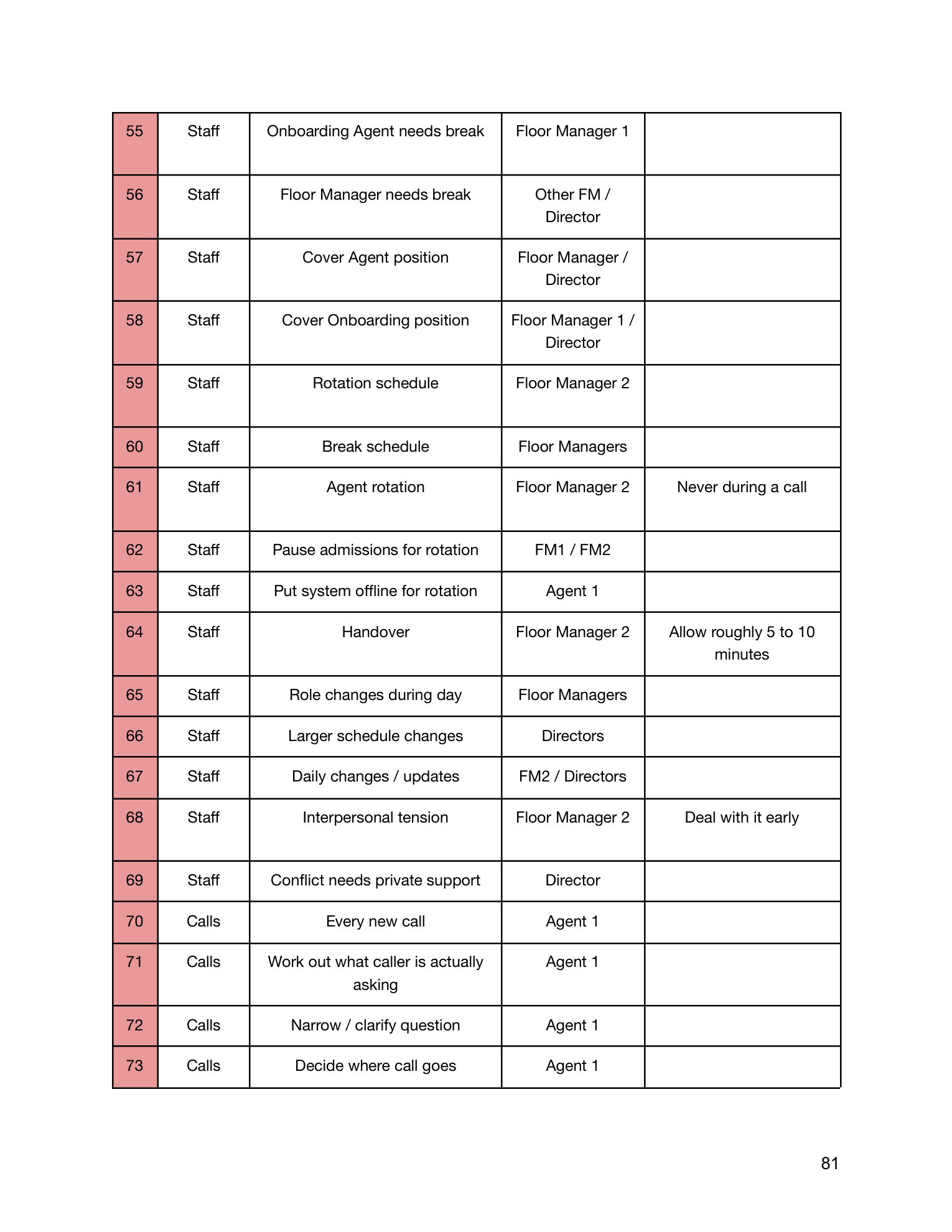
55
Staff
Onboarding Agent needs break
Floor Manager 1
56
Staff
Floor Manager needs break
Other FM /
Director
57
Staff
Cover Agent position
Floor Manager /
Director
58
Staff
Cover Onboarding position
Floor Manager 1 /
Director
59
Staff
Rotation schedule
Floor Manager 2
60
Staff
Break schedule
Floor Managers
61
Staff
Agent rotation
Floor Manager 2
Never during a call
62
Staff
Pause admissions for rotation
FM1 / FM2
63
Staff
Put system offline for rotation
Agent 1
64
Staff
Handover
Floor Manager 2
Allow roughly 5 to 10
minutes
65
Staff
Role changes during day
Floor Managers
66
Staff
Larger schedule changes
Directors
67
Staff
Daily changes / updates
FM2 / Directors
68
Staff
Interpersonal tension
Floor Manager 2
Deal with it early
69
Staff
Conflict needs private support
Director
70
Calls
Every new call
Agent 1
71
Calls
Work out what caller is actually
asking
Agent 1
72
Calls
Narrow / clarify question
Agent 1
73
Calls
Decide where call goes
Agent 1
81
Staff
Onboarding Agent needs break
Floor Manager 1
56
Staff
Floor Manager needs break
Other FM /
Director
57
Staff
Cover Agent position
Floor Manager /
Director
58
Staff
Cover Onboarding position
Floor Manager 1 /
Director
59
Staff
Rotation schedule
Floor Manager 2
60
Staff
Break schedule
Floor Managers
61
Staff
Agent rotation
Floor Manager 2
Never during a call
62
Staff
Pause admissions for rotation
FM1 / FM2
63
Staff
Put system offline for rotation
Agent 1
64
Staff
Handover
Floor Manager 2
Allow roughly 5 to 10
minutes
65
Staff
Role changes during day
Floor Managers
66
Staff
Larger schedule changes
Directors
67
Staff
Daily changes / updates
FM2 / Directors
68
Staff
Interpersonal tension
Floor Manager 2
Deal with it early
69
Staff
Conflict needs private support
Director
70
Calls
Every new call
Agent 1
71
Calls
Work out what caller is actually
asking
Agent 1
72
Calls
Narrow / clarify question
Agent 1
73
Calls
Decide where call goes
Agent 1
81
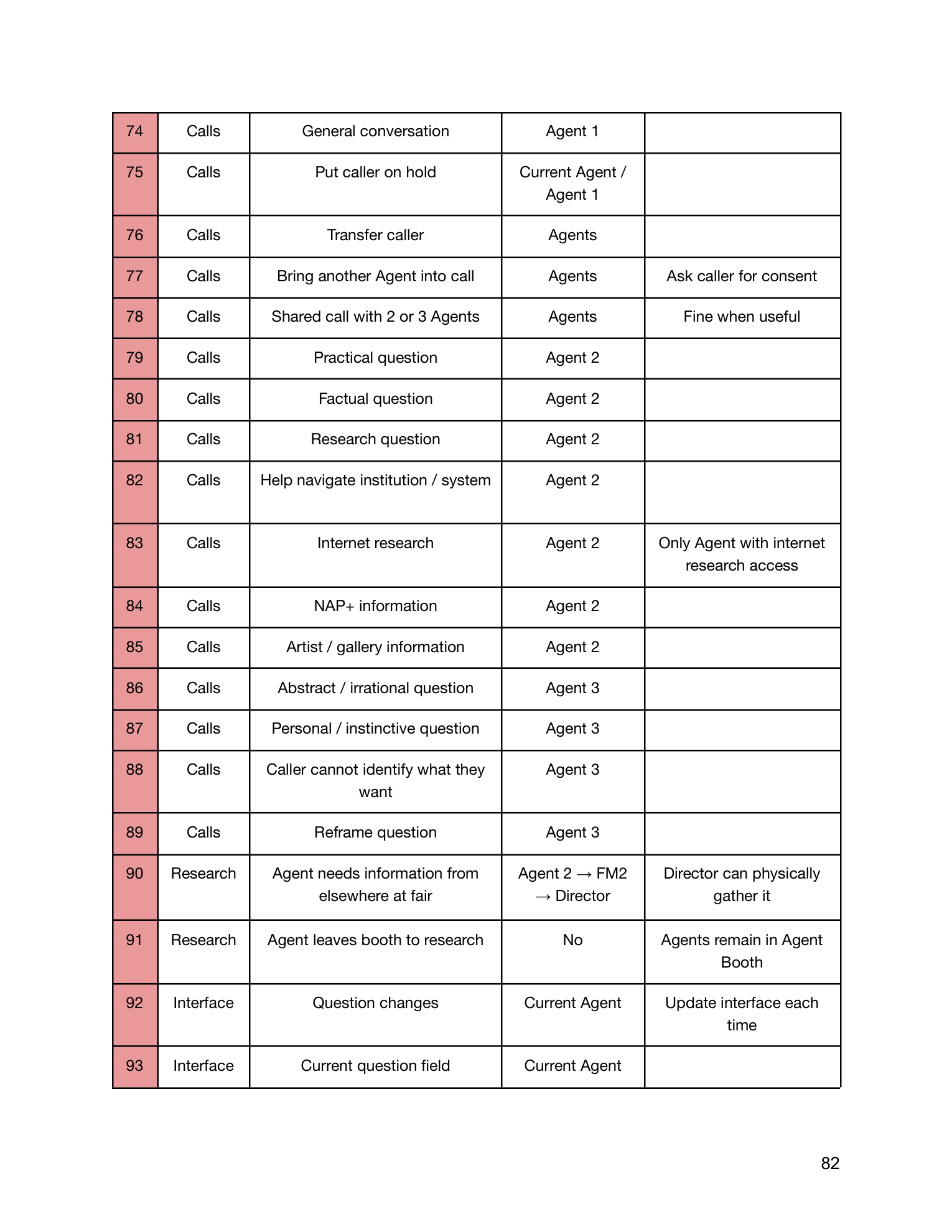
74
Calls
General conversation
Agent 1
75
Calls
Put caller on hold
Current Agent /
Agent 1
76
Calls
Transfer caller
Agents
77
Calls
Bring another Agent into call
Agents
Ask caller for consent
78
Calls
Shared call with 2 or 3 Agents
Agents
Fine when useful
79
Calls
Practical question
Agent 2
80
Calls
Factual question
Agent 2
81
Calls
Research question
Agent 2
82
Calls
Help navigate institution / system
Agent 2
83
Calls
Internet research
Agent 2
Only Agent with internet
research access
84
Calls
NAP+ information
Agent 2
85
Calls
Artist / gallery information
Agent 2
86
Calls
Abstract / irrational question
Agent 3
87
Calls
Personal / instinctive question
Agent 3
88
Calls
Caller cannot identify what they
want
Agent 3
89
Calls
Reframe question
Agent 3
90
Research
Agent needs information from
elsewhere at fair
Agent 2 → FM2
→ Director
Director can physically
gather it
91
Research
Agent leaves booth to research
No
Agents remain in Agent
Booth
92
Interface
Question changes
Current Agent
Update interface each
time
93
Interface
Current question field
Current Agent
82
Calls
General conversation
Agent 1
75
Calls
Put caller on hold
Current Agent /
Agent 1
76
Calls
Transfer caller
Agents
77
Calls
Bring another Agent into call
Agents
Ask caller for consent
78
Calls
Shared call with 2 or 3 Agents
Agents
Fine when useful
79
Calls
Practical question
Agent 2
80
Calls
Factual question
Agent 2
81
Calls
Research question
Agent 2
82
Calls
Help navigate institution / system
Agent 2
83
Calls
Internet research
Agent 2
Only Agent with internet
research access
84
Calls
NAP+ information
Agent 2
85
Calls
Artist / gallery information
Agent 2
86
Calls
Abstract / irrational question
Agent 3
87
Calls
Personal / instinctive question
Agent 3
88
Calls
Caller cannot identify what they
want
Agent 3
89
Calls
Reframe question
Agent 3
90
Research
Agent needs information from
elsewhere at fair
Agent 2 → FM2
→ Director
Director can physically
gather it
91
Research
Agent leaves booth to research
No
Agents remain in Agent
Booth
92
Interface
Question changes
Current Agent
Update interface each
time
93
Interface
Current question field
Current Agent
82
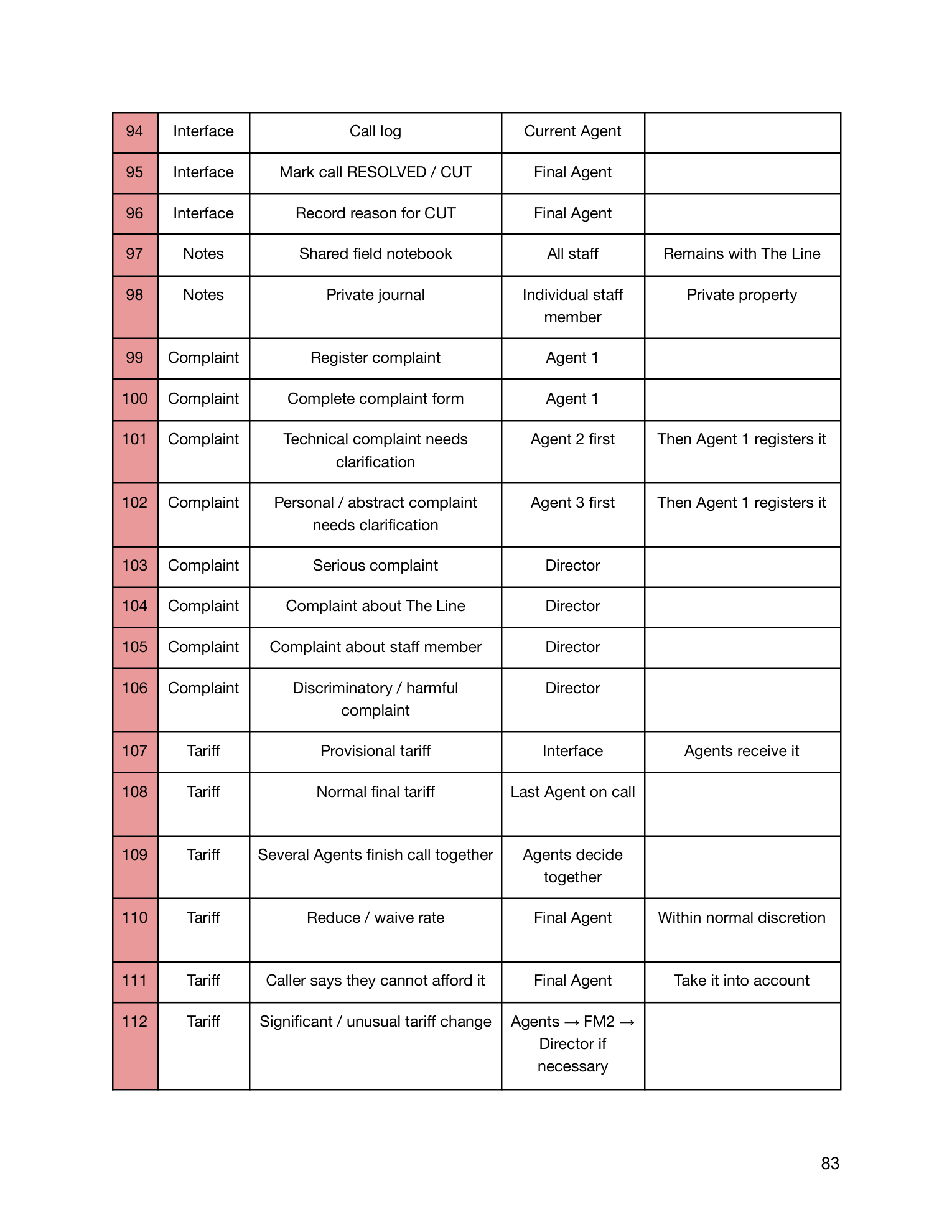
94
Interface
Call log
Current Agent
95
Interface
Mark call RESOLVED / CUT
Final Agent
96
Interface
Record reason for CUT
Final Agent
97
Notes
Shared field notebook
All staff
Remains with The Line
98
Notes
Private journal
Individual staff
member
Private property
99
Complaint
Register complaint
Agent 1
100
Complaint
Complete complaint form
Agent 1
101
Complaint
Technical complaint needs
clarification
Agent 2 first
Then Agent 1 registers it
102
Complaint
Personal / abstract complaint
needs clarification
Agent 3 first
Then Agent 1 registers it
103
Complaint
Serious complaint
Director
104
Complaint
Complaint about The Line
Director
105
Complaint
Complaint about staff member
Director
106
Complaint
Discriminatory / harmful
complaint
Director
107
Tariff
Provisional tariff
Interface
Agents receive it
108
Tariff
Normal final tariff
Last Agent on call
109
Tariff
Several Agents finish call together
Agents decide
together
110
Tariff
Reduce / waive rate
Final Agent
Within normal discretion
111
Tariff
Caller says they cannot afford it
Final Agent
Take it into account
112
Tariff
Significant / unusual tariff change
Agents → FM2 →
Director if
necessary
83
Interface
Call log
Current Agent
95
Interface
Mark call RESOLVED / CUT
Final Agent
96
Interface
Record reason for CUT
Final Agent
97
Notes
Shared field notebook
All staff
Remains with The Line
98
Notes
Private journal
Individual staff
member
Private property
99
Complaint
Register complaint
Agent 1
100
Complaint
Complete complaint form
Agent 1
101
Complaint
Technical complaint needs
clarification
Agent 2 first
Then Agent 1 registers it
102
Complaint
Personal / abstract complaint
needs clarification
Agent 3 first
Then Agent 1 registers it
103
Complaint
Serious complaint
Director
104
Complaint
Complaint about The Line
Director
105
Complaint
Complaint about staff member
Director
106
Complaint
Discriminatory / harmful
complaint
Director
107
Tariff
Provisional tariff
Interface
Agents receive it
108
Tariff
Normal final tariff
Last Agent on call
109
Tariff
Several Agents finish call together
Agents decide
together
110
Tariff
Reduce / waive rate
Final Agent
Within normal discretion
111
Tariff
Caller says they cannot afford it
Final Agent
Take it into account
112
Tariff
Significant / unusual tariff change
Agents → FM2 →
Director if
necessary
83
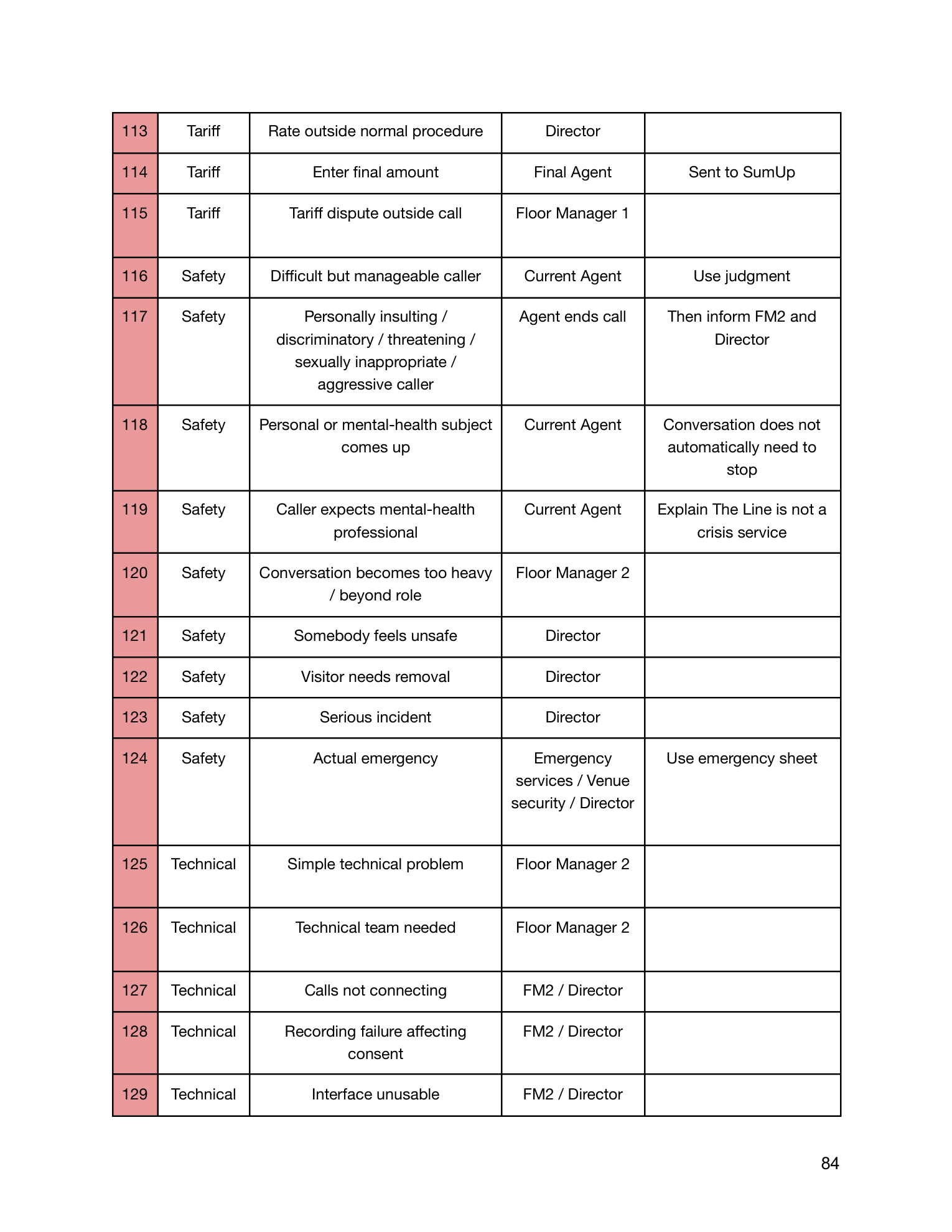
113
Tariff
Rate outside normal procedure
Director
114
Tariff
Enter final amount
Final Agent
Sent to SumUp
115
Tariff
Tariff dispute outside call
Floor Manager 1
116
Safety
Difficult but manageable caller
Current Agent
Use judgment
117
Safety
Personally insulting /
discriminatory / threatening /
sexually inappropriate /
aggressive caller
Agent ends call
Then inform FM2 and
Director
118
Safety
Personal or mental-health subject
comes up
Current Agent
Conversation does not
automatically need to
stop
119
Safety
Caller expects mental-health
professional
Current Agent
Explain The Line is not a
crisis service
120
Safety
Conversation becomes too heavy
/ beyond role
Floor Manager 2
121
Safety
Somebody feels unsafe
Director
122
Safety
Visitor needs removal
Director
123
Safety
Serious incident
Director
124
Safety
Actual emergency
Emergency
services / Venue
security / Director
Use emergency sheet
125
Technical
Simple technical problem
Floor Manager 2
126
Technical
Technical team needed
Floor Manager 2
127
Technical
Calls not connecting
FM2 / Director
128
Technical
Recording failure affecting
consent
FM2 / Director
129
Technical
Interface unusable
FM2 / Director
84
Tariff
Rate outside normal procedure
Director
114
Tariff
Enter final amount
Final Agent
Sent to SumUp
115
Tariff
Tariff dispute outside call
Floor Manager 1
116
Safety
Difficult but manageable caller
Current Agent
Use judgment
117
Safety
Personally insulting /
discriminatory / threatening /
sexually inappropriate /
aggressive caller
Agent ends call
Then inform FM2 and
Director
118
Safety
Personal or mental-health subject
comes up
Current Agent
Conversation does not
automatically need to
stop
119
Safety
Caller expects mental-health
professional
Current Agent
Explain The Line is not a
crisis service
120
Safety
Conversation becomes too heavy
/ beyond role
Floor Manager 2
121
Safety
Somebody feels unsafe
Director
122
Safety
Visitor needs removal
Director
123
Safety
Serious incident
Director
124
Safety
Actual emergency
Emergency
services / Venue
security / Director
Use emergency sheet
125
Technical
Simple technical problem
Floor Manager 2
126
Technical
Technical team needed
Floor Manager 2
127
Technical
Calls not connecting
FM2 / Director
128
Technical
Recording failure affecting
consent
FM2 / Director
129
Technical
Interface unusable
FM2 / Director
84
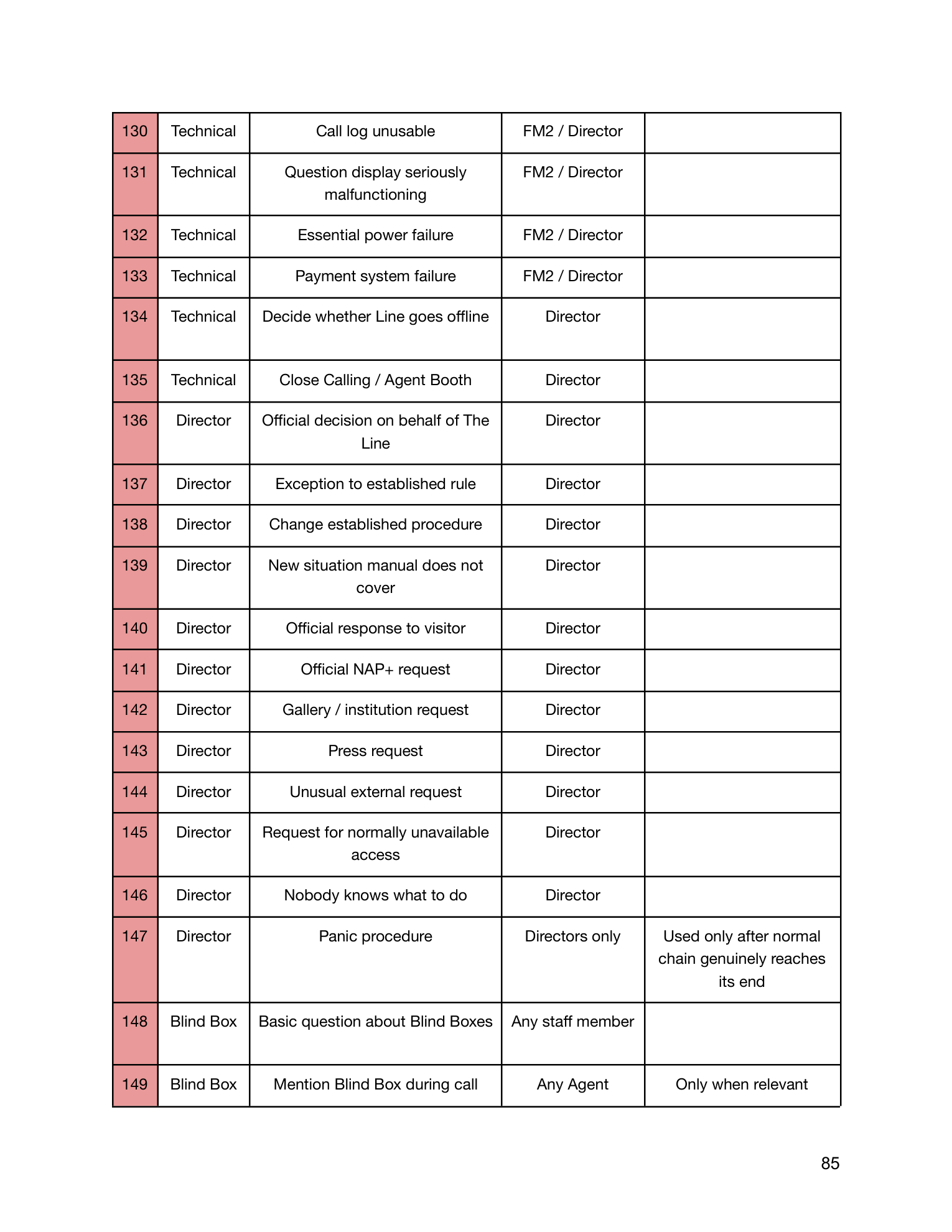
130
Technical
Call log unusable
FM2 / Director
131
Technical
Question display seriously
malfunctioning
FM2 / Director
132
Technical
Essential power failure
FM2 / Director
133
Technical
Payment system failure
FM2 / Director
134
Technical
Decide whether Line goes offline
Director
135
Technical
Close Calling / Agent Booth
Director
136
Director
Official decision on behalf of The
Line
Director
137
Director
Exception to established rule
Director
138
Director
Change established procedure
Director
139
Director
New situation manual does not
cover
Director
140
Director
Official response to visitor
Director
141
Director
Official NAP+ request
Director
142
Director
Gallery / institution request
Director
143
Director
Press request
Director
144
Director
Unusual external request
Director
145
Director
Request for normally unavailable
access
Director
146
Director
Nobody knows what to do
Director
147
Director
Panic procedure
Directors only
Used only after normal
chain genuinely reaches
its end
148
Blind Box
Basic question about Blind Boxes
Any staff member
149
Blind Box
Mention Blind Box during call
Any Agent
Only when relevant
85
Technical
Call log unusable
FM2 / Director
131
Technical
Question display seriously
malfunctioning
FM2 / Director
132
Technical
Essential power failure
FM2 / Director
133
Technical
Payment system failure
FM2 / Director
134
Technical
Decide whether Line goes offline
Director
135
Technical
Close Calling / Agent Booth
Director
136
Director
Official decision on behalf of The
Line
Director
137
Director
Exception to established rule
Director
138
Director
Change established procedure
Director
139
Director
New situation manual does not
cover
Director
140
Director
Official response to visitor
Director
141
Director
Official NAP+ request
Director
142
Director
Gallery / institution request
Director
143
Director
Press request
Director
144
Director
Unusual external request
Director
145
Director
Request for normally unavailable
access
Director
146
Director
Nobody knows what to do
Director
147
Director
Panic procedure
Directors only
Used only after normal
chain genuinely reaches
its end
148
Blind Box
Basic question about Blind Boxes
Any staff member
149
Blind Box
Mention Blind Box during call
Any Agent
Only when relevant
85
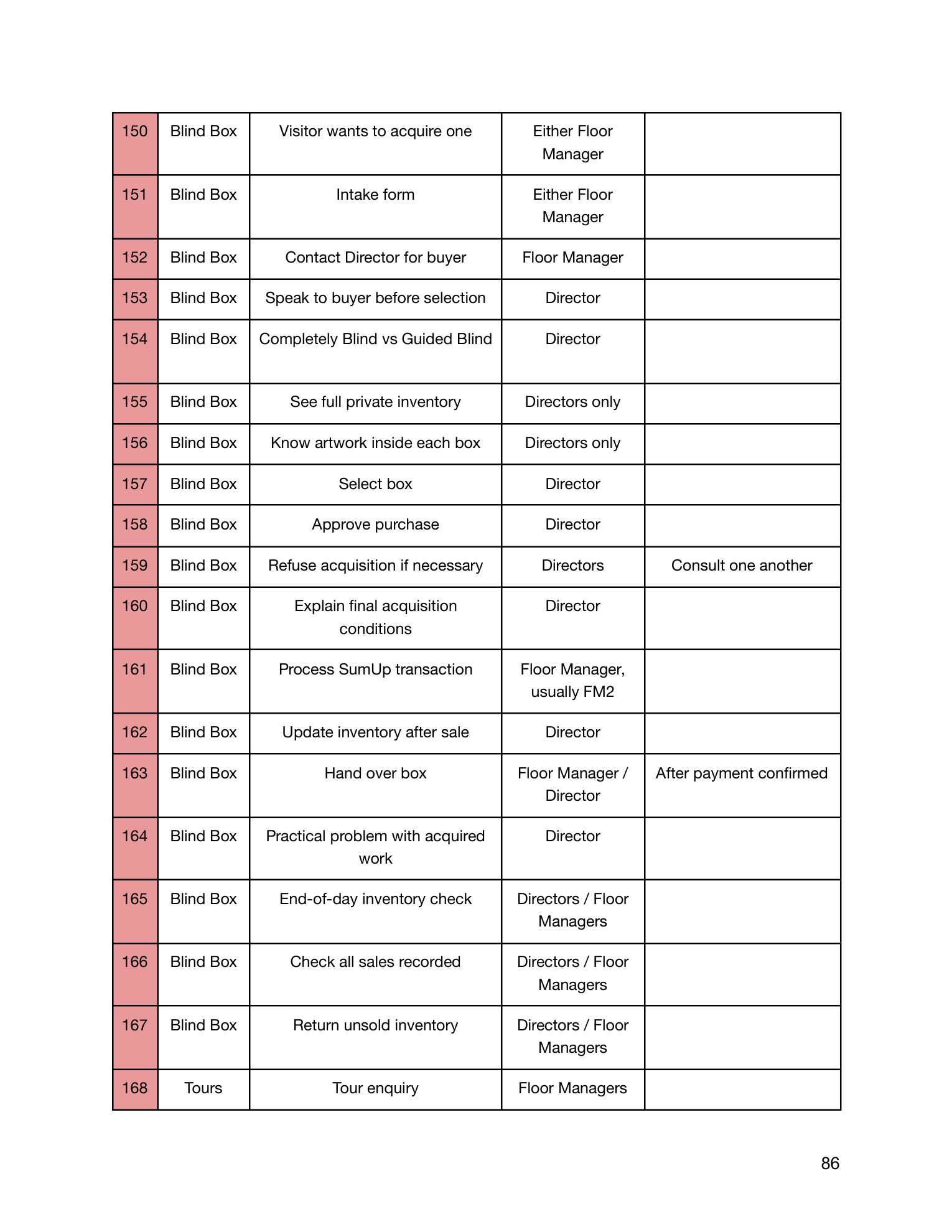
150
Blind Box
Visitor wants to acquire one
Either Floor
Manager
151
Blind Box
Intake form
Either Floor
Manager
152
Blind Box
Contact Director for buyer
Floor Manager
153
Blind Box
Speak to buyer before selection
Director
154
Blind Box
Completely Blind vs Guided Blind
Director
155
Blind Box
See full private inventory
Directors only
156
Blind Box
Know artwork inside each box
Directors only
157
Blind Box
Select box
Director
158
Blind Box
Approve purchase
Director
159
Blind Box
Refuse acquisition if necessary
Directors
Consult one another
160
Blind Box
Explain final acquisition
conditions
Director
161
Blind Box
Process SumUp transaction
Floor Manager,
usually FM2
162
Blind Box
Update inventory after sale
Director
163
Blind Box
Hand over box
Floor Manager /
Director
After payment confirmed
164
Blind Box
Practical problem with acquired
work
Director
165
Blind Box
End-of-day inventory check
Directors / Floor
Managers
166
Blind Box
Check all sales recorded
Directors / Floor
Managers
167
Blind Box
Return unsold inventory
Directors / Floor
Managers
168
Tours
Tour enquiry
Floor Managers
86
Blind Box
Visitor wants to acquire one
Either Floor
Manager
151
Blind Box
Intake form
Either Floor
Manager
152
Blind Box
Contact Director for buyer
Floor Manager
153
Blind Box
Speak to buyer before selection
Director
154
Blind Box
Completely Blind vs Guided Blind
Director
155
Blind Box
See full private inventory
Directors only
156
Blind Box
Know artwork inside each box
Directors only
157
Blind Box
Select box
Director
158
Blind Box
Approve purchase
Director
159
Blind Box
Refuse acquisition if necessary
Directors
Consult one another
160
Blind Box
Explain final acquisition
conditions
Director
161
Blind Box
Process SumUp transaction
Floor Manager,
usually FM2
162
Blind Box
Update inventory after sale
Director
163
Blind Box
Hand over box
Floor Manager /
Director
After payment confirmed
164
Blind Box
Practical problem with acquired
work
Director
165
Blind Box
End-of-day inventory check
Directors / Floor
Managers
166
Blind Box
Check all sales recorded
Directors / Floor
Managers
167
Blind Box
Return unsold inventory
Directors / Floor
Managers
168
Tours
Tour enquiry
Floor Managers
86
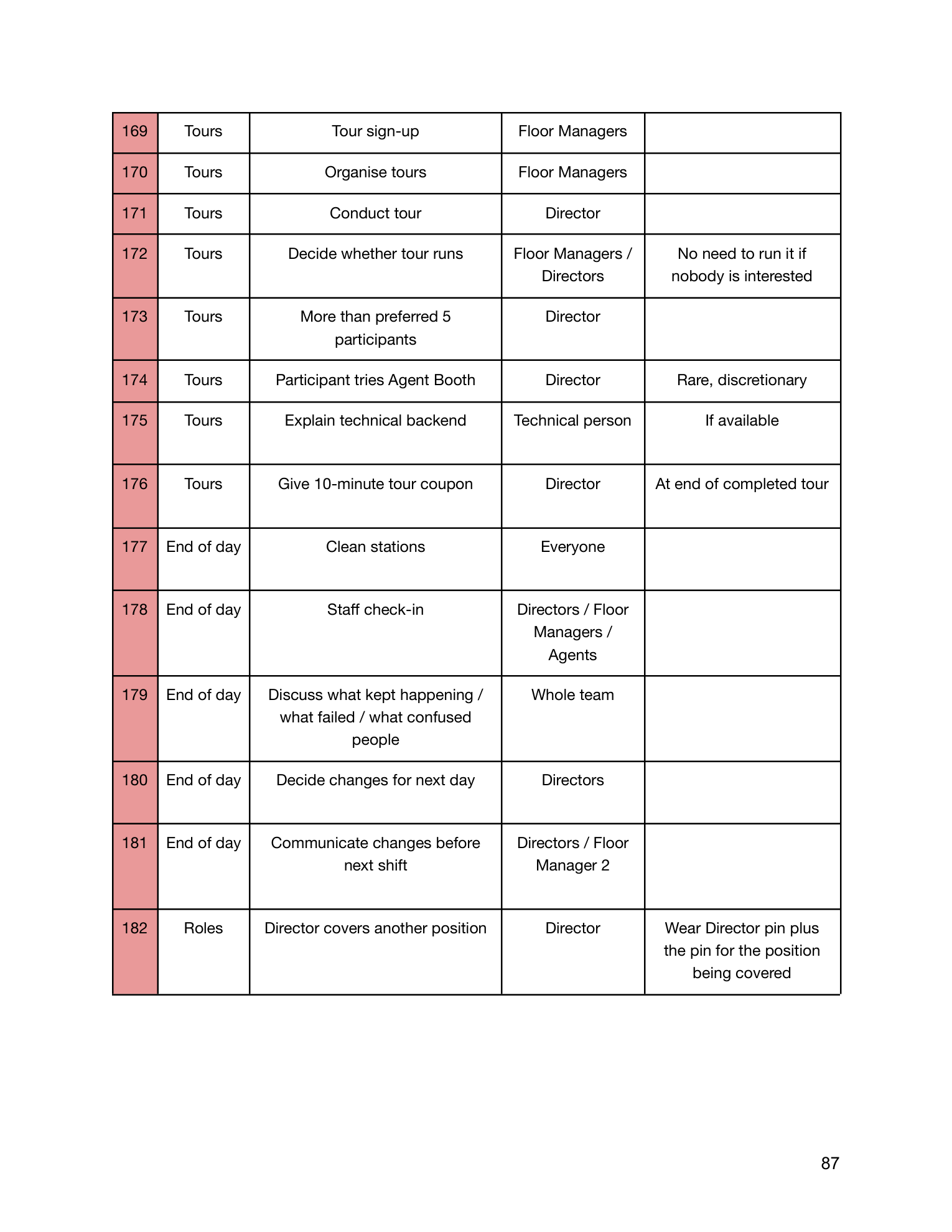
169
Tours
Tour sign-up
Floor Managers
170
Tours
Organise tours
Floor Managers
171
Tours
Conduct tour
Director
172
Tours
Decide whether tour runs
Floor Managers /
Directors
No need to run it if
nobody is interested
173
Tours
More than preferred 5
participants
Director
174
Tours
Participant tries Agent Booth
Director
Rare, discretionary
175
Tours
Explain technical backend
Technical person
If available
176
Tours
Give 10-minute tour coupon
Director
At end of completed tour
177
End of day
Clean stations
Everyone
178
End of day
Staff check-in
Directors / Floor
Managers /
Agents
179
End of day
Discuss what kept happening /
what failed / what confused
people
Whole team
180
End of day
Decide changes for next day
Directors
181
End of day
Communicate changes before
next shift
Directors / Floor
Manager 2
182
Roles
Director covers another position
Director
Wear Director pin plus
the pin for the position
being covered
87
Tours
Tour sign-up
Floor Managers
170
Tours
Organise tours
Floor Managers
171
Tours
Conduct tour
Director
172
Tours
Decide whether tour runs
Floor Managers /
Directors
No need to run it if
nobody is interested
173
Tours
More than preferred 5
participants
Director
174
Tours
Participant tries Agent Booth
Director
Rare, discretionary
175
Tours
Explain technical backend
Technical person
If available
176
Tours
Give 10-minute tour coupon
Director
At end of completed tour
177
End of day
Clean stations
Everyone
178
End of day
Staff check-in
Directors / Floor
Managers /
Agents
179
End of day
Discuss what kept happening /
what failed / what confused
people
Whole team
180
End of day
Decide changes for next day
Directors
181
End of day
Communicate changes before
next shift
Directors / Floor
Manager 2
182
Roles
Director covers another position
Director
Wear Director pin plus
the pin for the position
being covered
87

To be filled in by Ilja.